Understanding the Impact of Controversies on Corporate Bond Returns

Understanding the Impact of Controversies on Corporate Bond Returns

Understanding the Impact of Controversies on Corporate Bond Returns





Sustainable fixed income investors have long factored corporate controversies into their investment process. Many exclude issuers involved in severe controversies related to environmental, social, and governance (ESG) issues, based in part on the assumption that these events weigh on performance. To date, however, little analysis has been done to demonstrate a link between controversies and the performance of corporate bonds.
As part of our ongoing commitment to identifying material drivers of investment performance, we conducted our own analysis of this topic, drawing on the expertise of Goldman Sachs Asset Management’s Sustainable and Impact Fixed Income team and our Sustainable Investing Platform within Public Investing. We looked specifically at whether corporate controversies generate statistically significant impacts on residual returns in investment grade corporate bonds and whether these effects differ across currencies.
Our results confirmed the assumption that severe controversies are a drag on performance, but they also revealed nuances with potential importance for portfolio management. For example, we found that the sharpest drop in a bond’s value occurs before the controversy has been acknowledged by third-party data vendors, and once the price falls, it remains lower for an extended period. We also found that while an issuer’s first major controversy has a significant impact on bond performance, subsequent controversies have far less effect.
We think investors should treat ESG-related factors such as controversies no differently than other financially material inputs in the investment process. Our analysis demonstrates the potential relevance of controversies for all corporate bond investors, not just those with a focus on sustainability. It underscores the need to identify topics with the potential to influence investment performance in a timely manner based on the best available information, and to apply these insights thoughtfully in the assessment and selection of securities.
Methodology: Measuring the Impact of Corporate Controversies
Controversies cover a broad range of publicized incidents in which corporate actions have a negative impact on the environment, society, or corporate governance. Environmental controversies could include accidents such as an oil spill, persistent issues such as plastic pollution, or deceptive environmental claims in marketing. Social controversies may center on violations of labor rights or consumer safety failings. Governance controversies could include cases of accounting fraud, bribery, or other corporate misconduct. All of these could potentially expose a company to financial, legal or reputational damage.
In our analysis, we looked at controversy events as recognized by two sustainability-related data vendors, Sustainalytics and MSCI. Both focus on negative ESG impacts. Sustainalytics says its Controversies Research service assesses companies’ involvement in incidents with negative ESG implications.1 MSCI similarly explains that controversy cases arise “when reported negative environmental or social impacts are allegedly caused or contributed to by a company, or are otherwise linked to its operations, value chain, products, or services.” These cases can also occur when a company is “allegedly involved in misconduct that is seen as enabling adverse impacts.”2
Sustainalytics and MSCI identify controversy cases by monitoring vetted public sources including news media, governments and regulators, nongovernmental organizations, legal materials, and corporate disclosures.3 They then rate the cases on a scale from less to more severe, providing investors with valuable insights into the nature and extent of these events. For the purposes of our analysis, we combined the data sets of these two vendors. We focused on more significant cases with the potential to result in material reputational and legal costs.4 The sample period was November 2019 – the earliest available data – through June 2025.
We tracked cumulative residual corporate bond returns over a six-week period starting 21 days before controversy cases were registered by the data vendors and ending 21 days after this date. The investment universe consisted of bonds denominated in euros and US dollars in the Bloomberg Global Aggregate Corporate Index, which is often used as a proxy for the global investment-grade corporate bond market.
To determine if the return pattern was attributable to the controversy event or general market movement, the typical (average) cumulative residual return path of bonds from issuers affected by significant controversies was compared with the performance of all other corporate bonds in the universe during this period after correcting for factors such as duration, rating, country, and sector. When the returns of controversy-affected bonds differed markedly from the rest of the universe, this difference could therefore be more confidently attributed to the controversy.
Findings: How Controversies Drive Down Corporate Bond Prices
Our analysis yielded four key findings. First, it demonstrated that controversies have a significant impact on corporate bond returns. Second, it showed that most of the impact is observed before data providers acknowledge the controversy event and reflect it in their data. In the case of the US dollar-denominated bonds in our analysis, the bond price begins a steep decline 10 days before the controversy is registered by data vendors, and the maximum drop occurs two days before. This suggests that investors are also monitoring public sources for signs of controversy and acting quickly on this information. A similar pattern is seen when credit ratings are changed: by the time the rating has been changed, most of the impact has been priced in.
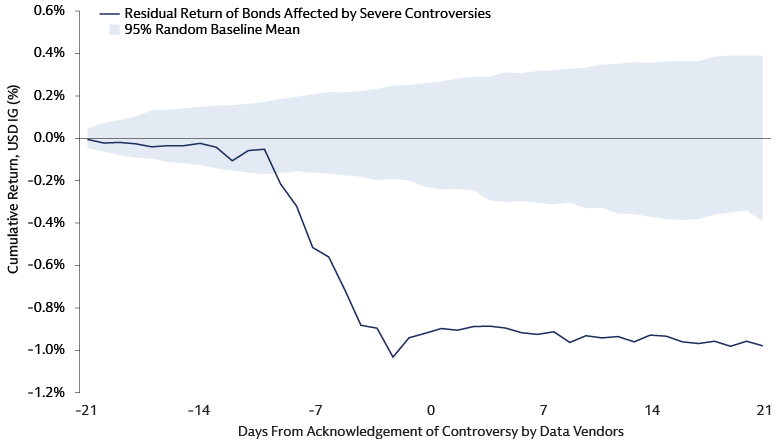
Source: Bloomberg, Goldman Sachs Asset Management, MSCI, Sustainalytics. As of July 31, 2025.
When we looked at euro-denominated corporate bonds, we found a roughly similar pattern, though with three important differences:
- Downward pressure on returns ramps up about 11 days before data vendors register a controversy, one day earlier than with US dollar bonds.
- The returns on euro-denominated bonds fell farther than we saw in US dollar bonds.
- The lowest point in the decline was reached later – two days after the event was registered by data vendors.
In our view, the first two differences probably reflect the greater integration of ESG criteria into investment processes in Europe compared with the US. We think the additional drop after the acknowledgment by data vendors probably results from the activation of exclusions in European investors’ portfolios, a feature that is less common among US investors. Another contributing factor may be a response by European investors focused on ESG data who take action only when the controversy has been registered by data vendors.
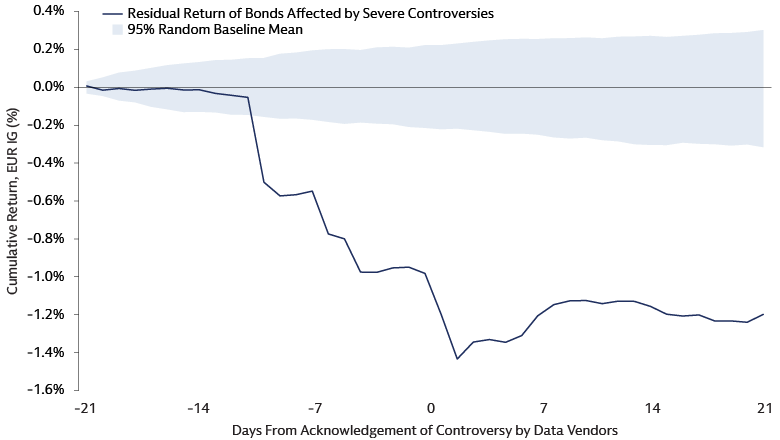
Source: Bloomberg, Goldman Sachs Asset Management, MSCI, Sustainalytics. As of July 31, 2025.
Lower for longer: Prices show no mean reversion after impact
Our third key finding is that once returns have dipped amid a controversy, they remain lower throughout the sample period. The damage done by the controversy is not easily repaired. The charts in the preceding section show a limited price recovery in the 21 days following the acknowledgment of a controversy by data vendors. To see how this dynamic develops over a longer period, we repeated the analysis and extended the period to 120 days. As the following chart shows, the bond price made only modest gains over this period and gave no indication of mean reversion, the theory that asset prices tend to return to the long-term historical mean following bouts of extreme fluctuation. This chart combines our euro- and US dollar-denominated bond samples to show how this occurs across currencies.
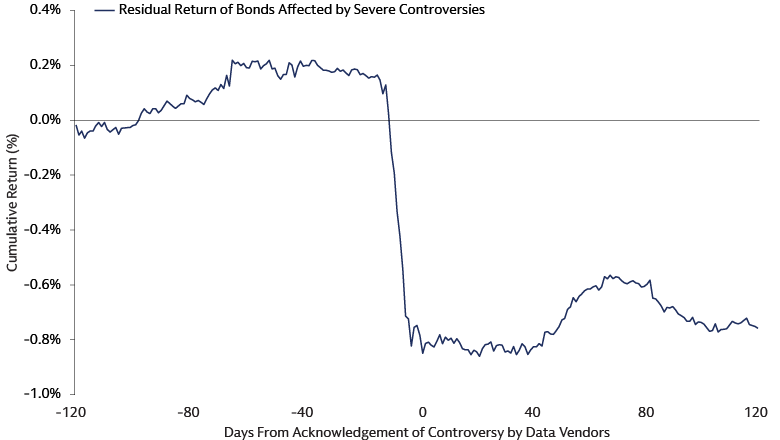
Source: Bloomberg, Goldman Sachs Asset Management, MSCI, Sustainalytics. As of July 31, 2025.
Pricing the unexpected: Impact is concentrated on first severe
controversy
Finally, we analyzed how the impact on returns differs between bonds issued by companies experiencing their first severe controversy and those with a history of controversy. We found that returns fall sharply for bonds affected by their issuer’s first controversy. By contrast, the bonds of issuers with a history experience only a modest decline. We think this difference probably results in part from ESG-aware investors selling off their holdings in an issuer at the time of the first severe controversy. When subsequent controversies arrive, these investors are no longer active in the name, reducing the selling pressure on those occasions.
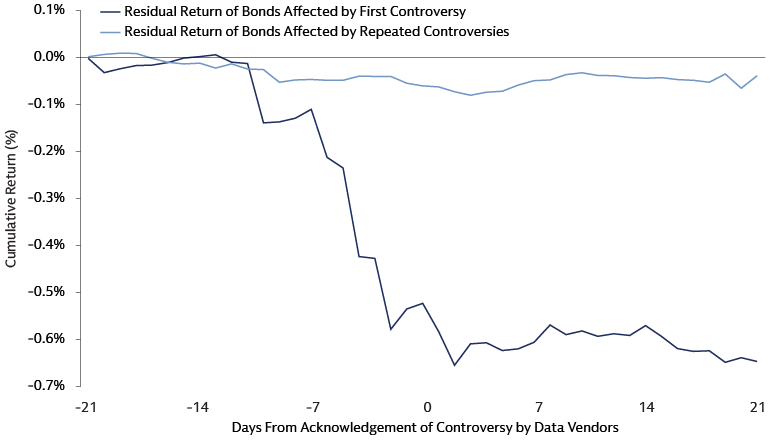
Source: Bloomberg, Goldman Sachs Asset Management, MSCI. As of July 31, 2025.
Note: This chart is based on controversy data from a single vendor, MSCI, which permitted us to distinguish between issuers' first major ESG controversies and subsequent controversies.
Takeaways for Corporate Bond Investors
Controversies have a significant negative impact on corporate bond returns. As our analysis shows, on average the decline in performance occurs before controversy events are registered or rated by data vendors, and returns remain at their new, lower level for an extended period. The impact was similar across currencies, though bonds denominated in euros reacted more quickly to controversies than US dollar bonds and showed a steeper decline. Lastly, the impact was far more pronounced in the case of an issuer’s first severe controversy, while bonds from issuers with a history of controversies saw a modest additional decline in returns.
We see three key takeaways from our analysis for corporate bond investors. The first is the importance of incorporating controversies into credit analysis. We believe the process of leveraging financially material ESG investment insights begins with identifying topics that could potentially affect investment performance at the security, company, or portfolio level. The significant impact on returns makes this an issue that all investors, not just those focused on sustainability, need to consider, in our view.
The second takeaway stems from our finding that the decline in returns tends to happen mostly before a severe controversy event has been registered by external data providers. An investor who bases the decision to exclude an issuer on this formal recognition may therefore take action too late to avoid any related price drop. Instead, our analysis suggests that investors should preemptively assess the risk that an issuer could become caught up in a severe controversy and factor this information into their security-selection process.
These first two points underscore the importance for investors to seek additional information to supplement any data and analysis from external providers. This is our third takeaway. The use of artificial intelligence (AI) tools such as Natural Language Processing and a broad range of datasets is highly complementary. Nevertheless, even with the host of dedicated ESG data vendors and datasets in the market, there is still value in obtaining more granular detail through dedicated analyst research and engagement with the issuer.
We believe the goal for investors is to identify the potential for controversies before they escalate. By equipping their analysts with the real-time information needed for thorough analysis, investors can engage in more informed decision-making. With advance warning of a potential issue, investors can engage with an issuer to determine if a nascent or less severe controversy represents an ESG-related weakness in the company’s business operations. Based on all this information, investors put themselves in a better position to make timely, effective investment decisions.
1 “Sustainalytics’ Controversies Research FAQ,” Sustainalytics. As of April 2020.
2 “MSCI Controversies and Global Norms Methodology,” MSCI. As of October 2025.
3 For Sustainalytics’ sources, see “Sustainalytics’ Controversies Research FAQ,” Sustainalytics. As of April 2020. For a full list of MSCI’s sources, see “MSCI ESG Controversies and Global Norms – Process,” MSCI ESG Research. As of April 2025.
4 Our analysis looked at cases with a rating of 3 to 5 from Sustainalytics (with 5 having the most severe impact) and yellow, orange or red (with red indicating the most severe ongoing cases) from MSCI.