Introduction to Real Estate

What is real estate?
Real estate encompasses a wide range of properties and facilities for housing and supporting our society. Properties are generally classified by usage type, such as residential, office, industrial, retail, and hospitality. The nature and location of opportunities are evolving as our societies shift the way we live and work.
Real estate strategies encompass a wide variety of opportunities across the risk and return spectrum. As such, they can offer diversification across return sources, degrees of sensitivity to economic cycles, and a combination of income and long-term growth, depending on the underlying approach.
Potential Reasons to Invest
1. Potential yield enhancement, with inflation protection
Core real estate has historically served as an attractive source of income, providing yields in excess of stocks and bonds. This yield has outpaced inflation over the past 30 years. Overall rents have kept pace with, or exceeded, broader inflation (but can vary considerably across sectors and markets, based on market-specific supply and demand factors). Commercial real estate asset prices have also historically moved with inflation, given the impact of construction costs (in the form of labor and materials) and changes in land values on replacement costs.
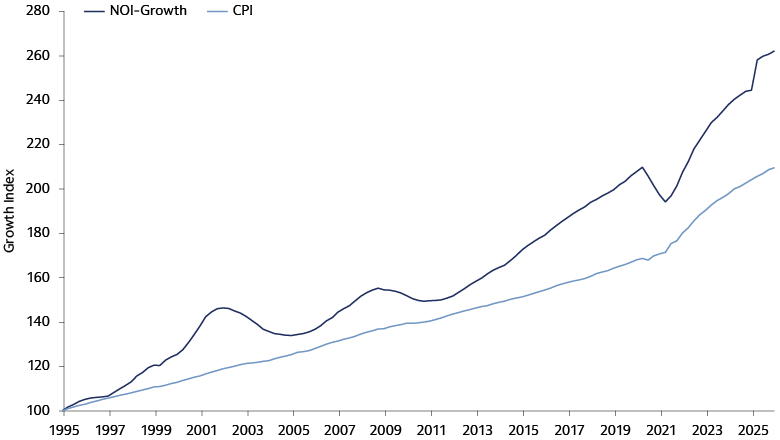
Source: FRED, NCREIF Property Index (NPI); NPI represents direct, unlevered investments in a diversified portfolio of U.S. commercial property. Note: Information as of December 31, 2025. Indexed, 1994=100. CPI and NPI is weighted by market value, reported on an unleveraged basis, includes multifamily, hotel, logistics, office, and retail properties, and has quarterly history since fourth quarter 1977. CPI refers to Consumer Price Index for All Urban Consumers: All Items Less Food and Energy in U.S. City Average (CPILFESL). Indices are meant to illustrate overall market performance. It is not possible to invest in indices directly. The indices presented here have material differences in investing in a non-traded REIT including investment objectives, fees, expenses, tax implications, and liquidity. Past performance does not guarantee future results, which may vary.
2. Differentiated returns
Real estate has the potential to enhance a portfolio’s risk-adjusted return by offering differentiated, less correlated sources of return. Underlying real estate supply and demand drivers, and the structure of underlying leases, introduce market-, sector-, and asset-specific considerations that may help offset some sensitivity to broader economic factors. These dynamics have helped mute correlations to public equity and credit markets—particularly for private real estate. Value-added and opportunistic real estate strategies are primarily the purview of private markets and offer exposures that are not easily accessed in public markets. Core private market strategies have featured lower correlations than their public counterparts — REITs — whose inclusion in broad equity indices has made them sensitive to broad equity market dynamics.
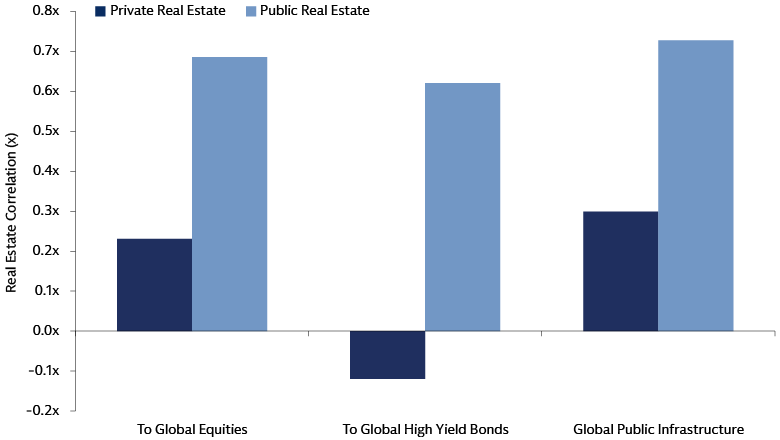
Source: Refinitiv. Private real estate index courtesy of Cambridge Associates. Global equities proxied by the MSCI World index, Global High Yield proxied by the Barclays Global HY Index, Public Infrastructure proxied by the FTSE Global Infrastructure Index, Public Real Estate proxied by the FTSE EPRA Nareit index. 15 years of quarterly data through December 31, 2025. Past performance is not indicative of future results.
3. Capitalizing on secular megatrends
By its nature, real estate is tied to global demographics and secular megatrends, as well as to their local expressions. As such, we believe segments of the real estate market stand to benefit from demographic, sustainability, technology, and geopolitical shifts to support evolving space demands. Demand for data centers, for instance, has spiked over the past five years as large tech companies invest in the physical infrastructure needed to support AI.
Real estate opportunities within secular megatrends

- Data centers
- Distribution facilities to support e-commerce demands
- Life sciences and lab facilities

- Sustainable buildings and facilities to meet evolving tenant preferences and regulations

- Logistics assets (e.g., warehouses) for reconfigured supply chains

- Rental housing to support demographic shifts and population trends
- Hospitality and retail aligned to global consumer trends
Real estate investments involve risks which include, but are not limited to, fluctuations in the real estate markets, the financial conditions of tenants, changes in building, environmental, zoning and other laws. In addition, real estate assets may be leveraged, which could have significant adverse consequences for the assets and therefore an investment vehicle.