Market Pulse September




Macro Views

Global economies have been surprisingly resilient as consumer spending remains healthy, artificial intelligence infrastructure investment robust, and oil demand more flexible than anticipated. Looking ahead, we expect GDP growth to re-accelerate in 2027, with stimulus running Europe and Japan above potential at 1.2% and private sector investment driving US growth at 2.1%.

US inflation continues to make progress and we expect core personal consumption expenditures inflation to fall near 2% in 2027. Temporary drivers such as tariffs, AI shortages, energy price passthrough, and portfolio management fees are likely to subside while structural drivers such as wage and housing inflation remain subdued.

Fed pricing has turned more hawkish, even as inflation and labor data has softened. Ambiguity around the new Chair’s reaction function may raise rate volatility in the near-term as there is more uncertainty in each meeting. Meanwhile, markets are now expecting a hike from both the European Center Bank and Bank of Japan in September. We think the ECB will then hold at 2.5%, while the BoJ may raise two more times in 2027.
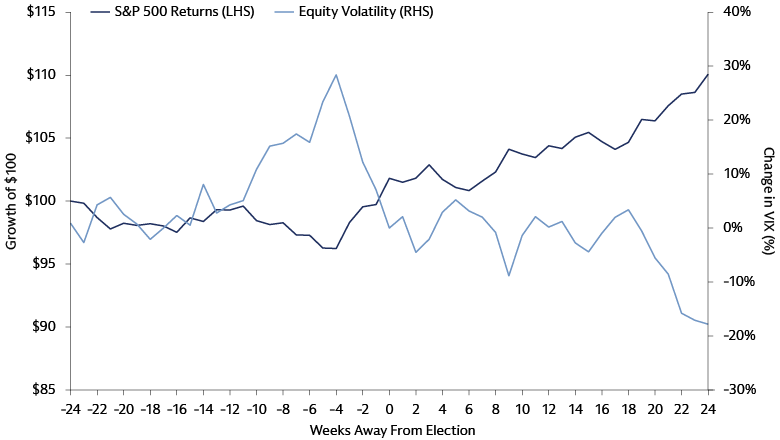
Bloomberg and Goldman Sachs Asset Management. As of August 31, 2026. Chart shows the average performance of the S&P 500 and VIX Index around the 1994, 1998, 2002, 2006, 2010, 2014, 2018, and 2022 midterm elections. Past performance does not predict future returns and does not guarantee future results, which may vary.
Market Views

We remain constructive on equities as exceptional earnings and strong corporate fundamentals drive returns. Consensus expects 2026 EPS growth of 31% in the US, 17% in Europe, 18% in Japan, and more than 70% in EM. Potential risks exist, including such lofty expectations, AI surprises, and upcoming election cycles – which historically are preceded by a pickup in volatility. However, as geopolitical uncertainty clears, we believe markets can return to fundamentals and continue the march higher.

We are focused on carry potential in higher quality and core fixed income, maintaining neutral duration exposure and being selective in corporate credit given tight spreads. In the US, we see Treasury Inflation-Protected Securities (TIPS) as a worthwhile inflation hedge to address tail-risk.

We see potential for alternative investments, both private market strategies and public replicators, to provide additional diversification to portfolios. Hedge funds historically outperform 60/40 portfolios when equity and rate volatility rises. Private infrastructure and real estate strategies are beneficiaries of AI investment, including data centers and power generation. While broad private equity historically trails public markets during bull runs, we think growth equity may offer interesting exposure to AI.
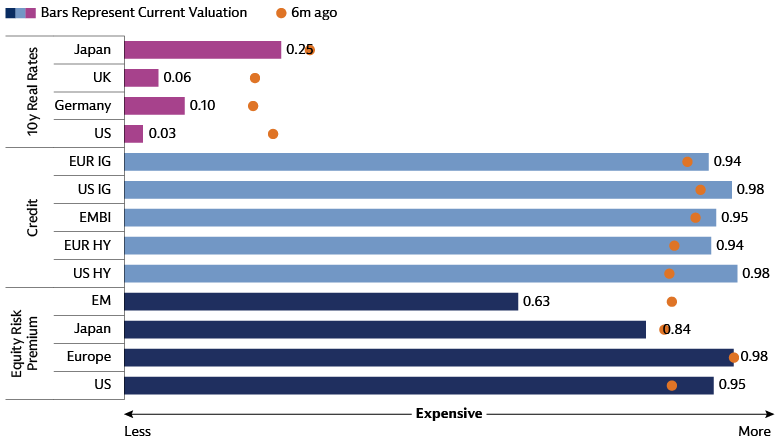
Source: Bloomberg, Haver, MSCI and Goldman Sachs Asset Management. As of September 1, 2026. Chart shows the Equity Risk Premium = 12M forward earnings yield (1 / Bloomberg Best 12M forward P/E) less 10Y real yield; country-specific for US/Japan, Germany for Europe and the US for EM. Credit = respective index spreads; 10Y real yields = 10Y nominal yield less 10Y breakeven inflation. Historical percentile: Monthly observations since November 2006 are used to rank each valuation metric against its historical distribution.
Remodeling Total Portfolio Solutions
Multi-asset portfolios are evolving as market dynamics change and technology allows for more sophisticated solutions. We believe well diversified portfolios today incorporate a range of asset classes and risk factors, from traditional equity and fixed income to alternatives and buffer strategies. They may also incorporate ETFs, SMAs, direct indexing, and evergreen alternatives all in a single managed account, adding potential tax alpha and illiquidity premiums to total portfolio returns.
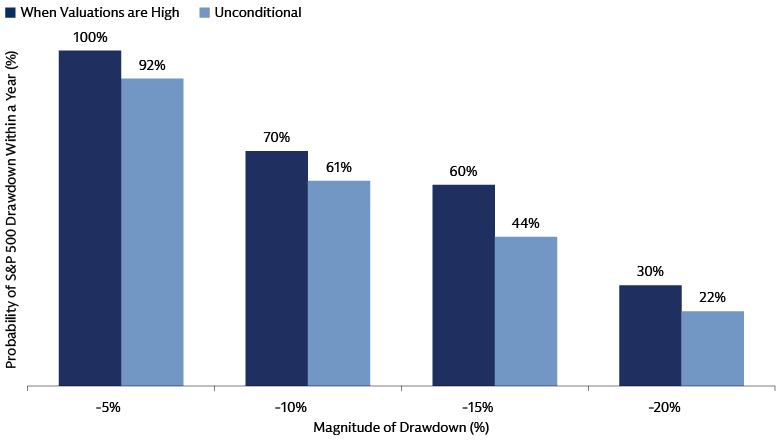
Source: Bloomberg and Goldman Sachs Asset Management. As of August 31, 2026. Chart shows the historical frequency of different magnitudes of US equity market peak to trough drawdowns at any point within a year. Probability of drawdown is conditional on US equity valuation being in the 9th or 10th decile. “Bullish” refers to a positive view.
Strong earnings and a resilient economy have driven equities this year. We believe the trend is still higher but recognize risks from geopolitics to rates to AI. Pullbacks in this context are historically normal, and we may see pockets of volatility ahead. We are responsibly bullish – constructive on market beta yet believers that there are better ways to take risk in portfolios. That includes option strategies that aim to enhance income and buffer downside risk, tax loss harvesting, and diversification.
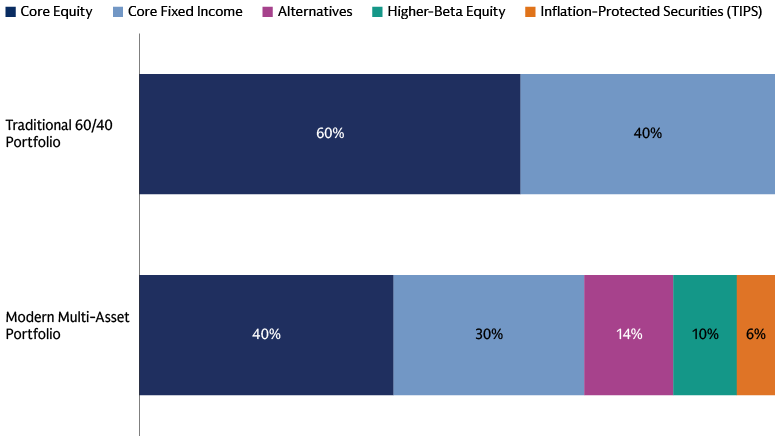
Source: Goldman Sachs Asset Management. As of August 31, 2026. Chart shows illustrative portfolio weights for a traditional 60/40 portfolio and a modern multi-asset portfolio.
Diversification in the modern portfolio has evolved beyond a simple mix of stocks and bonds. Adding higher-beta exposures like emerging market and small caps, together with diversifiers such as alternatives, can widen what a portfolio can pursue. Fixed income does more than one job too, spanning core bonds and securities designed to keep pace with inflation. Based on independent risk factors, we believe each building block earns its place for a specific reason. The result is a portfolio designed for a wider range of market conditions.
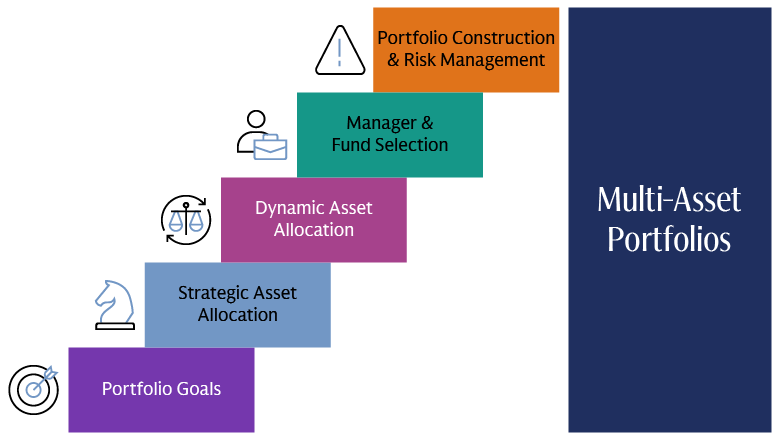
Source: Source: Goldman Sachs Asset Management. As of August 31, 2026. Chart shows the illustrative building blocks of multi-asset portfolios.
A personalized multi-asset portfolio is built on individual goals, but the foundation is the asset allocation. More than 90% of portfolio return variation is driven by asset allocation – both strategic (over a 10-15 year horizon) and dynamic (based on short- and medium-term market fundamentals). From there, we believe thoughtful manager selection and disciplined portfolio construction and risk management each add to the result.