Fixed Income Outlook 2Q 2026
Top of Mind
- Thinking: The ongoing conflict in the Middle East means that rising energy prices are dictating the near-term outlook for interest rates. Markets appear somewhat skittish given broader uncertainty, however there are potential opportunities given ongoing policy divergence.
- Positioning: Neutral US duration in the short term due to the inflation environment, but are constructive longer term given downside risks to growth and increased rate differentials. We are flat to the US dollar, and long emerging market currencies funded by select developed markets.
- Watching: The direction of markets remains tied to the duration of the conflict in the Middle East. Elsewhere, we are sensitive to labor market weakness turning into deterioration, while corporates’ ability to turn AI capex into revenue is also key.

Source: Bloomberg, Goldman Sachs Asset Management. US inflation swaps are CPI, Euro area is HICP ex-tobacco, and UK is RPI. As of March 30, 2026.
- 27bps
- Increasein one-year gilt yields on the day of the Bank of England’s March meeting.
- 94.5%
- Increasein price of Brent crude oil futures through the quarter.
- 15bps
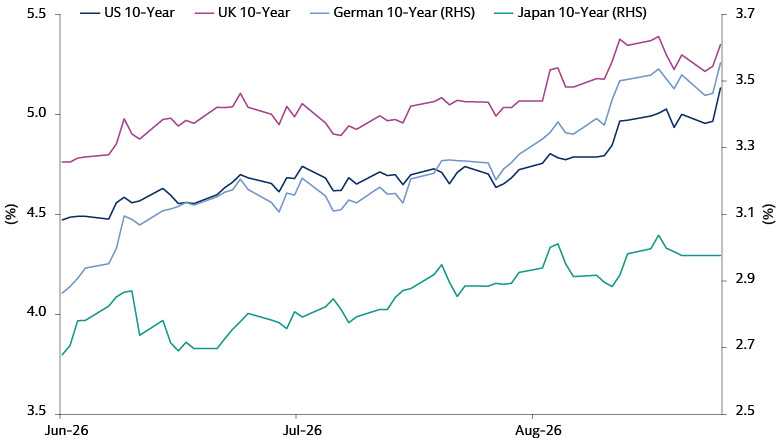
- Increasein US 10-year Treasury yield through the quarter.
Source: Bloomberg, as of March 31, 2026.
Macro Round Up
Growth
Economic activity remains robust in the US but is cooling, and the potentially positive impact of the One Big Beautiful Bill may be counterbalanced by the drag of higher oil prices. The growth story in Europe meanwhile is increasingly uncertain. Early signs of supply chain disruption from the conflict hint that future economic indicators could come out weaker, while soft data is drifting downward, leaving the bloc vulnerable to a ‘stagflationary’ environment. The UK potentially faces a similar risk stemming from the Middle East conflict given its higher starting point for inflation, particularly if hard and soft activity indicators continue to demonstrate weakness. Growth in Japan meanwhile appears somewhat resilient given support from domestic demand and loose fiscal and monetary policy.
Inflation
Short-term inflation expectations have increased materially since the outbreak of conflict in the Middle East, however depending on its duration could have different magnitudes of impact in different markets. Although not immune to global developments, the US’s status as a net energy exporter with comparatively lower reliance on imported oil and gas, could mitigate some of the impact of higher energy prices on inflation. Euro area inflation meanwhile appears more sensitive to energy price shocks, and the level of increase is more likely directly tied to how high oil and gas prices go. UK inflation will also likely face significant upward pressure, particularly if gas reserves in Qatar remain affected by the conflict. Japanese inflation upside is likely to be more limited compared with elsewhere given the gasoline price cap, and underlying inflation will be driven more by inflation expectations, the yen and overall economy.
Employment
The US labor market remains relatively soft, but is not showing signs of significant deterioration, allowing the Fed to focus on the recent price shock. The eurozone’s labor market meanwhile continues to be relatively resilient. By contrast, the outlook for employment in the UK appears less constructive, with events in the Middle East likely to exacerbate existing concerns on labor market slack. Japan’s labor market remains historically tight, meanwhile, with solid wage momentum prior to the shock.
Download the full PDF for our Central Bank Snapshot including our interest rate expectations and the market-implied pricing.
Talking Points
How to Navigate the Software Selloff in High Yield and Bank Loans
Software companies came under increased pressure in the first quarter, as enthusiasm surrounding AI advances also came with increased concerns over what the technological development could mean for incumbents. This led to a large selloff in AI-adjacent equities, something which spilled over into high yield and leveraged loan markets (see chart above). We don’t think the entire software sector is facing an existential crisis; however, incumbents will need to adapt their businesses and improve their products using AI to stave off competition and pressure from emerging ‘AI-native’ startups.

Source: J.P Morgan, Goldman Sachs Asset Management. As of March 30, 2026.
Some industries may adapt better than others:
- Lower AI disruption risk potential sectors include mission-critical software providers embedded in customer workflows, particularly if they leverage proprietary data and serve regulated industries. Cybersecurity software providers may be more insulated, especially since criminals are using AI to create malware and increase the breadth and depth of attacks. Providers of systems of record software that store and organize primary data sources customers use to make business decisions. Examples of this data include financial transaction data and sensitive employee and client data.
- Higher AI disruption risk potential industries may include single-product software providers with small- to medium-sized business customer bases, which are more likely to churn or experiment with emerging technologies. Software providers that lack proprietary data may also struggle, as they could lack data that provides superior differentiation and increase the overall value proposition of their products relative to competing software. Information technology consulting, where advances in agentic AI have the potential to disrupt business models that have a meaningful labor component, could also come under pressure.
The Strategic Case for Investing in Emerging Markets Debt
We think that, despite recent volatility, emerging market debt has an enduring case to earn a place in global fixed income portfolios:
- Multipolar World: We are shifting to an increasingly multipolar world as non-aligned middle countries with greater policy autonomy and strategic relevance sit at the center of the adjustment. Countries around the world take steps to diversify beyond US-centric trade and defense systems. Some Latin American economies could benefit from President Trump’s foreign policy.
- US Dollar Less Constraining: Periods of broad dollar downturns have historically been constructive for EM, and the policy bias in the US reduces the probability of prolonged dollar upcycles. This matters for both hard-currency debt and local markets.
- Convergence: The lines between developed markets (DM) and emerging markets (EM) are increasingly blurring as EM policy frameworks and balance sheets have improved and parts of DM are carrying their own constraints. This doesn’t eliminate risk, but it changes the nature of the debate – from a binary risk on/ risk off label or just a higher carry opportunity to more classic fixed income questions: who can absorb shocks, who benefits from them, and where you’re being paid for genuine risk.
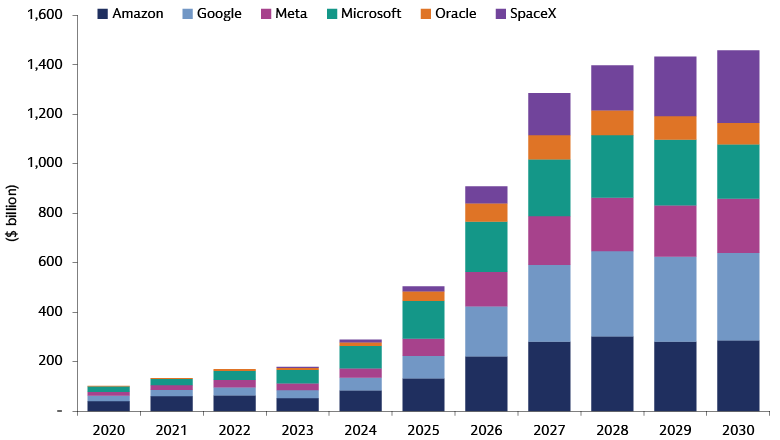
- Strategic Case: Including emerging markets within a fixed income allocation could improve risk-return characteristics of the portfolio given its potential as a role as a diversifier against US exceptionalism and the AI capex boom. From a technical perspective, allocations to emerging market debt also remain underweight.

Left Source: IMF ‘World Economic Outlook’, Goldman Sachs Asset Management. As of October 6, 2025. Right Source: J.P. Morgan, Goldman Sachs Asset Management. As of October 14, 2025.
Download the full PDF to read more about What Matters for Managers on positioning for the Iran conflict’s effect on growth, separating the potential AI winners from losers in credit, and understanding the health of the US labor market.