Diversifying for Income: Core Building Blocks to Strengthen your Portfolio



Income generation has become a primary driver of total returns for investors, with all-in yields for investment grade for example hovering around 5%. In our view, strategies across the fixed income offering are flexible and differentiated enough to suit investor appetites across the risk spectrum, with some also possessing robust, ‘safe-haven’ properties that provide support for portfolios as other asset classes wane.
Diversification and income generation: Why it matters now
Fixed income was historically viewed as a one-stop shop for diversifying wider portfolios, due to its general negative correlation with equity prices. This has been most expressed through a traditional ‘60/40’ portfolio, consisting of 60% equities and 40% fixed income instruments. The negative correlation meant that equities would generate most outperformance during periods of positive economic momentum, while the fixed income portion would provide a degree of downside protection through downturns.
This has changed in recent times, and investors need to diversify not just with fixed income, but within fixed income. Correlations in traditionally harmonious bond markets have become increasingly decoupled in an era of higher rates and volatility; for example, return profiles in US and global aggregate indices have become increasingly disparate. In addition, income has become a key driver of fixed income returns in the past three years. This means it is imperative for investors to consider how to appropriately diversify their portfolio while also maximising income potential.
Here, we explore four different ways investors of various risk appetites can rethink their fixed income allocations with diversification and income optimisation in mind:
Exploring income and diversification across the fixed income universe
- Core government bonds: Investments in developed market sovereign bonds such as US Treasuries can help give portfolios a solid underpinning of high-quality assets that can offer resilience in periods of uncertainty, potentially providing a source of returns as riskier assets underperform.
We believe the current environment also provides core bond investors with the additional opportunity of locking in higher starting yields rather than just downside protection and capital appreciation.
- Investment grade corporate bonds: Holding bonds issued by high-quality corporates—known as investment grade bonds—can also assist in portfolio diversification. Blue-chip names with robust balance sheets and diverse business lines can provide investors not just with a steady stream of income supported by strong underlying fundamentals, but could also act as another form of ballast for a portfolio in times of stress. Long-dated notes in investment grade credit, for example, can appreciate in volatile times should interest rates come down in that period. The additional yield relative to sovereign debt can also increase the income component of returns, emphasizing the primary role carry has for fixed income investors in 2026.
Some assets within fixed income can also offer increased income opportunities as well as potential diversification, further along the risk spectrum:
- Emerging market bonds: Both sovereign and corporate issuers across emerging markets can provide investors with compelling yield and diversification opportunities. From an income perspective, emerging market issuers can deliver higher yields to portfolios than developed market counterparts; hard-currency EM sovereign debt, for example, was providing yields on average of 6.97% at the end of April,1 compared with 4.03% for developed market sovereigns.2
EM corporates meanwhile can be useful as a pivot away from developed market peers who are more concentrated in the AI trade and associated risk, while also offering attractive carry and roll. Corporates in the EM index issuing in hard currency had a yield to worst of 6.47% at the end of April,3 around 137 basis points above the global investment grade corporate index.4
Emerging markets also offer enough divergence that investors can pivot strategically within the asset class to take advantage of dislocations, or even manage exposure dynamically in response to broader, systematic events. For example, bonds from emerging market sovereign issuers that are net energy exporters, such as in Latin America, could be better insulated than those elsewhere, particularly net energy importers such as in Asia.
- High yield bonds: Corporate bonds below the investment grade threshold can offer even greater potential for investors seeking higher income levels. While investments in this space come with additional risk given the assessed lower creditworthiness and lower-quality balance sheets. The fundamental picture for the asset class has improved in recent years with the credit quality of the US high yield index having increased to be majority Ba-rated, for instance.
The current high yield environment could offer selective opportunities for active investors to take advantage of pockets of weakness, in our view. The recent selloff in the software space, for example, has been indiscriminate, with spreads in the sector widening significantly relative to the benchmark on AI concerns. We think this creates a window for active managers to pick up names facing relatively less AI disruption risk, such as mission-critical software providers, for instance, at relatively cheap valuations.
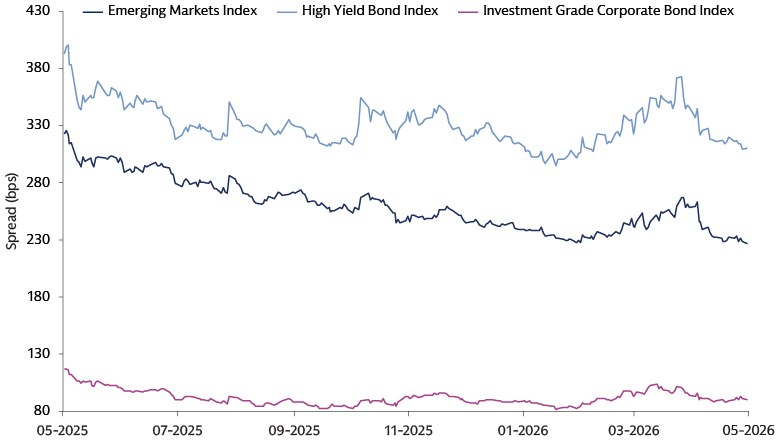
Source: JP Morgan as of May 5, 2026.
Listen to our leaders and learn more about our Fixed Income Platform.
1 J P Morgan Emerging Market Bond Index Global Diversified, as of April 30, 2026.
2 J.P. Morgan Global Government Bond Index, as of April 30, 2026.
3 J.P Morgan CEMBI Broad Diversified Index, as of April 30, 2026.
4 J.P. Morgan Global Corporate Index IG, as of April 30, 2026.