What is Private Real Estate?

Real estate investors generally classify properties by their usage type, such as residential, office, industrial, retail, and hospitality. Assets can range from fully leased properties to properties in need of renovation to ground-up development of entirely new properties.
What is Private Real Estate?
Many people associate real estate investing with buying properties they either live in or rent out. But it’s also possible to invest in real estate through a real estate vehicle that packages interests in multiple properties into a single fund.
Vehicles like this allow investors to tap commercial real estate, an investible market of about $20 trillion in the U.S.1 Private market vehicles let investors access commercial real estate investment opportunities without the market swings that public real estate securities are subject to or the headache of actively managing a property.
How Does Private Real Estate Work?
Private real estate investments are made across both equity and credit. Private real estate investing generally occurs in three ways:
Closed-end funds have a set stop and start date, often lasting from seven to 10 or more years. This makes them generally less liquid versus other vehicles. Investors – known as Limited Partners (LPs) – commit capital before the fund begins investing, and the fund manager – known as the General Partner (GP) – gradually issues capital calls as they identify properties to invest in. Investors usually receive returns only as these underlying properties are sold.
Open-end funds, also known as evergreen funds, don’t have a set stop and start date but generally continue indefinitely. That generally makes them more liquid: investors can redeem and subscribe to the fund on a regular basis (usually monthly or quarterly), with some restrictions designed to help ensure the manager sells the underlying assets based on long-term value rather than short-term market demands.
Direct investment in private real estate is when a fund manager puts investor capital directly into a property or properties. Investors gain exposure to the performance of these specific assets rather than a pool of investments within a fund structure.
What Does Private Real Estate Invest In?
Real estate investments also differ by strategy, with each strategy providing different levels of income, appreciation, and liquidity.
Real estate equity investments give investors ownership stakes in real estate assets, with returns usually generated through rental income, property appreciation, or both. These investments generally fall into the following four tiers:
Core strategies invest in stabilized properties with long-term, predictable rent payments that serve as income for investors. That steadiness, combined with a relatively low level of leverage, makes them lower risk – but less likely to deliver much capital appreciation. Core real estate investments are usually held for seven to 10-plus years and frequently appear in open-end funds.
Core-plus strategies are stabilized properties that generate steady income, but may also present an opportunity to drive value and deliver some capital appreciation through modest renovations, operational improvements, or lease-up initiatives aimed at attracting more tenants. Like Core strategies, they’re often held for roughly seven to 10-plus years and often appear in open-end funds.
Value-add strategies are, as their name implies, strategies that invest in real estate opportunities where targeted improvements through renovations, enhanced management, or other changes can help increase the value of the property and the rents the manager can command. Because these strategies assume the risk of making these changes and usually take on higher levels of debt to finance them, they can potentially deliver higher returns.
This focus on adding value means investors in these properties are often looking to sell rather than just to collect rent, so the hold period is shorter, often five to seven years. That focus on selling also means they’re more likely to appear in closed-end funds, where investors expect returns to be staggered as properties are bought and sold.
Opportunistic strategies invest in properties that require redevelopment or new development altogether. Think of a dated hotel in a desirable area that’s in need of major modernization or building a new apartment complex in a growing suburban town.
Because these properties need so much up-front investment, they often aren’t delivering steady income during development and the majority of the returns come from the capital appreciation when they’re sold. That focus on selling means they’re often held for a shorter period of time – about five years – use the most leverage, and usually appear in closed-end funds.
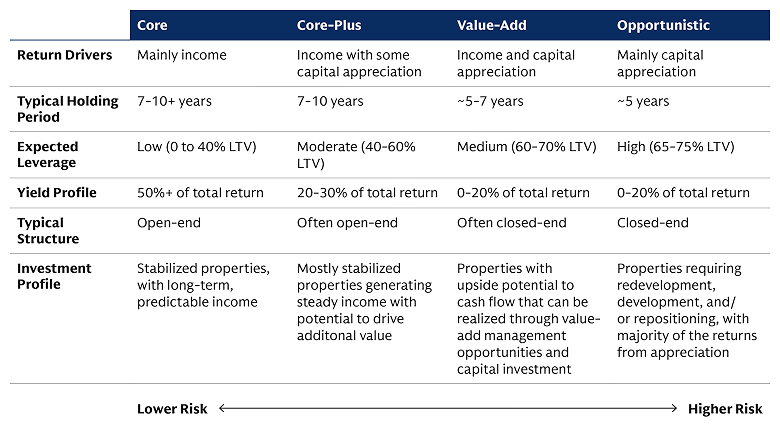
Please note the yield profiles displayed are samples and are for illustrative purposes only. No returns are guaranteed.
Real estate debt investments are where borrowers use debt financing for acquisition, renovation, or new construction, or take out a loan against the value of a property. It’s among the more secure forms of lending because it’s backed by a hard asset: if the borrower defaults, the lender would own the property in question.
Real estate credit falls across three similar tiers:
Senior real estate debt sits at the top of the capital structure, which means that the borrower typically prioritizes repaying the lender before they repay other debt in the event of a default. This prioritization makes it the least-risky form of debt and a common source of income.
High-yield real estate debt sits below senior debt in the capital structure. That means borrowers prioritize paying other loans first and lenders aren’t entitled to the asset in question as collateral. To compensate for this added risk, these bonds will often include a higher coupon or interest rate.
Opportunistic real estate credit, also known as distressed credit, sits lowest in the capital structure, providing financing in more distressed or challenged situations. Because of that, it offers the most risk and the most potential for return and often features downside protections to help offset this risk. For instance, a lender may require the borrower to set aside a reserve account in case cash flows aren’t covering payments.
Real estate investments also fall across different property quality classifications.
Class A
Class A real estate is newer or well-maintained assets in central, highly desirable areas that can command premium rents.
Class B
Class B real estate is well-maintained assets that may be older, but in a less central location.
Class C
Class C real estate is older real estate often in need of repair or operational improvements, usually in less desirable areas.
Why Invest in Private Real Estate?
Private real estate can offer a steady source of income. Real estate income has delivered steadily positive returns since 2001, unlike fixed income and global equities. Part of the reason for that is that real estate is backed by a hard asset, so it’s more secure than a corporate bond whose value can plummet or evaporate in the event of a bankruptcy.
Total returns (2001-2005)
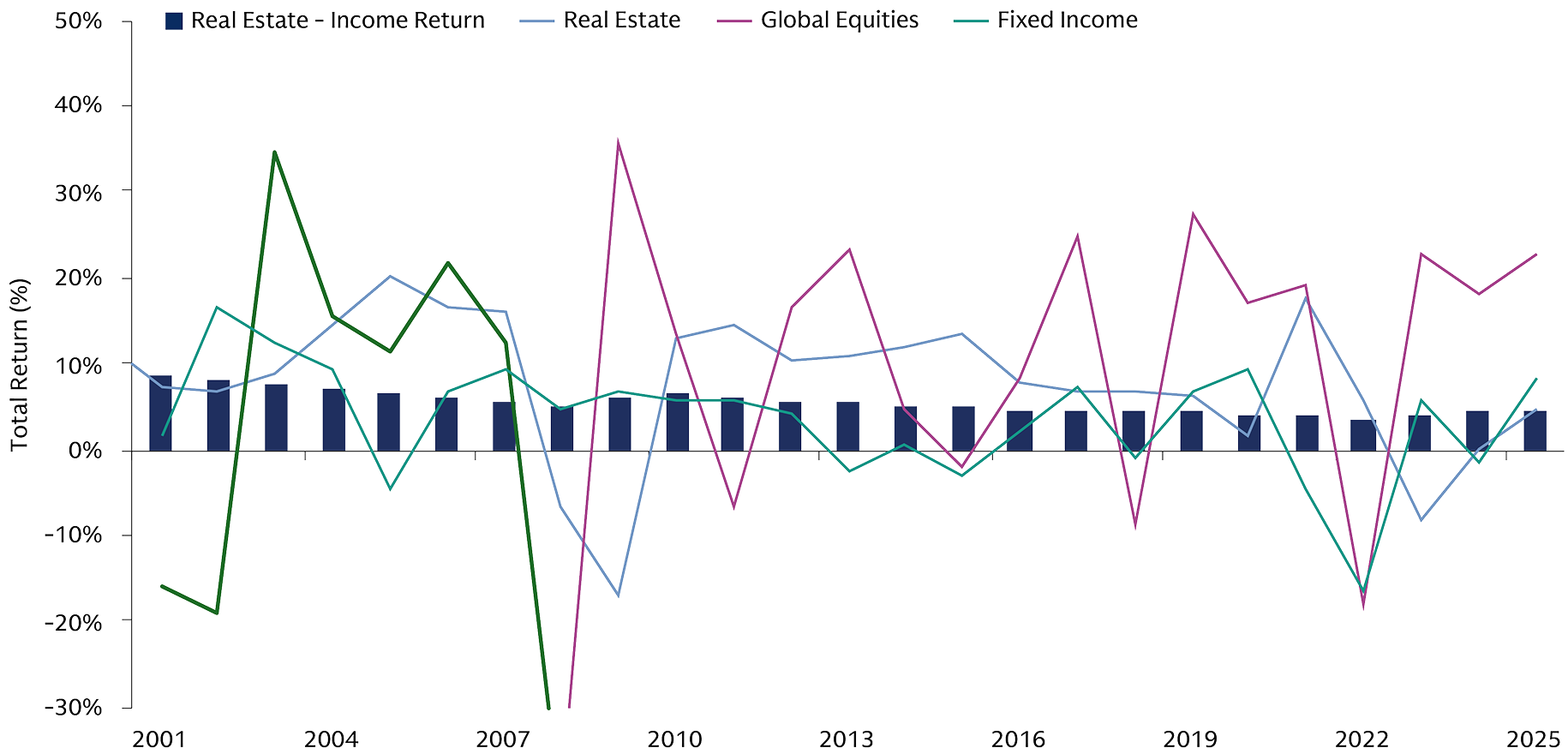
Sources: NCREIF, MSCI, Barclays. Note: Information as of December 31, 2025. 1. Real Estate (as well as Income Return breakdown) are represented by the NCREIF Property Index (NPI). Global Equities are represented by the MSCI ACWI Gross Total Return Index (USD); Fixed Income is represented by the BBG Barclays Global Aggregate Total Return Index (USD). Past performance does not guarantee future results, which may vary.
Private real estate is less correlated to other asset classes. That’s because real estate is subject to underlying supply and demand drivers that can help offset some sensitivity to broader market and economic factors. Demand for office might be plummeting in one city but growing in another as a result of migration patterns, or a particular country might be emerging as a hospitality hotspot even as travel to another declines.
This is particularly true in private real estate. Public REITs are included in broad equity indices, which makes them sensitive to the ups and downs equity markets experience, but private real estate investments are generally valued based on the underlying properties and their cash flows.
Plus, many of the value-add and opportunistic strategies that may have the potential to deliver the most compelling returns generally are primarily available via private markets. That gives investors diversification, allowing them to customize their exposures based on risk and return preferences more than they may be able to in public real estate.
Real estate correlation
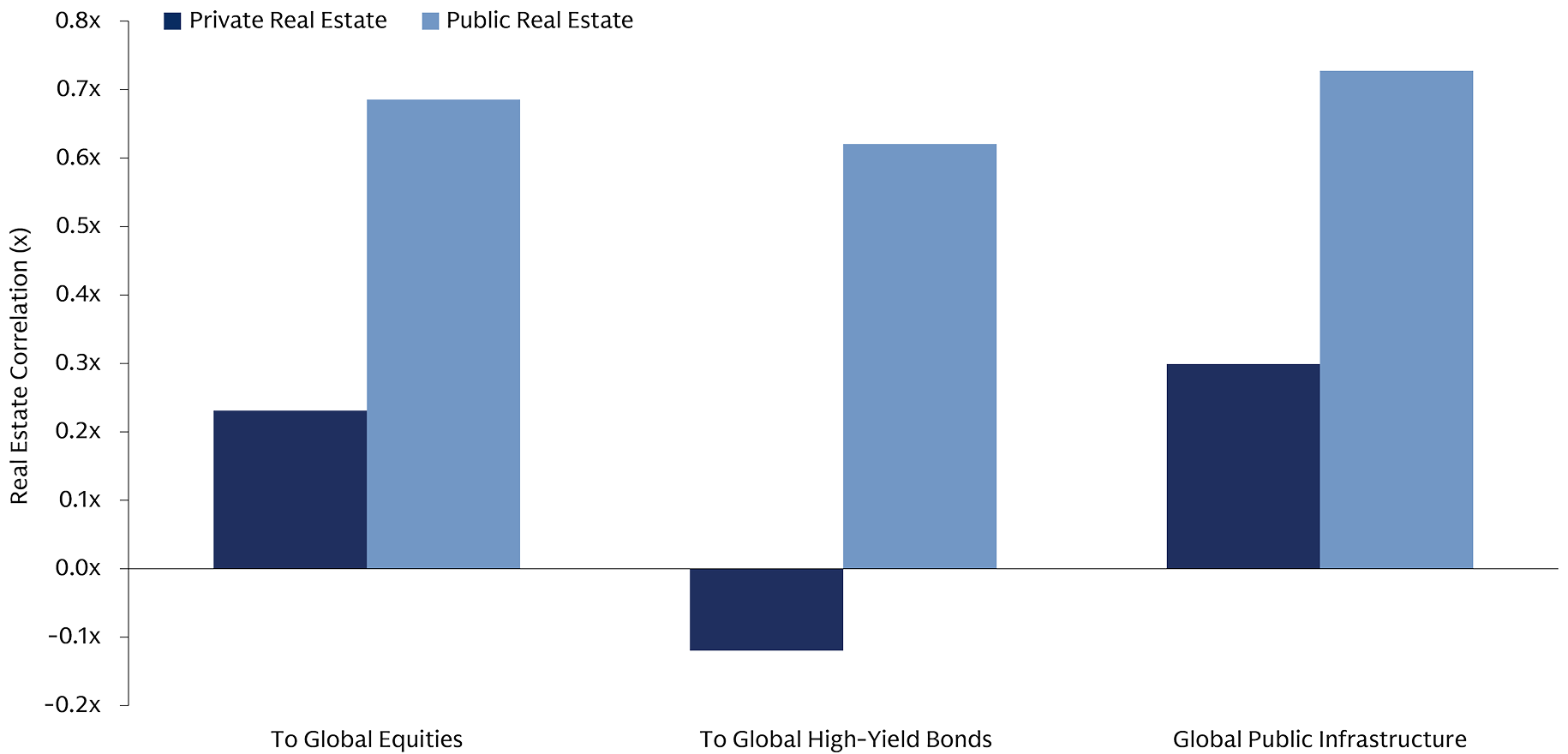
Source: Refinitiv. Private real estate index courtesy of Cambridge Associates. Global equities proxied by the MSCI World index, Global High-Yield proxied by the Barclays Global HY Index, Public Infrastructure proxied by the FTSE Global Infrastructure Index, Public Real Estate proxied by the FTSE EPRA Nareit index. 15 years of quarterly data through December 31, 2025. Past performance is not indicative of future results.
Private real estate can provide income that outpaces inflation. Many leases have contractual rent increases built into them to keep abreast of inflation, and growing demand means market rents often increase with time. And inflation also pushes up on the cost of construction materials and labor, making it more expensive to build new assets and making existing assets even more valuable.
Real estate income and inflation
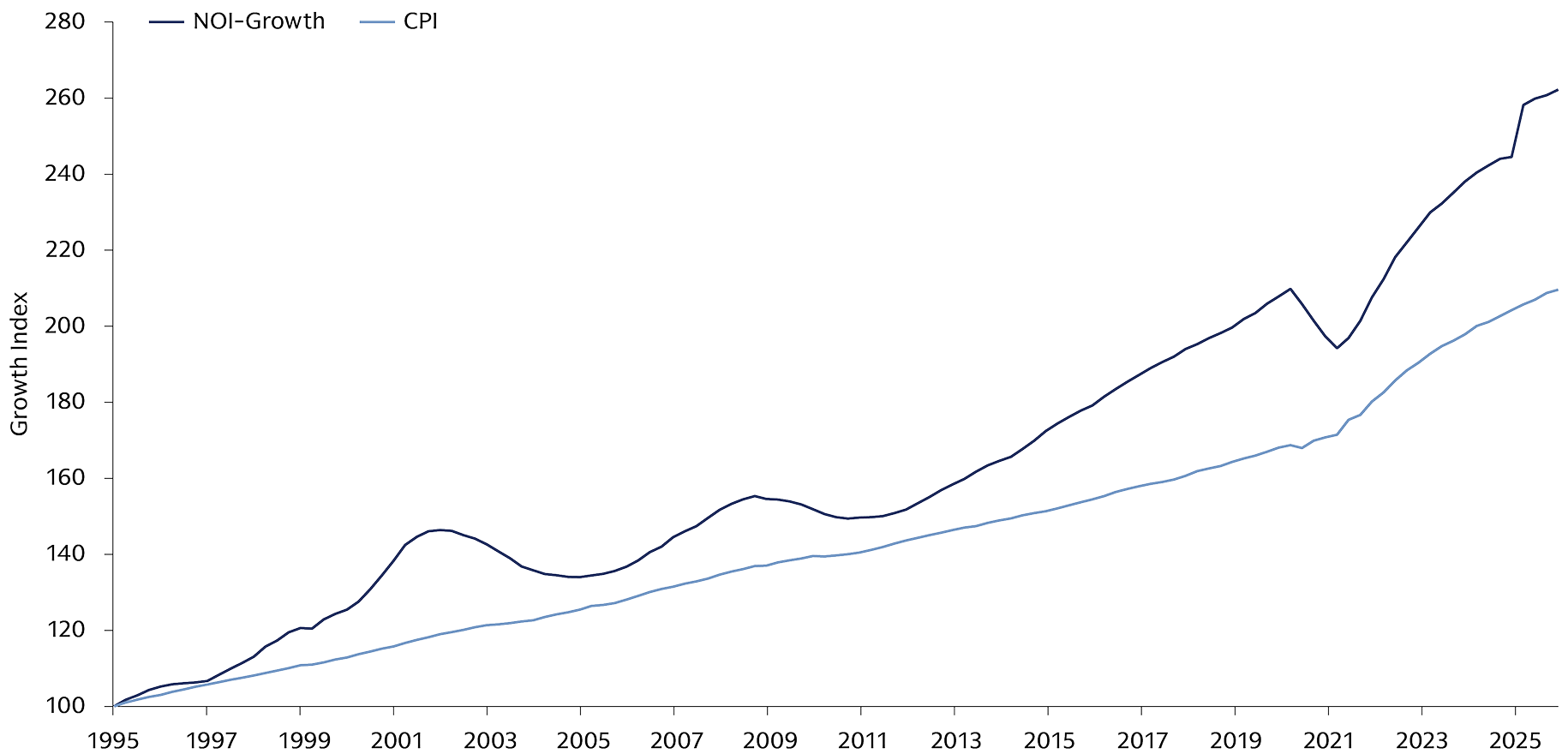
Source: FRED, NCREIF Property Index (NPI); NPI represents direct, unlevered investments in a diversified portfolio of U.S. commercial property. Note: Information as of December 31, 2025. Indexed, 1994=100. CPI and NPI is weighted by market value, reported on an unleveraged basis, includes multifamily, hotel, logistics, office, and retail properties, and has quarterly history since fourth quarter 1977. CPI refers to Consumer Price Index for All Urban Consumers: All Items Less Food and Energy in U.S. City Average (CPILFESL). Indices are meant to illustrate overall market performance. It is not possible to invest in indices directly. The indices presented here have material differences in investing in a non-traded REIT including investment objectives, fees, expenses, tax implications, and liquidity. Past performance does not guarantee future results, which may vary.
Private real estate is tax sheltered. The REIT structure that most private real estate investment comes in also favors investors from a tax perspective. Shareholders of corporations pay federal income tax twice: both at the entity level and at the individual level. REITs distribute 90% or more of their taxable income, which reduces or even eliminates entity-level federal income taxes.
That means investors may only get taxed once – as ordinary individual income tax – allowing them to take home more of their return. However, the tax treatment of REIT distributions depends on an investor's individual circumstances, and investors should consult their tax advisors regarding their specific situation.
What to Consider When Investing in Real Estate

Because private real estate funds don’t trade in the public market, there’s no consensus valuation for the assets they contain. Instead, the assets in an open-end private real estate fund are generally valued on a quarterly basis. That slower cadence, known as a valuation lag, partly accounts for private real estate’s lower reported volatility: it’s not subject to the same daily valuations that occur in public markets.
It may be worth considering how a manager approaches valuation – whether, for example, they engage an independent third-party appraiser or report to an independent board of directors. It also may be worth considering how management fees and other fund expenses may affect returns.

By the same token, the very quarterly valuation process that shields open-end private real estate from the ups and downs of public markets also means the returns it delivers are usually narrower. Management fees and expenses also impact returns, so investors may want to consider performance on a net basis.
Closed-end real estate funds, by contrast, often see wide dispersion in returns. The value-add and opportunistic investments in these funds are exposed to more risks: market timing, delays, or other setbacks in construction and refurbishment. Investors may want to assess a manager’s track record of successful exits, as this dispersion means manager selection particularly matters.

Factors like the financial conditions of tenants and changes in building, environmental, and zoning laws all impact real estate investments. Many of these factors are particular to individual localities and regions. Investors may want to consider a real estate manager’s ability to underwrite these sector-specific and regional insights.

While some open-end funds offer periodic redemption opportunities, those redemptions are often subject to limitations designed to protect investors and the fund's long-term investment strategy. Closed-end funds typically require investors to remain invested for the life of the fund, which can span several years. Investors should consider their investment objectives, time horizon, and cash flow needs.
Frequently Asked Questions
*All content Goldman Sachs Alternative Asset Management unless otherwise noted, September 1, 2026.
1 See Federal Reserve Statistical Release, Financial Accounts of the United States–Z.1, Flow of Funds, Balance Sheets, and Integrated Macroeconomic Accounts, First Quarter 2026, June 11, 2026. Reasonable discounts applied for estimate of the investible universe.