What are Hedge Funds?

What are Hedge Funds?
What makes hedge funds different from other investment strategies? Most traditional investors measure themselves against a stated benchmark, such as the S&P 500, and aim for outperformance relative to their benchmark – no matter if the benchmark is positive or negative. They also only go “long,” meaning they invest in hopes that a stock’s price will rise over time and that the stocks they select will beat this benchmark.
Hedge funds don’t operate under these constraints. Instead, they aim for absolute returns, or a consistently positive total return over time, regardless of what the broader market does. And in addition to going long, hedge fund managers can also “short” stocks. This is when the manager borrows a stock and sells it, anticipating that the stock’s price will fall. If it does, they’ll be able to buy the stock back at a lower price, return it to the initial lender, and hold onto the difference.
Why would investors seek to pursue absolute returns? In our view, it comes down to major changes that have unfolded in the broader investment backdrop over recent years.
In the decade following the Global Financial Crisis in 2008, interest rates plunged to historically low levels. That “easy money” period acted as the rising tide that lifted all boats, boosting equity markets. Today, interest rates are rising back towards historic norms and volatility is still above average, creating a tougher backdrop for traditional assets like stocks and bonds.
This is where hedge funds can shine. Now that markets aren’t indiscriminately buoyed by low interest rates, dispersion is also returning to more historic norms. That’s creating more opportunities to capture the alpha – or returns that don’t depend on broader market behavior – that hedge funds seek to deliver. Read more about the current opportunity in hedge funds.
How Do Hedge Funds Work?
Hedge fund structures vary by manager, the goals of the client, and liquidity, or the ease with which an investment can be converted into cash. Hedge funds differ from many other private market strategies because they invest primarily in liquid assets like stocks and bonds rather than illiquid assets like real estate, infrastructure, and private equity.
That means that hedge fund strategies themselves vary more widely in terms of the liquidity they offer investors than standard private market funds, which tend to come either in the form of an illiquid closed-end fund, where the manager holds onto the assets for many years, or an open-end fund, where the manager offers some periodic liquidity, usually quarterly.
- Direct hedge fund investment
- Multi-manager portfolio
- Separately managed accounts (SMAs)
- Co-investments
- Liquid alternatives
Direct hedge fund investment
Investors pool capital that the hedge fund manager invests into a single fund. Known as a commingled fund, this has historically been the most common type for most investors.
Multi-manager portfolio
Also known as a fund of funds, investors pool capital into a fund that offers access to a portfolio of different hedge fund managers instead of directly picking one manager. The manager monitors the performance of these underlying funds and adjusts them as needed to achieve return targets. This is a common choice for LPs who want to outsource building a portfolio.
Separately managed accounts (SMAs)
A single investor – commonly a large institution – works with a hedge fund manager to make investment decisions for a dedicated pool of capital. The investor will often mirror the investments in the hedge fund’s portfolio, but they put their own capital directly into these securities rather than into a fund structure.
Co-investments
Investors are given the opportunity to invest in specific deals alongside the hedge fund manager rather than investing in the entire fund and all the underlying deals. This is a common option for larger, more sophisticated investors that want to use their own resources to assess and manage the risk of a given deal.
Liquid alternatives
Liquid alternatives products often trade on a public exchange in a mutual fund or ETF, letting investors cash in and cash out on a daily basis. Some products seek to mimic the performance of a certain type of hedge fund strategy; some seek to mimic the performance of the broader hedge fund universe, much the same way that certain passive ETFs will track and seek to mimic the performance of an index.
- Equity long-short funds
- Event-driven hedge funds
- Tactical trading hedge funds
- Multi-strategy or multi-PM hedge funds
Equity long-short funds
Equity long-short hedge funds allow investors to take full advantage of the fund manager’s stock-picking capabilities. Hedge fund managers can bet that a stock’s price will rise – known as going “long” – but they can also bet that a stock’s price will fall, known as “shorting” a stock. This additional tool can help them deliver returns that aren’t correlated to the broader market. Hedge fund managers tend to either engage in quantitative research and trading methods or a fundamental method.
- In quantitative research and trading, managers use algorithmic models to decide which stocks to buy and sell.
- In fundamental equities, managers assess a company’s intrinsic economic value to see if the company is overvalued – in which case they’ll sell – or undervalued, in which case they’ll buy.
Overall, equity long-short tends to be the most correlated to broader markets of all the hedge fund strategies. Why? Public equities by their very nature respond to broader market movements. Equity long-short managers aim to limit this exposure to the broader market – what’s known as “hedging” – but they can never fully neutralize it.
Event-driven hedge funds
Event-driven hedge funds invest in corporate securities and derivatives that attempt to profit from the outcome of corporate events like bankruptcies, mergers and acquisitions, IPOs, and reorganizations. A derivative is a financial instrument where the buyer holds the risk of potential price swings in the asset without having to hold the actual asset.
For example, a manager might seek to take advantage of the gap between the stated stock price when one company says it plans to acquire another company and what the market prices the stock at in response to the news. The market often slightly discounts the stock price to reflect the potential that the merger falls through. If the deal closes at the stated price, the manager profits off the difference. This kind of hedge fund trading tactic is known as merger arbitrage.
Overall, these strategies tend to be slightly less correlated to what’s happening in the markets than equity long-short strategies. This is because the success or failure of the corporate events these funds invest around are more driven by the underlying strength or weakness of the deal than by broader market movements, but are still affected by the macro and regulatory backdrop.
Tactical trading hedge funds
Tactical trading hedge funds tend to fall into two categories: 1) global macro and 2) managed futures or commodity trading advisor hedge funds.
- Global macro hedge funds seek to predict and capture value from shifts in the macroeconomic backdrop. Macro managers typically hold views on the relative economic health and central bank policies of different countries, as well as trends in inflation, relative purchasing power parity, and trade flow. They usually trade fixed income, currencies, and commodities.
For example, if inflation patterns suggest that a central bank is likely to increase interest rates, which would then push up bond yields, a global macro manager would place a bet via a derivative to capture the benefit of the subsequent fall in bond prices.
- Managed futures or Commodity Trading Advisor hedge funds follow price momentum rather than placing bets on a single company or asset. For example, if a systematic model detects that gold prices have been steadily rising over several days, weeks or months, a managed futures fund would buy gold futures to ride that trend – and would automatically reverse the position if the trend turns.
Tactical trading strategies are often the least correlated to broader markets as these strategies are designed to capture movement in the market – regardless of direction.
Multi-strategy or multi-PM hedge funds
Multi-strategy or multi-PM hedge funds bring all of these strategies, plus various others, together under one roof and allocate capital across them.
Why Invest in Hedge Funds?
Hedge funds can provide returns that are less correlated to the broader market
Why? Hedge fund managers use several techniques – such as shorting and derivatives – that aim to eliminate the static of broader market patterns and home in on specific risks that, in the manager’s view, can deliver strong returns.
Consider an airline investor who believes that Airline A will outperform Airline B. A traditional investor might simply buy Airline A stock and hope the airline sector performs well.
A hedge fund manager, however, could buy stock in Airline A and short Airline B’s stock at the same time. As long as Airline A outperforms Airline B, the manager can generate a profit – even if the airline sector or the broader stock market declines. This focus on relative performance helps hedge fund managers generate returns that are less dependent on market movements and more dependent on investment skill.
Stock-bond correlation
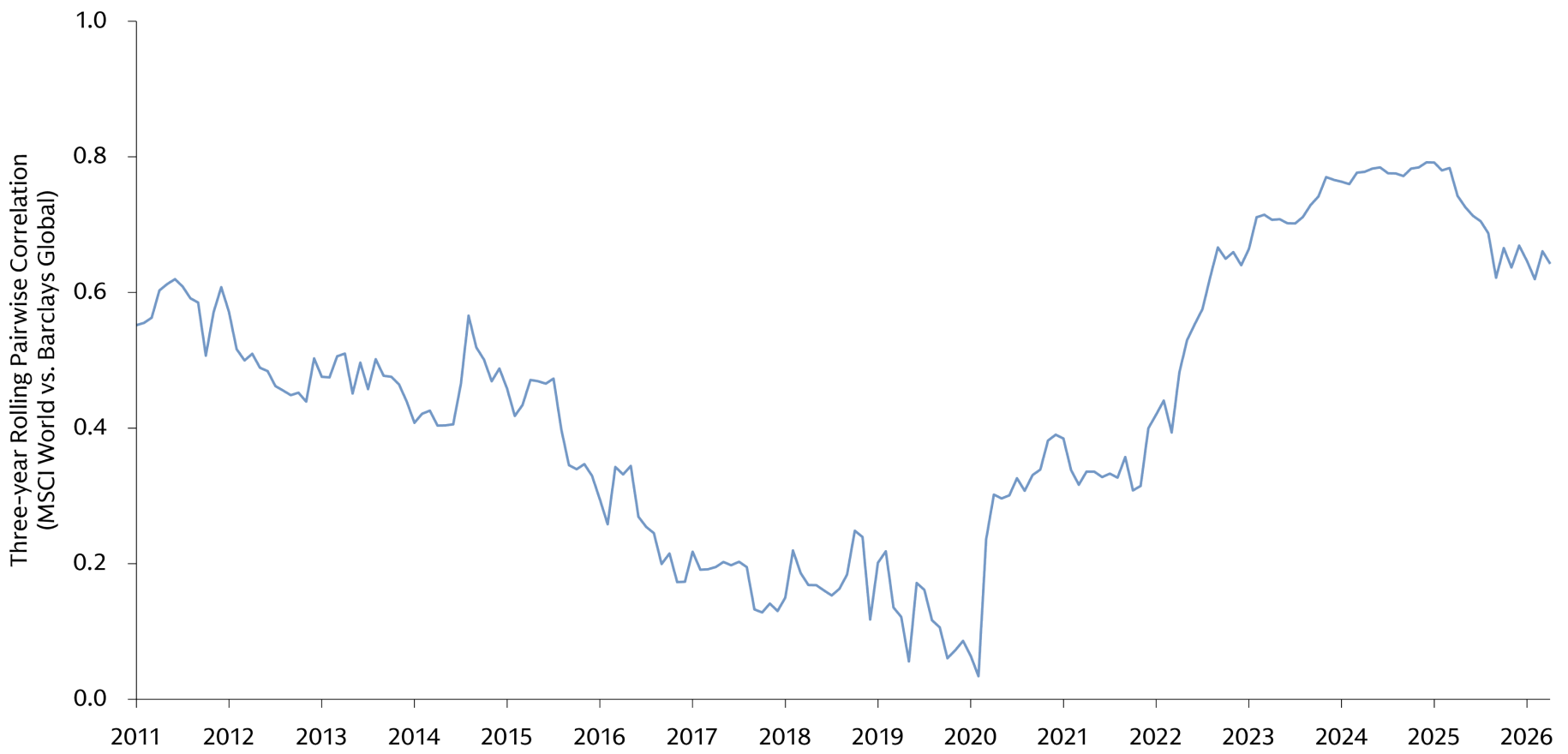
Source: Goldman Sachs Asset Management as of April 30, 2026. The graph above reflects the rolling three-year correlations over the period shown between (i) monthly total returns of MSCI World Index - Net and (ii) monthly total returns of Barclays Global Aggregate Gross Unhedged in USD from 2008 to 2026. Past correlations are not indicative of future correlations, which may vary. Diversification does not protect an investor from market risk and does not ensure a profit. Neither MSCI nor any other party involved in or related to compiling, computing, or creating the MSCI data makes any express or implied warranties or representations with respect to such data (or the results to be obtained by the use thereof), and all such parties hereby expressly disclaim all warranties of originality, accuracy, completeness, merchantability, or fitness for a particular purpose with respect to any of such data. Without limiting any of the foregoing, in no event shall MSCI, any of its affiliates or any third party involved in or related to compiling, computing or creating the data have any liability for any direct, indirect, special, punitive, consequential or any other damages (including lost profits) even if notified of the possibility of such damages. No further distribution or dissemination of the MSCI data is permitted without MSCI’s express written consent.
Hedge funds may help dampen volatility and mitigate risk.
Hedge funds often use sophisticated techniques that pivot off market volatility – but the end goal of those techniques is to capture returns that are immune to this volatility. Because of that, a diversified portfolio of hedge funds may combine the higher return potential of equities with the lower volatility of bonds.
Drawdown: Stocks vs. hedge funds
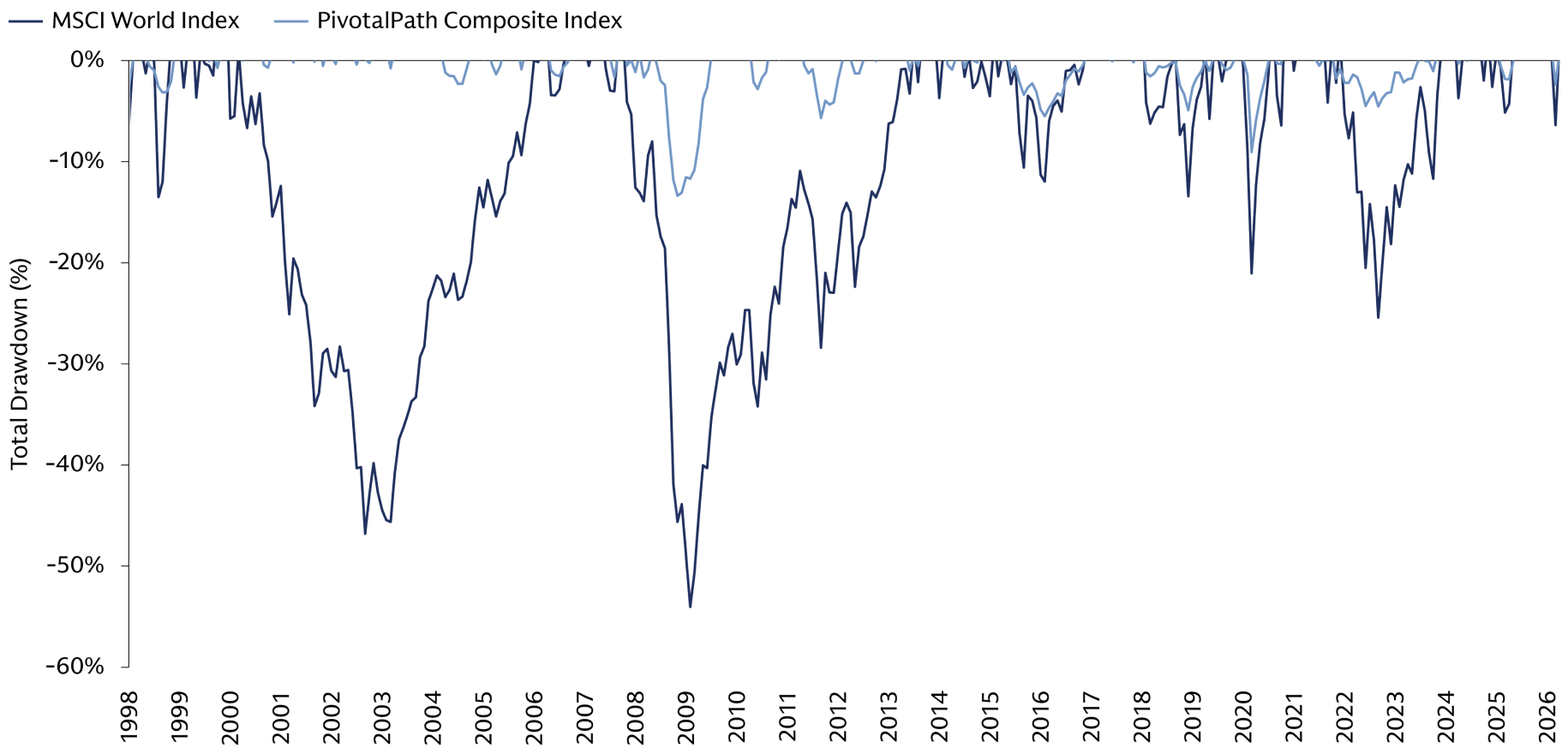
Source: XIG as of April 30, 2026. The graph above reflects drawdown for MSCI World Index - Net and the PivotalPath Composite from 1998 to present. The PivotalPath Composite Hedge Fund Index (Net of 1% fee) is a global, asset-weighted index tracking over 1,100 institutional quality funds covered by PivotalPath. The constituent funds report monthly performance, net of all fees, in USD. The Index is representative of hedge fund performance across strategies and geographies with a minimum fund track record of 18 months and a minimum fund AUM of $50mm. The constituents are updated annually at the end of each calendar year. To reflect the fees of a fund of fund provider, the composite performance is shown net of assumed XIG Hedge Funds advisory fees of 1.00% and the prevailing annual expense assumptions for entry-level XIG Hedge Funds discretionary portfolios. Actual fees charged to clients may vary depending on, among other things, the negotiated fee schedule, portfolio size, and scope of services performed
Hedge funds offer access to skilled investors.
Many of the world’s most skillful investors choose to manage hedge funds. The flexibility of these vehicles lets managers express their highest-conviction ideas with the least amount of constraint. That in turn magnifies the impact of investor skill: the difference between the performance delivered by top quartile hedge fund managers versus bottom quartile hedge fund managers is far larger than it is in traditional investments like equities and fixed income, as well as alternatives such as private credit and real estate. Manager selection matters more.
Plus, hedge fund managers are often quite literally invested in the success of these ideas: generally speaking, they put more of their own capital into the funds they manage than traditional fund managers do.
Net return dispersion by asset class
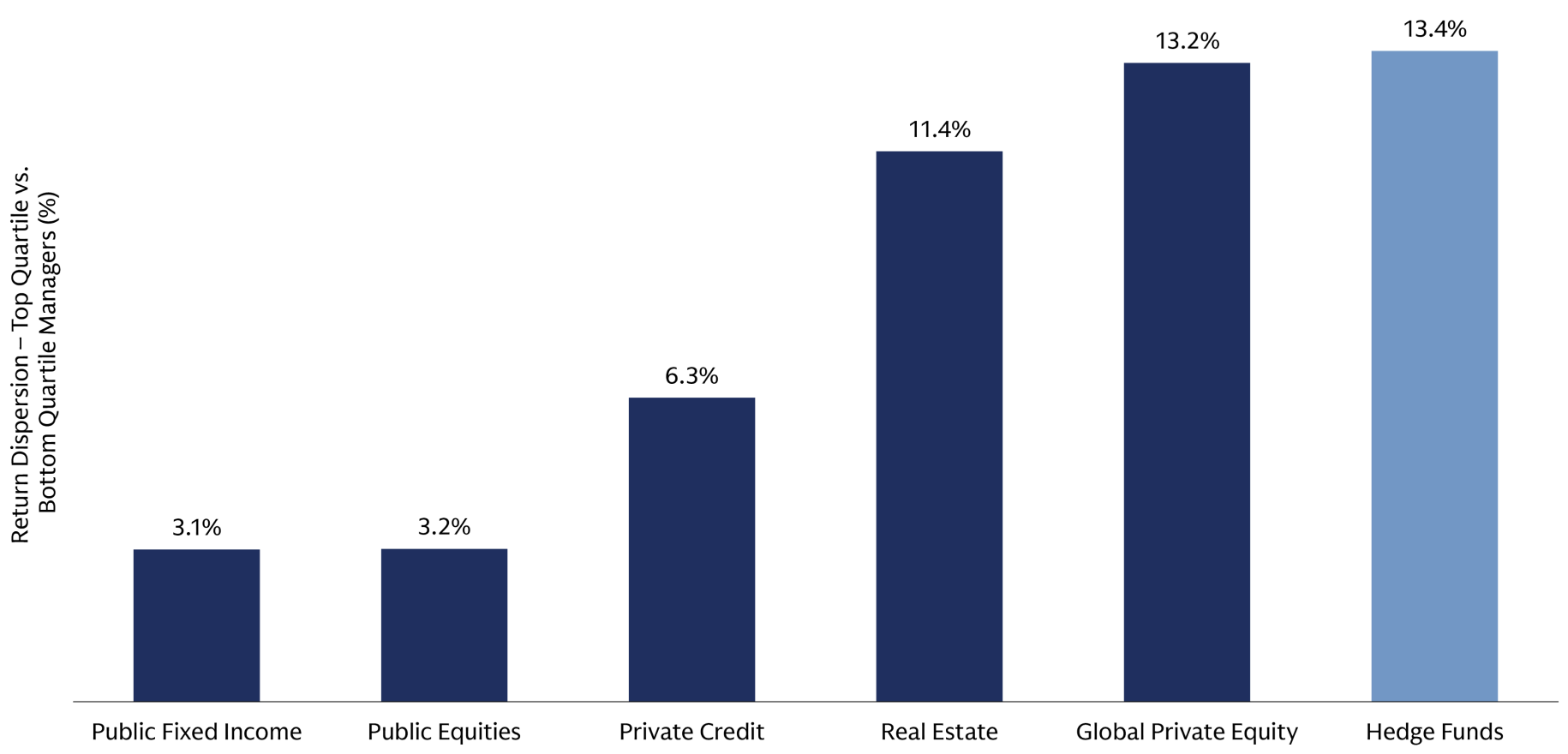
Source: Goldman Sachs Asset Management, Cambridge Associates, Nasdaq eVestment, Albourne as of March 2026. Represents the average dispersion between top quartile and bottom quartile managers across vintages 2000-2022 within each private strategy and across ten-year returns within each public strategy and hedge funds. Public Equities are represented by US Large Cap Global Equities. Fixed Income is represented by Global Fixed Income. Private Credit is represented by Credit Opportunities. Real Estate is represented by Value Added and Opportunistic Real Estate. Private Equity is represented by Venture Capital, Growth Equity, Buyout and Control-Oriented Distressed.
What to Consider When Investing in Hedge Funds

Hedge funds may have lock-up periods that prevent investors from getting their capital back immediately. Some hedge funds also have what are known as gate provisions to help manage liquidity risk. Gate provisions work either at the investor or at the fund level, and they limit 1) how quickly an investor’s capital is returned and 2) how much of the total amount of investor capital committed to the fund can get returned in a single period, such as a quarter.
A manager might stagger return of capital so that an investor only receives 25% back per quarter, or set a cap so that only 50% of the total capital in the fund goes back to investors at a time – no matter how many investors in the fund request to cash out. Managers implement gate provisions so they can sell at a more optimal price later on rather than selling to meet an influx of requests to cash out.
That said, hedge funds are generally more liquid than other private market investments that can lock up capital for more than a decade, such as private credit and private equity. Consider your liquidity needs before investing.

The gap between top-performing hedge funds and bottom-performing hedge funds is larger than it is in fixed income and equities.1 This dispersion makes manager selection all the more critical. Said another way, the price of selecting the wrong manager is higher in hedge funds than nearly all other asset classes.

Hedge funds have several fee structures designed to ensure that the manager’s and the investors’ incentives are aligned.2
One of these is commonly known as the 2 and 20 fee structure. It’s named after an arrangement where the manager takes about 2% as a standard management fee and about 20% as a performance or incentive fee, but only when the fund beats what’s known as the “high water mark,” or its last peak performance.
So, for example, if in the first year of a fund, the manager delivers a 12% return above an initial million-dollar investment, the manager could charge a 20% performance fee on the $120,000 profit, as well as an annual 2% management fee.
But if in the second year of the fund, the manager lost money and the value of the investment fell below $1,000,000, they could not charge any performance fees, just the 2% management fee. And even if they delivered a gain the following year that brought the total value of the portfolio up to $1,110,000, the manager still could only charge management fees and no performance fees until the portfolio value surpasses that initial $1,120,000.
Another common structure for hedge fund fees is what’s known as a hurdle rate. In this fund structure, the manager may not charge performance fees until the fund’s annual performance hits a minimum absolute return. If, for example, the fund cannot deliver performance higher than the return on cash, also known as the risk-free rate, there are no performance fees.
Frequently Asked Questions
1 Source: Goldman Sachs Asset Management, Cambridge Associates, Nasdaq eVestment, Albourne as of March 2026. Represents the average dispersion between top quartile and bottom quartile managers across vintages 2000-2022 within each private strategy and across ten-year returns within each public strategy and hedge funds. Public Equities are represented by US Large Cap Global Equities. Fixed Income is represented by Global Fixed Income. Private Credit is represented by Credit Opportunities. Real Estate is represented by Value Added and Opportunistic Real Estate. Private Equity is represented by Venture Capital, Growth Equity, Buyout and Control-Oriented Distressed.
2 Fees and performance shown are for illustrative purposes only.
3 Source: Goldman Sachs Capital Introduction SMA Survey 2026.