Fixed Income Outlook 1Q 2026
Finding Opportunity in Uncertainty
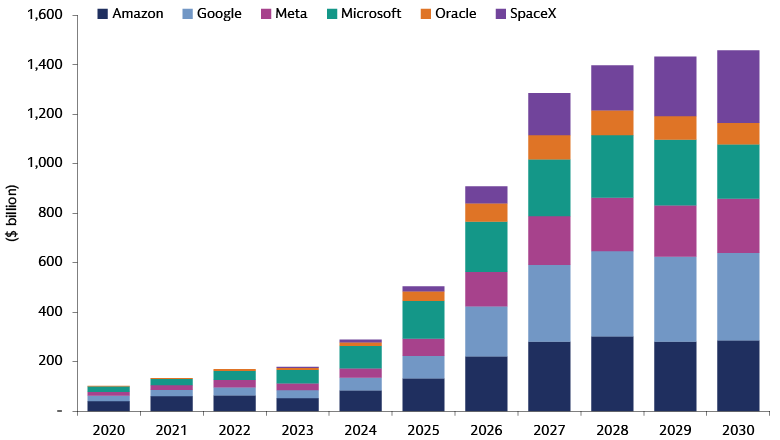
The health of the US, AI's impact on credit markets and the fiscal path ahead for many developed sovereigns are three of the key issues top of mind for our Fixed Income investment team entering 2026. Key highlights on the macro environment as well as our outlooks for select asset classes and the opportunities they present are below. For a deeper dive, including table summary of our investment views and central bank snap shot along with what we are watching, download our full publication.
Macro at a Glance
Growth: K-Shaped Recovery Takes Form in US
As the recent Q3 GDP release showed, household spending remains robust despite pressure on real incomes, with strength likely driven by higher-income consumers more sensitive to stock market wealth effects than labor market fragility.
The overall economy and Fed, however, remain sensitive to weakness in the labor market, and meaningful negative surprises in the nonfarm payrolls and unemployment rate now that data sources are less noisy post shutdown could alter that trajectory. Overall, however, we think that continued robust growth could curb the extent of any labor market softness, although we are mindful the current low-hire low-fire equilibrium is fragile and downside risks remain meaningful.
Among other major economies, we see upside and downside risks to European growth as finely balanced. In the short term, continued tensions over US trade and Chinese competition, as well as domestic political uncertainty, could potentially weigh on activity. However, the expected feeding through of increased fiscal spending, as well as robust activity driven by tourism and AI spending, could provide a catalyst to higher growth going forward. In the UK, meanwhile, a combination of risks point to the downside given subdued sentiment and ongoing labor market weakness, with recent GDP figures coming in well under Bank of England projections amid budget uncertainty.
In China, we expect exports to continue to grow solidly in 2026 and be an important growth engine against still soft domestic demand.
Inflation: Cautious Optimism
In the US, tariff passthrough has been slower and weaker than expected. While we expect further passthrough in 2026, with risks that firms opt to use start-of-year price resets to pass on costs, upward pressure on goods prices inflation should fade as the year progresses. Inflation expectations are well anchored, wage growth has converged to target consistent levels and further disinflation in housing services is providing an offset to higher goods inflation.
In Europe, meanwhile, we anticipate headline inflation to remain below the 2% target for the next two years, before the introduction of the new carbon pricing system for fossil fuels and heating in 2028 pushes it back to target level.
Inflation, in the UK, will take a big step down in 2026 due to the cost-of-living measures of the budget, easing wage pressures and the fading impact of some one-off measures in 2025, such as national insurance contribution increases. Underlying inflation pressures in Japan meanwhile remain strong. A tight labor market and weak yen could well continue supporting price increases, even as headline inflation comes under downward pressure from incoming government subsidies on energy, education and childcare.
Asset Class Outlook & Potential Opportunities
Interest Rates
The Fed is on pause for now, in our view, waiting for any change in the balance of risks between inflation and employment before adjusting policy again. However, the relatively dovish nature of the FOMC’s core, which has shown sensitivity to labor market weakness recently, suggests the bar to further cuts is low, while the arrival of a new Fed Governor in May—likely to adopt a dovish stance—also increases the case for further easing in 2026. The timing of these potential cuts remains unclear, however.
The ECB meanwhile is firmly on hold, in our view, with the bar for both easing and tightening relatively high. Recent projection upgrades suggest the risk is for inflation to surprise to the downside; however, growth would need to significantly weaken for cuts to come into play. In the UK, much lower inflation should help the BoE continue cutting rates to neutral, and any downside surprises to growth expectations could see rates being cut further. Japan is on course to hike twice in 2026. The BoJ’s timing, however, will likely depend on the outcome of wage negotiations and the direction of the yen.
Elsewhere in Europe, many easing cycles seen through 2025 are now at or nearing their end. In Sweden, for instance, the Riksbank is likely on hold for 2026, balancing a robust recovery with a relatively loose labor market. We see the bank starting a hiking cycle in the first quarter of 2027, although there is a risk of a cut in the second half of 2026 should its growth projections not materialize. The Swiss National Bank is likely to keep rates at zero this year, although could look to lift rates in 2027 if wider European growth prospects pick up, The Norges Bank, meanwhile, remains on course for two cuts this year in our view, with the economy continuing to gradually soften.
Across other G10 economies, Canada may keep rates steady for 2026 as it waits for unequivocal evidence that the recovery is taking hold. New Zealand and Australia interest rates also look set to be steady for 2026. However, we are cognizant that above-target inflation coupled with a cyclical recovery in both countries could see the Reserve Banks of Australia and New Zealand amongst the first DM central banks to pivot back to rate hikes.
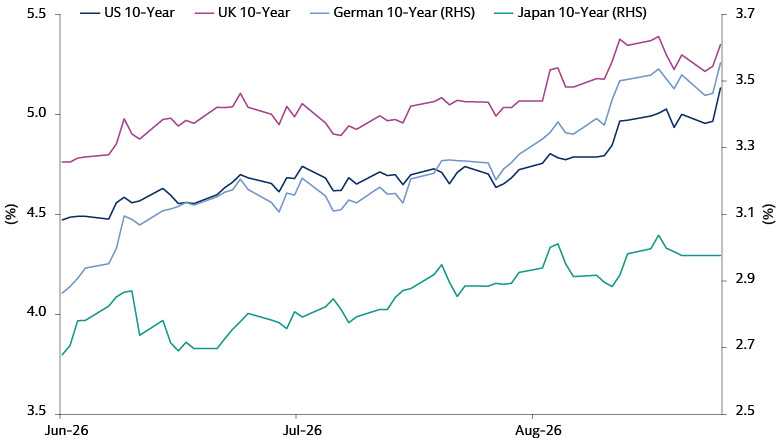
Opportunities: Curve dynamics across the major DM bond markets are likely to be a major source of opportunity. Directionally, we are neutral on US Treasuries and European bonds, but hold a steepening bias across both. US steepeners could benefit in either a risk-off (labor market weakness causing front-end rates to fall) or risk-on (fiscal expansion supporting growth and pushing up long-term yields) scenario. In Europe, an additional catalyst for steepeners could come from selling by Dutch pension funds transitioning from defined benefit to defined contribution schemes, which could continue to weigh on longer-dated notes.
Elsewhere in DM, divergent central bank policy should continue to give active investors opportunities. In Japan, we are positioned underweight and in curve flatteners, as continued rate hikes could push up the short end of the curve. By contrast, we are overweight duration in the UK, with a focus on the short end of the curve, as a weak labor market and falling inflation could drive more central bank cuts than anticipated. And in Australia and New Zealand we believe the market is overestimating the probability of a pivot to rate hikes, instead seeing central banks on hold, and are thus positioned overweight.
Currencies
Chair Powell’s comments at the December Fed meeting suggested the FOMC has a low tolerance for labor market weakness, implying that the US dollar could fall further than markets expect if the upcoming unemployment and nonfarm payroll figures surprise on the downside. By contrast, stronger-than-expected readings could remove that risk premium and provide support for the greenback, while continued AI-related capex may also be supportive. Overall, the dollar remains caught between several potential headwinds and tailwinds which could pull it in either direction. The Fed’s increased focus on the labor market has most of our attention.
Opportunities: We have a balanced view of the US dollar given the pressure it faces in both directions. Fiscal expansion, AI-capex spending and a labor market that is cooling rather than deteriorating should cap the number of Fed rate cuts, in our view. However, the possibility of AI optimism waning, as well as weakness in upcoming labor market data, could prove detrimental to the dollar.
Elsewhere, we are cautious on the British pound given ongoing fiscal concerns, and hold a similar view on the Japanese yen given the Takaichi premiership’s potential to increase government spending. In emerging markets, we hold select overweight positions in the South Korean won, Mexican peso and Czech koruna.