Introduction to Infrastructure

What is infrastructure?
Infrastructure is the backbone of our society, comprising assets that provide services essential to our lives. The scope of infrastructure is undergoing a profound transformation, as the ways we live, move, and communicate evolve. The modern infrastructure landscape can be classified across four key segments: energy and utilities, transport and logistics, digital assets, and circular economy and other services.
Infrastructure strategies encompass a wide variety of opportunities across the risk and return spectrum. They can offer a combination of income and long-term growth, depending on the underlying approach.
Potential Reasons to Invest
1. Resiliency, with potential inflation protection
Infrastructure companies have a distinct business model not typically found in other asset classes. The services they provide are essential, and the number of competitors is limited by regulatory and/or physical constraints. Many assets feature long-term revenue contracts, often with price escalators explicitly tied to inflation. Together, these factors make for sticky customer bases, resilient cash flows, and inflation protection. In the most recent inflationary environment, infrastructure yields rose at or above inflation levels.
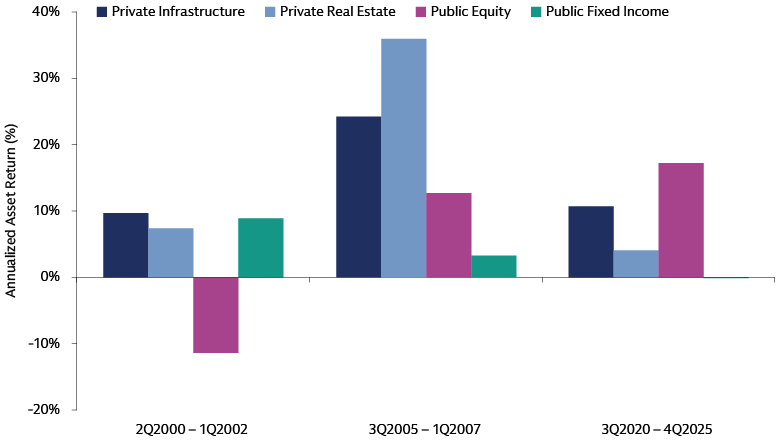
Source: Burgiss (private infrastructure and real estate), S&P 500 (public equities), Bloomberg Barclays US AGG (public fixed income) and BLS (inflation; year-over-year increase in CPI ex-food and energy), as of December 31, 2025. EDHEC Infra300 index for private infrastructure in 2Q2000-1Q2002 due to limited data coverage in Burgiss. Indices are unmanaged and do not include fees. Private infrastructure is not traded on an exchange and will have less liquidity than public entities. Past performance does not guarantee future results, which may vary.
2. Differentiated returns
The defensive nature of revenues for many infrastructure assets makes them less sensitive not only to economic cycles but, by extension, to macro-driven equity and credit market movements. The asset class has offered differentiated returns relative to equities and fixed income, with private infrastructure offering lower correlations to traditional asset classes. Given these differentiated returns, adding private infrastructure to a portfolio of traditional asset classes can enhance the portfolio’s risk-adjusted return profile.
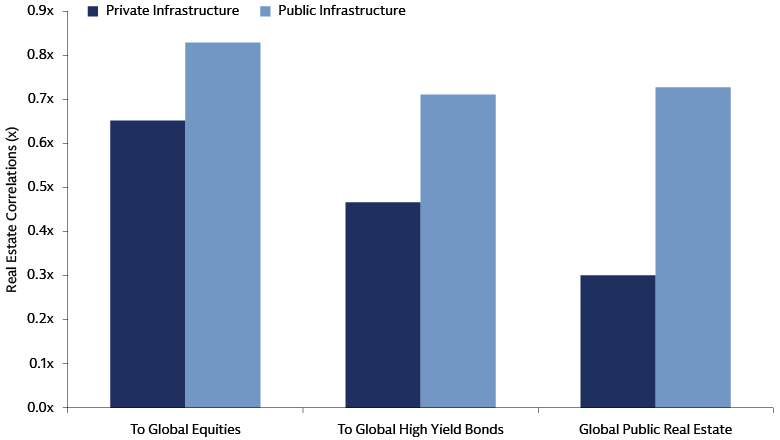
Source: Cambridge Associates (private infrastructure), MSCI (MSCI World, global equities), Bloomberg (Bloomberg Barclays global high yield), FTSE (FTSE EPRA NAREIT, global public real estate), FTSE Global Infrastructure index (public infrastructure). Based on 15 years of quarterly data through December 31, 2025. Past performance is not indicative of future results. Past correlations are not indicative of future correlations, which may vary.
3. Capitalizing on secular megatrends
Secular megatrends are driving waves of innovation, redefining the way we live, work, and communicate. As the backbone of our society, infrastructure supports and serves the tools of transformation by delivering critical energy, communications, and logistics services. As such, infrastructure provides investors with differentiated ways to gain exposure to these structural growth drivers.
Infrastructure Opportunities Within Secular Megatrends

- A 2.7x increase in data center power consumption is expected by 2030, requiring ~$475bn+ of new capex1

- $3.0tn clean power, energy and electrification investments required annually through 2030 to meet UN Sustainable Development Goals2,3

- Trade volumes are expected to grow at +3% in 2025,4 but trade patterns are realigning, requiring increased investment in port and logistics infrastructure

- People aged 65+ are projected to make up 15% of the world’s population in 20 years,5 potentially shifting public spending priorities and driving demand for private infrastructure funding
Certain infrastructure investments may be exposed to regulatory risks and there may be the possibility that legislative changes can affect partnerships and pricing structures. In addition, some infrastructure funds can be illiquid and typically cannot be transferred or redeemed for a period.