Disruptive Technology

Learnings from Earnings


December 10, 2025 | 11 minute read
Author(s)
Avatar
Alexis Deladerriere
Co-Deputy CIO of Fundamental Equity and Head of International Developed Markets Equity
Avatar
Başak Yavuz
Co-Deputy CIO of Fundamental Equity and Co-Head of Emerging Markets Equity
Avatar
Maarten Geerdink
Head of European Equities, Fundamental Equity
Key learnings from the 3Q 2025 earnings season highlight the continued strength of AI-related themes and the further divergence in the Consumer sector. We also spotlight the resilience in the European equity sectors and the opportunities that may be ahead.
Key Takeaways
1
AI Dominance and a Mostly Resilient Consumer
Earnings soared in 3Q 2025 on booming AI investment and selective consumer resilience, but investors stayed focused on future outlooks rather than past successes.
2
The Unstoppable AI Investment Wave
The AI theme continued its dominance, driving massive investment and growth across the entire technology ecosystem and beyond.
3
The Evolving and Nuanced Consumer Narrative
The story of the US consumer became more nuanced as the reporting season unfolded, shifting from a picture of broad resilience to one showing clear demographic and behavioral splits.

Earnings Season Recap

AI Dominance and a Mostly Resilient Consumer Shape a Strong Quarter - Again

The third quarter delivered a robust earnings season, underscoring the resilience of US corporates against a backdrop of macro uncertainty. Aggregate EPS growth remained firmly in double digits, marking the fourth consecutive quarter of expansion, with approximately 80% of companies surpassing consensus on earnings and revenue.1 Technology continues to lead the narrative, with exceptional performance across cloud and AI platforms, with hyperscalers reporting revenue acceleration. Consumer dynamics were more nuanced; discretionary spending trends skew positive for premium categories, while lower-income cohorts continue to be under pressure. Beyond these areas, three sectors stand out:

Financials
Financials

Banks delivered solid net interest income and credit quality, with notable improvements in capital markets activity as rate volatility stabilizes.

Healthcare
Healthcare

Managed care and pharmaceuticals performed well, supported by strong enrolment trends and resilient drug pipelines, with likely upside in medtech and GLP-1 therapies.

Energy
Energy

Integrated majors posted robust cash flows on disciplined capex and cost control, even as commodity prices moderated; shareholder returns and energy transition positioning appear as key differentiators.

The Unstoppable AI Investment Wave

The AI theme continued its dominance, driving massive investment and growth across the entire technology ecosystem and beyond. The demand for AI capabilities is reshaping capital expenditure plans and creating a clear boom for enabling companies.

  • Infrastructure and Component Demand Surges: The season highlighted incredible demand for the "picks and shovels" of the AI revolution. Companies providing essential infrastructure saw stellar results, with data center operators like Digital Realty and cooling specialists like Vertiv reporting remarkable strength. Networking hardware supplier Arista Networks posted a 27% revenue increase,2 while component manufacturer Amphenol delivered a "monster quarter," underscoring its critical role in supplying the interconnects, power, and thermal solutions for AI hardware. This demand extends to optical components, where Coherent and Lumentum saw significant growth, and data storage, with Seagate and SanDisk reporting strong demand for hard drives. This was all capped by Nvidia's announcement that its “Blackwell sales are off the charts.”3
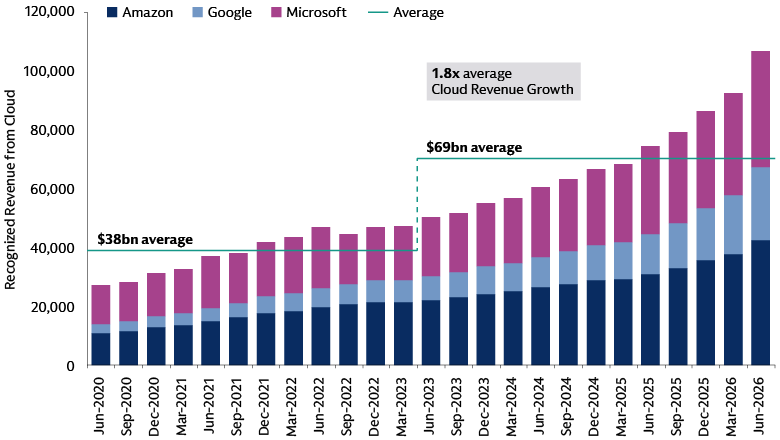
  • Hyperscalers Unleash Record Capex: Tech giants are in an arms race to build out AI capacity, with the top three cloud providers—Amazon's AWS, Microsoft's Azure, and Google's GCP—seeing accelerated revenue growth. Microsoft announced plans to double its data center footprint, while Google also increased its capex outlook. Meta signaled massive, front-loaded investments to support its AI roadmap. This surge in spending is a direct tailwind for the semiconductor sector, with firms like KLAC and Teradyne highlighting growth in memory and AI compute testing, and AMD projecting tens of billions in annual revenue by 2027,4 bolstered by its partnership with OpenAI.
  • AI Integration Spreads Across Sectors: The influence of AI was not confined to the Technology sector. Financial services firms were noted to be heavily investing in AI to drive efficiency and innovation. Northern Trust reported embedding AI in over 150 use cases to improve programming efficiency, while TransUnion is using it to speed up product development. Raymond James created specific leadership roles to spearhead its AI strategy, Blackstone is deploying capital into AI-related data centers, and Nasdaq has rolled out an AI workforce in its Fintech division.

The Evolving and Nuanced Consumer Narrative

The story of the US consumer became more detailed as the reporting season unfolded, shifting from a picture of broad resilience to one showing clear demographic and behavioral splits.

  • Initial Reports Signal Broad Resilience: Early in the season, corporate commentary painted a picture of a "largely resilient" consumer. Reports from payment processors like Visa and Mastercard showed healthy spending trends, and financial firms like Capital One pointed to strong consumer fundamentals. While spending was discerning, there was still a willingness to spend in discretionary categories, including travel & leisure (Expedia, Uber) and areas with compelling innovation like beauty and apparel (e.l.f. Beauty, Tapestry, Ralph Lauren).
  • Sentiment Shifts as Demographic Weakness Emerges: As more companies reported, a more complex picture emerged. Weakness became more pronounced among middle- to lower-income consumers and younger demographics. This was especially concentrated in restaurants and food retail, with Chipotle, McDonald's, Sweetgreen, CAVA, and Wingstop all noting slowing frequency among these cohorts, who are being pinched by inflation and student loan repayments. Sprouts Farmers Market and Shake Shack also cited demand softening, and PayPal observed consumers trading down in their spending patterns.
  • A "K-Shaped" Economy Solidifies: By the end of the season, the narrative had solidified around a "K-shaped" economy. Retail bellwethers like Walmart, Target, and BJ's Wholesale confirmed that lower-income shoppers were under pressure, a situation exacerbated by the temporary government shutdown's impact on SNAP payments, which also affected demand at companies like Costco and Affirm. In contrast, consumers of all income levels gravitated toward value and convenience, fueling robust sales and traffic growth for off-price giants like TJX Companies and Ross Stores.

Looking Ahead into 2026

As we think about the next earnings season and look ahead into 2026, we see a sustained US earnings momentum, underpinned by the robust AI-driven capital expenditure cycle, a supportive monetary environment, and strong corporate fundamentals. We believe, however, that several themes merit close attention. While AI remains a structural growth driver, we note the evolving focus: monetization and ROI of hyperscalers’ investments continue to be under scrutiny, and leadership will be selective, so diversification is essential. Earnings have been resilient, yet guidance is cautious, particularly across Industrials and low-income consumers, where signs of pressure are evident. Conversely, Healthcare seems to be gaining momentum, supported by tariff-related deals and renewed R&D commitments. Overall, a disciplined focus on high-quality, secular growth companies, prudent sector rotation, and active risk management will be critical to navigating the evolving market landscape into 2026.

Spotlight on European Equities

As part of our 3Q 2025 Learnings from Earnings, we sat down with Maarten Geerdink, Head of European Equities, Fundamental Equity, on the resilience of European sectors—including Utilities, Healthcare, Industrials, and Consumer—and how many are driving growth amid evolving market dynamics and the rise of AI.

1. How should we interpret the latest European earnings season? What is the outlook from here?

Despite the uncertain macro background, European firms have demonstrated notable resilience, with their fundamentals surpassing expectations. Most companies have maintained their outlooks, which has led to consensus forecasts for 2025 and 2026 either holding steady or seeing some improvement.

Financials pulled their weight again this quarter, making up for softness in Industrials and Consumer Discretionary names. About half the companies beat their EPS estimates, which is not unusual, but sales growth did fall 1%,5 so demand remains a bit subdued. Margins are holding together thanks to cost discipline, even if revenues are under pressure.

Our outlook for 2026 remains positive. We expect improved growth across the Eurozone to underpin robust earnings and are encouraged by several developments. Notably, Germany is set to step up fiscal spending in 2026, Spain continues to demonstrate solid economic performance, and political uncertainty in France has eased for now.

In addition, we expect the drag from currency fluctuations to ease. Earlier this year, the earnings downgrades were driven by the strengthening euro and trade tariff challenges, which hit large, globally oriented companies the hardest. The euro has stayed steady against the US dollar since the summer, so earnings forecasts haven’t been cut any further after the reductions earlier this year. Also, with a more favorable environment in China supporting European exporters, reduced trade friction, and easier access to financing, conditions appear set to provide tailwinds for European corporate earnings.

2. Are European Banks still a structural overweight in your view? The sector has had a strong rally this year - do you expect continued outperformance?

European Banks may still be benefitting from the rate environment, so margins and earnings are solid. Loan growth is decent in key markets like Spain, Portugal, Greece, the Netherlands, Belgium, and Ireland, helped by corporate lending support in Germany. Capital buffers are strong, and dividends look attractive versus global peers. That said, valuations aren’t as cheap as they were after a long rally, so there’s less safety margin. Plus, if growth slows or rates start heading down, that could cap the upside. So, instead of blanket exposure, I’d focus on banks with strong capital positions, diversified revenues, especially those making headway in fee businesses, digital transformation and exposed to loan growth.

For investors, this means a shift from broad exposure to selective positioning in banks with above mentioned traits or having idiosyncratic stories.

3. What other sectors would you highlight?

Right now, European Utilities are at a turning point, with electrification picking up pace right across the region. Following the initial focus on renewable generation, Europe’s energy transition is now all about infrastructure, with modernizing power grids and electrification front and center. Together, the EU countries are planning a €584 billion upgrade to their grids by 2030,6 highlighting just how big the opportunity is. This includes transmission of renewable power, better cross-border connections and rolling out smart grids. In this context, Utilities stand out as a great mix of growth and defensive qualities, especially if you’re looking to tap into the ongoing shift towards cleaner energy. This sector is in a strong spot to offer steady returns, while also taking advantage of the big trends around decarbonization and digitalization that are changing Europe’s energy scene. Some companies have already made a name for themselves as “electrification compounders”, riding the wave of grid upgrades and power capacity auctions in the UK and Germany, among others.

We would highlight Healthcare, where we believe the outlook is constructive: innovation in areas such as obesity treatments, rare disease therapies, and AI-integrated imaging (and potentially AI in R&D drug discovery) continues to underpin long-term growth potential. The overhang around US pricing facing pharmaceutical companies has started to de-risk, now that we have greater clarity after the first few deals were signed between pharmaceutical companies and the US Administration, leading to a sector re-rating. Despite the re-rating, we continue to see value in companies with market-leading R&D innovations and management. In other Healthcare sectors, medtech continues to face an uncertain tariff impact. We are seeing incremental upside from product launches and M&A activity. Valuations remain attractive relative to historical levels.

Another area worth mentioning in Industrials, which overall didn’t have a great quarter outside of aerospace and defense.  However, fiscal stimulus, notably Germany’s €500 billion infrastructure fund,7 is expected to drive demand for construction materials and heavy industrial inputs from next year. Electrification and grid upgrades create opportunities for medium-voltage equipment and energy management solutions. Longer term, higher corporate capex, alongside green transition initiatives and defense spending could underpin growth, making selective exposure to diversified industrials and capital goods suppliers attractive for investors navigating Europe’s reindustrialization phase.

4. What about European consumer companies? Luxury and beauty are rebounding—do you see this as a tactical trade or a structural trend? And what about consumer staples?

We started seeing some signs of recovery across European Consumer sectors, albeit uneven for now. Luxury brands are seeing sequential improvements in demand; for instance, after 2.5 years of softer results, a leading French domiciled luxury conglomerate has seen sequential improvement from better-than-expected demand from China, which is around a third of the company’s revenues.8 Within Consumer Staples, the beauty segment stands out, with growth driven by fragrances. In contrast, the spirits category continues to face structural challenges with underlying demand still very weak in both US and China.

Rising demand from China has started to bolster European consumer companies, particularly in luxury and beauty, helping to counterbalance weaker trends elsewhere and supporting overall sales growth. Recent improvements in consumer sentiment and spending in China have contributed to the sequential recovery not only of high-end luxury goods products but also more aspirational categories. This is especially apparent in areas such as fragrances, where heightened interest in premium goods has led to stronger than expected performance.

Despite ongoing macro headwinds—including trade tariffs and geopolitical uncertainties—these positive developments suggest selective opportunities in premium discretionary and beauty staples. Investors may want to focus on businesses with robust brand equity and wide economic moats, which underpin pricing resilience and margin stability.

5. How can investors “play tech” in European equities amid the AI-related boom?

As the AI boom spreads to Europe, we believe investors seeking meaningful tech exposure should look well beyond traditional software plays. In our view, the focus should be on companies that are driving the region’s digital transformation and infrastructure evolution. Businesses involved in semiconductors and hardware that support AI infrastructure are at the forefront, capitalizing on increased demand for computing power and electrification. Additionally, firms offering energy-efficient solutions for data centers provide unique opportunities linked to sustainability-driven growth. Although certain segments have seen their valuations rise, it remains crucial to assess balance sheet strength and commitment to research and development when selecting investments. Investors should favor organizations with a broad range of end markets and robust pricing power, as these characteristics help cushion against cyclical downturns and position portfolios to benefit from ongoing digitalization and decarbonization. Furthermore, the latest survey results from European institutions reveal that firms across the EU are stepping up investment in advanced technologies, particularly artificial intelligence—a trend expected to persist into 2026, supporting continued improvements in productivity.

1FactSet Earnings Insight, as of November 21, 2025
2Company's earnings release, November 4, 2025
3Comment made by the CEO Jensen Huang during Nvidia's earnings announcement on November 19, 2025
4CEO Dr. Lisa Su at AMD Financial Analysts’ Day, November 10, 2025
5Bank of America, The European Earnings Season: Beat and Raise, November 14, 2025
6https://energy.ec.europa.eu/news/focus-eu-investing-energy-infrastructure-2024-10-15_en
7Germany votes for historic boost to defence spending, BBC, March 18, 2025
8Company's financial statements

Author(s)
Avatar
Alexis Deladerriere
Co-Deputy CIO of Fundamental Equity and Head of International Developed Markets Equity
Avatar
Başak Yavuz
Co-Deputy CIO of Fundamental Equity and Co-Head of Emerging Markets Equity
Avatar
Maarten Geerdink
Head of European Equities, Fundamental Equity
Start the Conversation
Contact Goldman Sachs Asset Management for a detailed discussion of your needs.
card-poster