The Future of DC? Lessons from the DB and Insurance Markets



Key Takeaways
Learning from Experience
The defined benefit (DB) pensions and insurance markets have delivered many interesting and innovative solutions over the last decade. Many are designed to deliver cashflows that support pension payments, manage risk, and deliver returns consistent with a wide range of time horizons and risk tolerances. These requirements are mirrored within defined contribution (DC) pensions as investors seek to grow their pension pots, manage risk, match annuity pricing and deliver income to support drawdown.
It therefore follows that there is a significant amount of relevant experience within the defined benefit and insurance world that can drive learnings for the defined contribution industry.
Most DC schemes invest passively in corporate bonds, not least because this is a cheap way of accessing the asset class. This is adequate in the context of a diversified growth or balanced portfolio, where you simply seek the broad risk and return characteristics of the asset class. Such an approach, however, offers no strategic alignment and comes with the inherent flaws of tracking a bond index. You are a forced seller of bonds should they fall to sub-investment grade and vice versa, whilst having a high exposure to the most indebted companies, as indices tend to be issuance weighted.
How DB Solutions May Work for DC
A relatively straightforward example of a transferrable solution from DB/Insurance to DC could be to invest in a tailored portfolio which is aligned to strategic objectives, managed on a buy-and-maintain basis, and structured to reflect the latest market risks and opportunities. We map this out below.
Buy-and-maintain
Many DB schemes and insurers employ buy-and-maintain, or low turnover corporate bond strategies, instead of tracking an index. This benchmark-agnostic style supports the strategic alignment required by DC pensions for cashflow or annuity matching, while being relatively low cost and reducing the manager oversight burden.
Holding bonds to maturity, in our view, tends to result in an allocation to issuers more likely to repay back the principal than may be the case within a traditional active portfolio, reducing volatility. Such portfolios can be structured to avoid the forced selling of bonds downgraded to sub-investment grade, a potential source of added value compared with a passive portfolio. This can be done by having a permitted allocation to sub-investment grade bonds to accommodate the retention of downgraded names.
Long-run data from Moody’s suggests that, on average, between 3% and 5% of an investment grade index gets downgraded to high yield annually, with this number rising in times of market stress. For example, the number was around 11% in 2002 and 2008, and 7.5% in 2009 following the global financial crisis.1
Very few of these names go on to default and a large cohort of such names eventually return to investment grade, with their performance post downgrade exceeding their performance pre-downgrade.2 Thus, proactively managing downgraded names within a buy-and-maintain framework, rather than being a passive forced seller of such bonds, can improve portfolio performance.
Strategic alignment
A buy-and-maintain portfolio could target a pre-determined level of cash generation to support the drawdown of an individual’s pot, similar to the cashflow-matching strategies commonly employed by DB pension schemes.
At an aggregate DC plan level, cashflow matching could be used to support predicted annuity purchases or lump-sum payments. This would avoid or reduce the need to sell bonds to fund such activity, reducing dealing costs and improving member outcomes.
Additionally, the duration or maturity profile of the bonds could be tailored to match annuity pricing, helping to lock in the affordability of an annuity for members. In each case, the average credit quality of the portfolio can be tailored to the risk tolerance of members.
Global credit allocations can aid the goals of this type of portfolio by broadening diversification and the opportunity set, as well as improving the quality of any cashflow matching. The sterling market is relatively small, particularly at longer maturities. Including allocations to dollar and euro denominated bonds (hedged into sterling) generally results in more accurate cashflow matching and better diversification at these longer maturities.
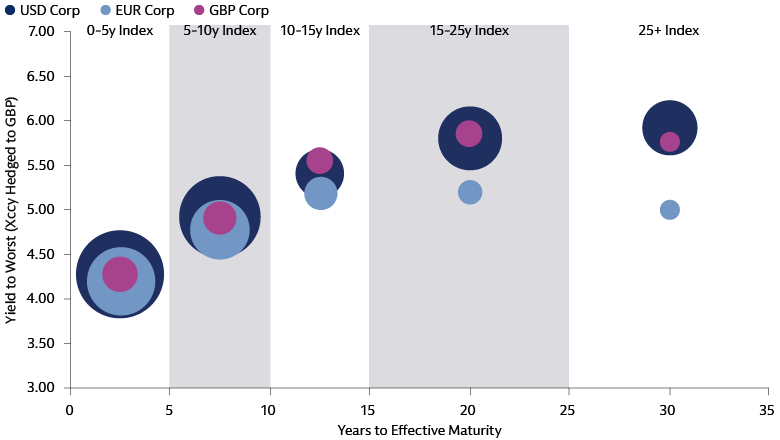
Source: Goldman Sachs Asset Management. Overview of spread levels as of December 2025. Diversification does not protect an investor from market risk and does not ensure a profit.
Market positioning
Buy-and-maintain does not mean buy-and-forget. The initial portfolio is built to reflect prevailing market dynamics and there is a proactive approach to monitoring and managing credit rating changes.
Incorporating a modest turnover budget—of maybe 10-15%, for example—could also be useful, as a way to facilitate gradual repositioning of the portfolio towards areas of value and away from relatively expensive sectors. Such an approach keeps costs low but provides some scope for enhancing risk adjusted returns. The recent market volatility and non-stop geopolitical noise create a rich opportunity set for us to take advantage of, where we have flexibility to position portfolios accordingly.
While credit spreads are currently tight, corporate fundamentals and supply/demand within the market are supportive of such valuations. This means that it is important to have access to the broadest toolkit possible and to proactively position the portfolio towards areas of value rather than simply investing passively.
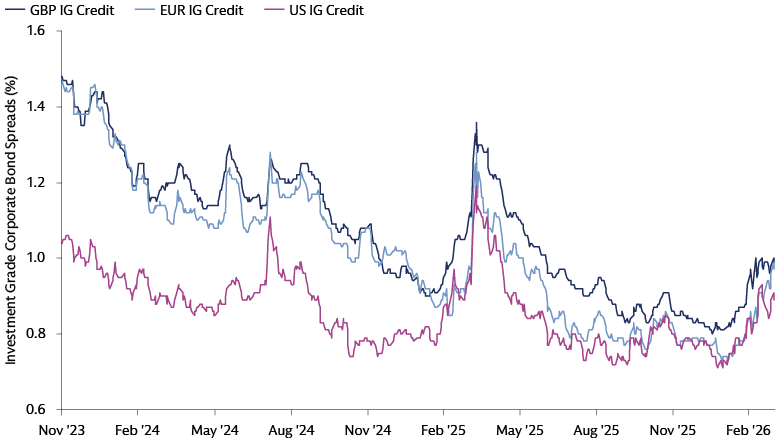
Source: Bloomberg. As of March 31. 2026.
By way of example, when we have been structuring buy-and-maintain portfolios recently, we have typically been seeing spreads of around 100 basis points, compared to broad market spreads of around 80 basis points. This spread pick-up being the result of us taking advantage of the full opportunity set (overseas bonds, high-quality securitised assets, modest allocations to higher quality sub-investment grade bonds and emerging market bonds) as well as optimising overall portfolio allocations.
Sustainability integration
Evaluating sustainability risks should be a core component of any credit research process, as they can have the same financial impact as business, macro and other traditional credit risks. Engagement with bond issuers on these risks should be considered as part of any credible process. However, the longer-term hold to maturity approach characterised by buy-and-maintain portfolios lends itself to an enhanced approach to integration of sustainability factors. For example, by employing a decarbonization overlay or positive/negative screening that aligns with underlying investor beliefs.
Looking to the Future
There are many tried and tested investment solutions from DB pensions and insurance portfolios that have direct applicability to DC pensions. Within corporate bond allocations, such solutions can be precisely tailored to investor requirements, aligning closely with strategic objectives such as cashflow delivery, annuity matching or leveraging a sustainable lens. Buy-and-maintain investing allows managers to keep costs low whilst positioning the portfolio to reflect current market conditions.
1 Moody’s historical data (1920-2018), Bank Underground a Bank of England staff blog (22 May 2019, based on ICE BofAML data and author calculations), Bank for International Settlements.
2 European Central Bank, As of December 31, 2025.