How UK Pension Schemes Can Gear Up for Run-on and Surplus Sharing

Key Takeaways
The UK government is overhauling the rules for DB pension schemes. The Pension Schemes Act, which became law on April 29, gives schemes greater flexibility to release surplus funds. Schemes are now focussed on upcoming detailed guidance on issues including minimum funding thresholds. With this in view, we find that more and more schemes are looking at run-on strategies with surplus sharing as an alternative to insurance buy-in and buy-out transactions. We believe the economic incentives are clear.
One reason for this increasing interest in run-on is that well-diversified and well-hedged schemes remain in a better position than they were five years ago despite the turmoil in global markets.1 Members are also older now, and schemes that closed to new entrants years ago continue to mature. Innovation in end-game options continues, such as the Stagecoach Group Pension Scheme’s recent run-on agreement with Aberdeen, in which Aberdeen replaced Stagecoach as the £1.2 billion scheme’s sponsoring employer.2 The transition from a buy-out-first mindset to run-on is not automatic, however. We believe the key to success lies in the bespoke structuring of these agreements and achieving total alignment between trustees, sponsors, and members.
In our conversations with trustees, they seem increasingly open to considering alternative end-game strategies, especially when members stand to benefit as well as employers. We believe that run-on and other alternatives to pension risk transfer will become an increasingly important part of the wider DB pension system.
This article continues our discussion of UK pension schemes. Here we will examine the rationale behind run-on discussions, explore how surplus extraction could work in practice, and look at investment strategies that could be helpful on the journey.
Is Surplus Sharing the Right Option?
We think schemes that are interested in surplus sharing need to consider several key factors, starting with scheme size. Historically, only larger schemes have pursued run-on because of the fixed governance and advisory costs involved. The size of a scheme relative to its sponsor is also a critical factor. Large schemes may find that sponsors have limited appetite to engage with amounts that are immaterial compared with corporate income. Conversely, sponsors of smaller schemes that are large compared with the corporate balance sheet may be more motivated, especially if there is a history of deficit contributions. We have seen a subtle change in recent months, with mid-sized and smaller schemes now seeing run-on as a viable long-term goal. Structuring the economics of these arrangements to benefit all parties will be the key to unlocking this value.
A second factor for schemes to consider is their governance framework. The importance of clear decision-making authority and accountability cannot be overstated. When assets are transferred out of a scheme, as would be expected in surplus sharing, the assets are no longer available to meet obligations to members.
The level of backing for surplus sharing from trustees and corporate sponsors is a third key factor. To succeed, any arrangement will need to provide a positive outcome for both parties, in our view. Surplus sharing potentially allows employers to extract value from a scheme that was previously viewed as a liability, while for trustees it can provide benefits to members.
Identifying the Right Investment Strategy
Once a decision has been made to explore surplus sharing, the sponsor and trustee need to think about the investment strategy that can prepare them to take this step. Important questions for sponsors and trustees to consider include:
- What funding level should trigger surplus extraction?
- How can we raise our funding level to the trigger level in a risk-controlled manner?
- How can we balance extracting surplus with the need to retain assets to continue compounding?
- What is the optimal level of investment return and risk for building surplus and investing assets that are not extracted?
- How can we manage the portfolio to protect against downside risks?
Arriving at a Suitable Trigger Funding Level
To examine the process of surplus sharing in practice, we analysed a hypothetical scheme with the following characteristics:
- £850 million of assets
- Liabilities of £810 million measured on a “gilts-flat” basis, a conservative valuation method that discounts liabilities using the gilts yield curve with no margin for outperformance
- Starting funding level of 105%
- Mature membership profile
- Closed for many years to new entrants and future accrual
- Duration of liabilities is 11 years
When considering a suitable trigger funding level, we think trustees will want to create a buffer above 100% to address potential investment and longevity risks and unforeseen circumstances. For the purposes of this analysis, we assume that a 10% buffer is appropriate. This means our hypothetical fund needs to increase its funding level to 110% on a gilts-flat basis before extracting surplus above that level.
Our analysis shows that a scheme currently funded at 105% could expect to reach 110% within three to five years by taking on a moderate level of investment risk; that is, by broadly targeting an investment strategy with an expected return of gilts plus 1.5%. Once the scheme reaches 110% funded, continuing to run this level of investment risk and extracting 30% of excess assets above this level minimizes the risk of the funding level falling below 100% (and therefore requiring additional contributions) whilst leaving enough behind to generate future surplus for extraction.
Taking less risk increases the time it takes to reach the trigger level, which in our view would make sponsoring employers less likely to back surplus sharing. Increasing the investment risk beyond gilts plus 1.75% per year leads to more severe downside risks in the tail of the distribution, potentially increasing the chance of additional contributions.
Targeting 110% funding with an investment strategy that delivers gilts plus 1.5%, and extracting 30% of the surplus, potentially results in the following surplus distribution across three scenarios: optimistic, median, and pessimistic.
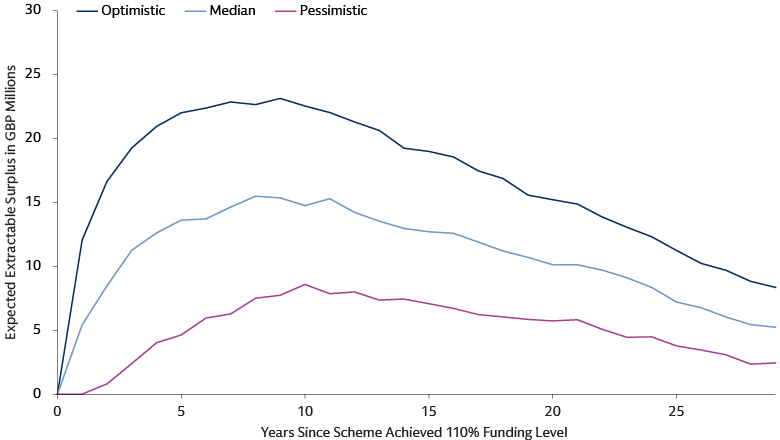
Source: Goldman Sachs Asset Management. As of December 2025. For illustrative purposes only. The chart shows expected extractable surplus, assuming 30% of the surplus over a 110% funding level can be extracted over time. The three scenarios refer to improvements in funding levels over time based on our stochastic return projections. The median scenario reflects our anticipated returns, while optimistic reflects better-than-anticipated returns and pessimistic, lower-than-anticipated.
Building a Portfolio to Provide Necessary Returns
To reach the trigger funding level and enable sustainable surplus extraction, our hypothetical portfolio needs to deliver the following outcomes:
- A return of gilts plus 1.5%
- A level of cash inflow that matches the high expected level of cash outflow for a mature pension scheme
- A level of liquidity high enough to ensure sufficient collateral backing a liability-driven investment strategy which fully hedges interest rate and inflation risk
Most UK DB pension schemes will not begin this process with a blank slate. The impact of the 2022 gilts crisis is still being felt, and many schemes are overweight illiquid assets that are now in the run-off phase. There may be a place in the portfolio for shorter-dated illiquid assets such as asset-backed finance or evergreen structures in private credit to boost cashflow certainty. If an asset-led discount rate is used, an allocation to credit and other contractual assets could help stabilize funding levels – a useful tool when surplus extraction depends on a predictable and stable funding level.
Given current credit spreads, we favour introducing a diversified growth portfolio into the asset allocation rather than reducing credit quality or increasing illiquidity to achieve the same return expectation. An example growth portfolio looks like this:
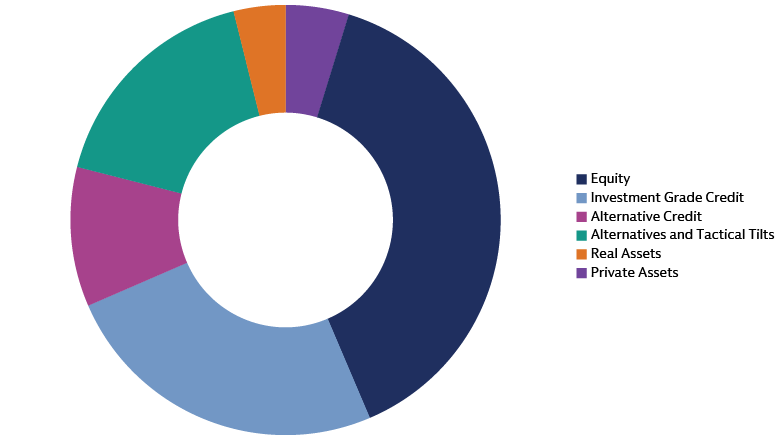
Source: Goldman Sachs Asset Management. As of May 2026. For Illustrative purposes only. The model portfolio provided herein has certain limitations. These results are based on simulated or hypothetical performance results that have certain inherent limitations. Unlike the results shown in an actual performance record, these results do not represent actual trading. Also, because these trades have not actually been executed, these results may have under-or over-compensated for the impact, if any, of certain market factors, such as lack of liquidity. Simulated or hypothetical trading programs in general are also subject to the fact that they are designed with the benefit of hindsight. No representation is being made that any account will or is likely to achieve profits or losses similar to these being shown. This model is shown for illustrative purposes only and is representative of a UK DB Pension Scheme Fiduciary Management Strategy. It does not purport to show the holdings or sector weightings of an actual account. This information is shown for illustrative purposes only and does not constitute a recommendation of exposures for any client account. The exposures for the model portfolio will differ from the exposures for a client account because of specific client guidelines, objectives and restrictions. Diversification does not protect an investor from market risk and does not ensure a profit. Allocation to GS managed investment products in investment portfolios raises potential risks and conflicts of interest, which may create incentives to recommend GS managed investment products rather than non-GS managed products. Please see additional disclosures. Past performance does not predict future returns and does not guarantee future results, which may vary. Diversification does not protect an investor from market risk and does not ensure a profit. The portfolio risk management process includes an effort to monitor and manage risk, but does not imply low risk.
Implementing Investment Governance Efficiently
Building and extracting surplus will take up governance bandwidth. We believe that there are advantages to delegating some or all of the day-to-day implementation of investment strategy to allow trustees to focus on more strategic issues. We work with schemes that choose to retain their current investment advisor and use Goldman Sachs Asset Management as an implementation manager. We also have clients who opt for a fiduciary management arrangement, which involves at least partial delegation of investment strategy and full delegation of implementation. Both models allow access to the full range of asset classes needed to build portfolios that can adapt to changing market conditions.
The next decade of UK DB pension management will require a paradigm shift in governance, in our view. Operating a scheme in run-on mode to extract surplus is not a passive strategy; it requires a higher standard of oversight across the trustee, advisory, and implementation chain. Success in this environment depends on investment agility — the ability to utilise a broader range of instruments to protect gains while capturing growth. This requires integrating sophisticated downside protection with precise capital allocation. Furthermore, as surplus sharing frameworks become more prevalent, the role of professional trustees who can navigate the nuanced tensions between UK and multinational corporate objectives will be paramount. Ultimately, robust governance is no longer just a risk mitigation tool; it is the engine for value extraction.
1 “PPF 7800 Index,” Pension Protection Fund. As of March 31, 2026.
2 “Stagecoach Pension Scheme Agrees £1.2bn ‘Run-on’ Deal With Aberdeen,” Pensions Age. As of December 4, 2025.