What are Secondaries?

What Is the Secondaries Market?
By selling their stake in the fund, investors can access cash more quickly – a conversion that’s known as liquidity – than if they waited for all of the fund's underlying investments to be sold and the proceeds of those sales distributed.
Imagine the newly appointed manager of a university endowment inherits a portfolio with large allocations to private markets. She wants to invest in newer private equity funds, but the portfolio is already invested in lots of existing private equity funds and there isn't enough room in it for her to do so.
Rather than waiting years for the existing funds to return capital, the endowment manager can turn to the secondary market. There, she can sell some of the stakes she already owns to a secondary buyer. Once the sale closes and she receives the proceeds, she can redeploy that capital into new investment opportunities.
Traditional secondaries occur when a Limited Partner (LP) decides to sell its stake in one or more funds. The Limited Partner is the investor in a private market fund who commits most of the capital but bears no responsibility for selecting and managing the underlying assets. The General Partner (GP), meanwhile, is responsible for managing the fund and the underlying investments.
The LP turns to the secondary market to find a buyer for its stake in the fund. Usually, the LP will sell at a discount to the estimated value of the fund's assets, known as net asset value (NAV). The buyer steps into the shoes of the LP, becoming the new investor in the fund. The buyer receives all the remaining returns associated with that investment. And if the initial Limited Partner had any capital commitments to the fund that they had yet to fulfill when they sold their stake to the secondary buyer, the secondary buyer would assume all these as well.
Why would an investor want to sell its stake? One of the most common reasons is portfolio rebalancing. If public markets decline, private investments perform better than expected, or returns from a private market fund trickle in more slowly than anticipated, an investor may find that their portfolio no longer matches its target allocations. Selling existing stakes can help free up capital for new investments and bring the portfolio back to target.
Another common reason is shifts in investment priorities. An investor may want to reduce exposure to a particular strategy, geography, industry, or manager. They may want to simplify a portfolio that has become too large or complex. They may want to recalibrate in response to regulatory changes, capital needs, or broader business priorities. The secondary market lets investors make these changes more quickly.
Non-traditional secondaries generally take one of two forms: continuation vehicles and portfolio finance.
Continuation vehicles, also known as GP-led secondaries, are created when a fund manager believes an investment can still deliver more value but investors are expecting liquidity.
Rather than selling the investment to a third party, the manager transfers it into a new fund, known as a continuation vehicle. Existing investors can then generally choose: sell their stake and receive cash today, or stay invested through the new vehicle and continue participating in the investment's future growth.
Why would a manager create a continuation vehicle? Imagine a private equity manager owns a medical device company that has performed well but still has opportunities for growth. The manager may believe expanding into new markets or launching additional products could create significant value over the next several years. A continuation vehicle allows the manager to pursue that opportunity while still giving existing investors the option to receive liquidity if they choose.
Portfolio finance lets investors and managers access liquidity without having to sell their investments outright – usually by taking out a loan against its stake in a portfolio of funds (in the case of an investor) or against the value of the assets in a fund (in the case of a manager).
Imagine an investor that needs access to cash today but does not want to fully lose exposure to the funds in its portfolio. Instead of selling their stake in the fund outright, they go to the secondary market. A secondary manager would give them a cash loan backed by the value of their stake in the fund. As the fund begins to sell investments and make what are known as distributions, the investor repays the loan with the distributions from the fund.
Why would an investor choose this approach? Portfolio finance allows investors to retain exposure to investments they continue to believe in while still meeting near-term liquidity needs. These transactions can also provide greater flexibility than traditional financing arrangements because they are often customized to meet an investor's specific objectives.
Closed-end funds or drawdown funds raise capital from investors and invest it over a defined period of time – usually about ten years – with funds having a set open and close date. Investments are staggered, with investors only providing the capital they have committed as the manager identifies secondary transactions they want to execute and issues capital calls throughout the investment period – usually three to four years – to fund the transactions. Investors typically receive their money back as the investments in the underlying funds are sold and proceeds are distributed as returns. Most secondary capital today is raised through closed-end funds.
Evergreen funds or open-end funds do not have a fixed end date. Investor capital is generally put to work more quickly, rather than the staggered capital calls of drawdown funds, and investors typically have periodic opportunities to cash in, or redeem, their investment subject to certain limits – often called gates – designed to protect all investors in the fund and ensure that an influx of redemption requests doesn’t lead to forced asset sales. Evergreen funds are a smaller but growing segment of the market, and the periodic opportunities for liquidity have helped make secondaries accessible to a wider range of investors.
What Do Secondary Managers Invest In?
Secondary managers invest across a wide range of private market asset classes, including private equity, infrastructure, private credit, real estate, and venture and growth capital.
The secondary market originally developed around private equity fund stakes, but it has expanded significantly over time. Today, investors can access secondary opportunities across nearly every area of the private markets.
Why Invest in Secondaries?
- Opportunity to buy at a discount
- Potential for faster return of capital
- Visibility into underlying assets
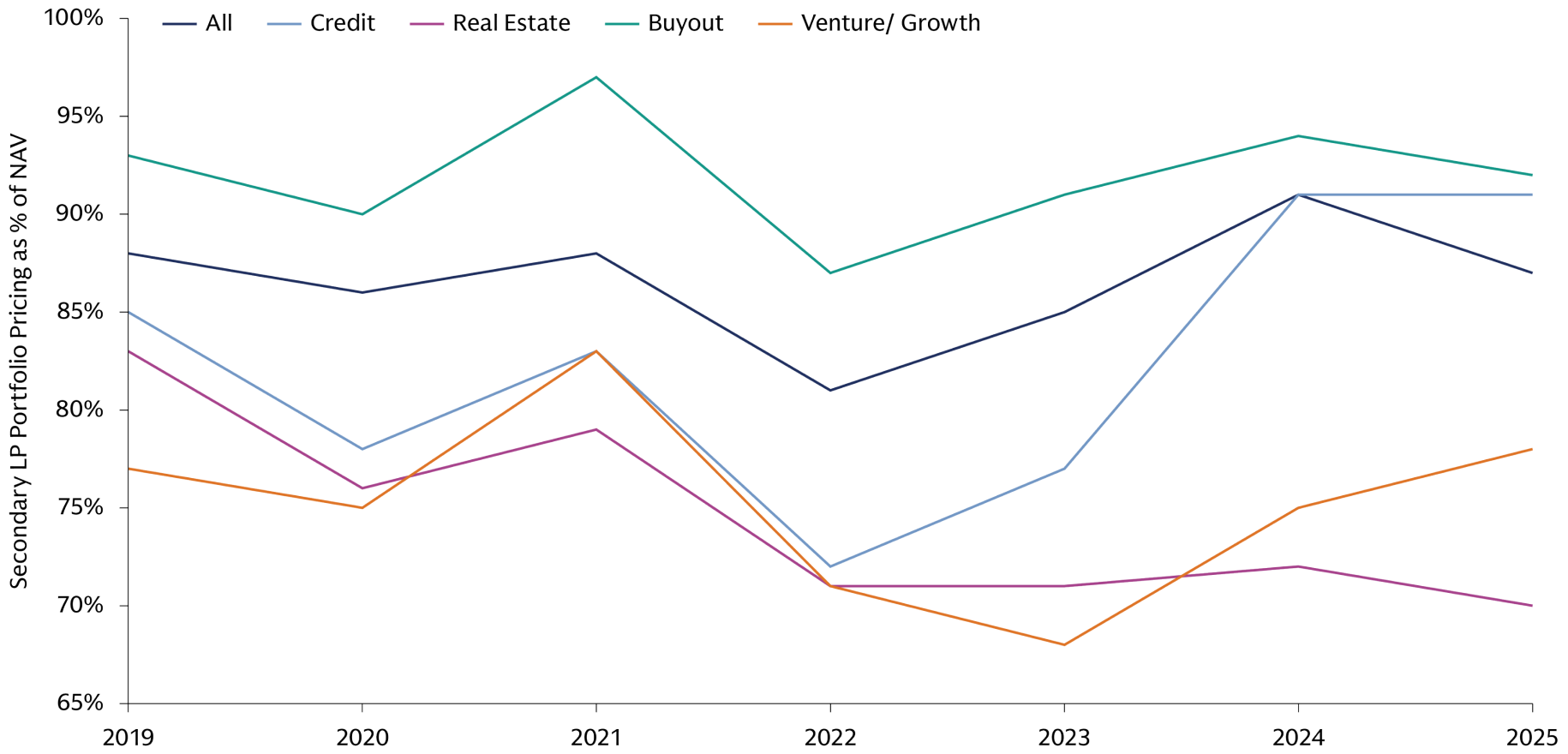
Secondaries may give investors the opportunity to buy at a discount. Investors enter the secondary market because they want liquidity. To get it, they will often sell their stakes in a portfolio at a discount to the total net value of all the assets in the fund, known as net asset value (NAV).
That discount benefits secondary buyers. If the underlying assets in the fund perform as expected, they are paying less than the initial investor in the fund for the same future returns.
Secondary market pricing as % of net asset value (NAV)
Source: Jefferies, “Global Secondary Market Review,” as of January 30, 2026, data on global secondary activity.
Secondaries can get investors a faster return of capital. Secondary investors are typically purchasing stakes later on in the life of the fund, so they may begin receiving distributions sooner. They also usually experience less of the J-curve – the initial dip early on in a private market fund's life when capital is being invested but little has yet been returned to investors.
J-curve in secondaries vs. buyouts
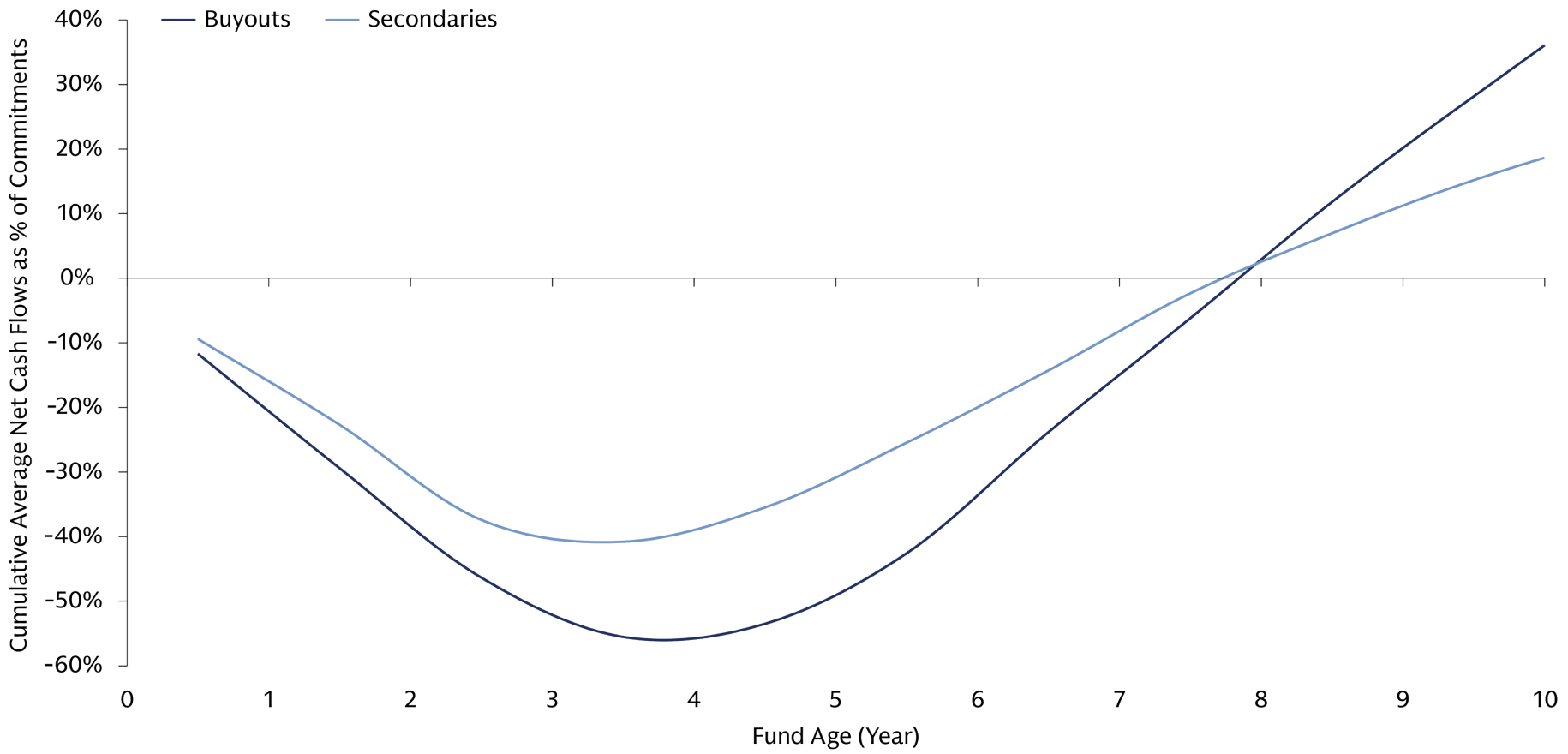
Source: Cambridge Associates, as of Q3 2025. Average across funds of vintages 2000-2019. The J-curve refers to the cumulative net cash flow seen by an investor, which for private equity investments is typically negative in the first several years after the initial commitment due to capital being drawn down for investments and generally becomes positive after capital is returned and the fund becomes net cash flow positive. Performance J-curve note: The performance J-curve refers to the negative performance typically seen by an investor in the early years after a primary commitment is made. This is because management fees and expenses often represent a relatively high percentage of the total capital called from investors in the first few years of a fund as investments must be identified, diligenced, and negotiated before capital is called and invested. This effect is mitigated as additional investments are made and commitments are more fully invested, and any gains from investments are reflected in net asset values.
Secondaries give investors greater visibility into underlying assets. Investors in a primary market drawdown fund commit capital before they know what assets the manager will invest in – what’s known as “blind pool risk.” Secondary investors are buying stakes in existing funds, so they have greater visibility into what assets they’re buying into and may be better able to diligence and value them.
In our view, that visibility is part of why secondary funds have had lower loss rates than primary funds; the number of funds below cost – or funds that fail to return the capital called from investors – is far lower in secondaries than it is in buyouts, growth, venture capital, and real estate. Plus, buying stakes in existing funds lets secondaries investors diversify across hundreds, even thousands, of underlying companies that span different industries, geographies, and vintage years – diversification that can also help mitigate risk and deliver strong returns.
Percentage of funds below cost: primary vs. secondary funds
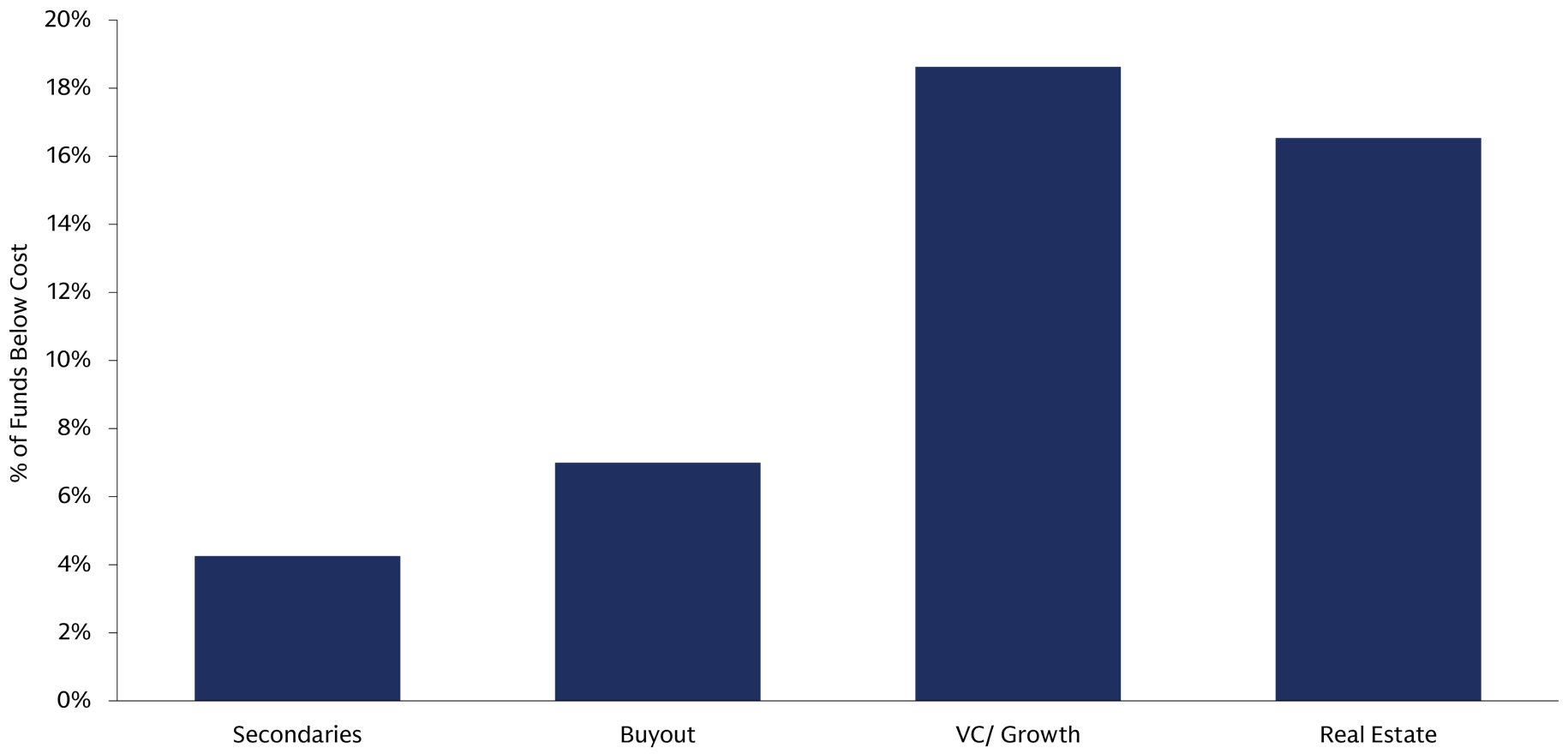
Source: Preqin. As of May 21, 2026. Includes funds in vintages 2000 to 2021 globally with latest performance reported on a track record of at least five years. Data on primary funds for each asset class excludes any underlying secondary funds. Past performance is not indicative of future results. The returns are gross and do not reflect the deduction of investment advisory fees, which will reduce returns.
What to Consider When Investing in Secondaries

Secondary funds bundle together stakes in multiple funds. That means the manager who selects all these funds must conduct diligence on all of the underlying assets in those market funds – a task that can amount to dozens, sometimes hundreds of assets. Consider whether your manager has the resourcing to execute the necessary diligence.

Secondaries can provide greater flexibility than many traditional private market investments, but they remain long-term investments and are far less liquid than most public market products. Evergreen funds typically offer periodic liquidity subject to certain restrictions, but there is a tradeoff that comes with this liquidity. These funds typically invest in some liquid assets – like cash or money market funds – so they can meet liquidity demands, but that means less capital gets invested in secondary transactions.
Closed-end funds can keep more capital invested, but investors generally only receive returns as underlying investments are sold. Consider whether a fund's liquidity profile aligns with your own needs and objectives.
Frequently Asked Questions