Biotech Bounceback: Private Equity and the Life Sciences Resurgence



Wichtige Erkenntnisse
Scientific Breakthroughs and an Attractive Investment Backdrop
The life sciences sector is experiencing a surge of innovation as the industry evolves from a focus of sickness management to a paradigm of proactive, predictive, and personalized health. This includes the maturation of advanced modalities and novel delivery mechanisms such as cell and gene therapy, antibody drug conjugates, and next-generation vaccine platforms. In neuroscience, we see the development of novel antidepressants and drugs to reduce anxiety. Oncology is reaching new levels through personalized cancer vaccines and targeted therapies. Advancements in immunology for a host of inflammatory conditions coupled with progress in treating rare diseases via personalized gene therapies, underscore a transformative era of life sciences innovation. This comes at a time of aging demographics. Globally, individuals over the age of 65 are set to double from 800 million to 1.6bn by 2050, with the US and Europe expected to see the largest increases.1 We believe this will drive higher healthcare spending and greater demand for new medicines as people seek to live better for longer.
Alongside continued scientific breakthroughs, there has been a reduction in political and regulatory uncertainty due to stabilizing commentary and actions taken by the US administration. Concerns over drug pricing eased following late 2025 Most Favored Nation (MFN) agreements between the US government and industry leaders including Pfizer, AstraZeneca, Merck, Eli Lilly, and Novo Nordisk, providing greater clarity around pricing and supporting commitments to expand US-based manufacturing and R&D. While the evolving Section 232 pharmaceutical tariff framework introduces new considerations for parts of the industry, it may also accelerate onshore investment, strengthen the competitiveness of the US biotechnology ecosystem, and reinforce demand for external innovation through partnerships, licensing activity, and M&A. Despite concerns regarding regulatory volatility and personnel turnover in 2025, FDA approval activity accelerated through the second half of 2025 and into 2026, signaling continued agency effectiveness and a more constructive operating environment.2 The sector’s recovery is evident in public markets, with the XBI up 86% over the past year, reaching 97% of the market's record high and substantially outperforming the broader healthcare sector. Fund flows have also turned positive following several years of weaker activity. In H1 2026, biotechnology equity funding reached $11.9bn across 88 deals, representing a 49% increase in total deployed capital compared with H1 2025. This backdrop of accelerating scientific breakthroughs, combined with a stabilizing regulatory environment, supports the life sciences sector and its continued growth trajectory in 2026 and beyond.
Big Pharma Pipeline Gaps Drive M&A and Exit Optionality for Private Equity
Some of the best-selling drugs in the world are facing a loss of exclusivity in the upcoming years in what the sector calls “the patent cliff.”3 This is driving a robust level of M&A activity in 2026, continuing a trend which started in fall of 2025. Activity has been concentrated in "bolt-on" deals under $15bn.4 GSK’s acquisition of Nuvalent (oncology treatments) and AbbVie’s acquisition of Apogee Therapeutics (immunological and inflammatory diseases) show that dealmaking activity is well positioned to continue in the back half of 2026 into 2027.5 Big Pharma’s drive to replenish pipelines through M&A presents a potentially more reliable exit path for investors in life sciences companies compared to relying solely on the IPO market.
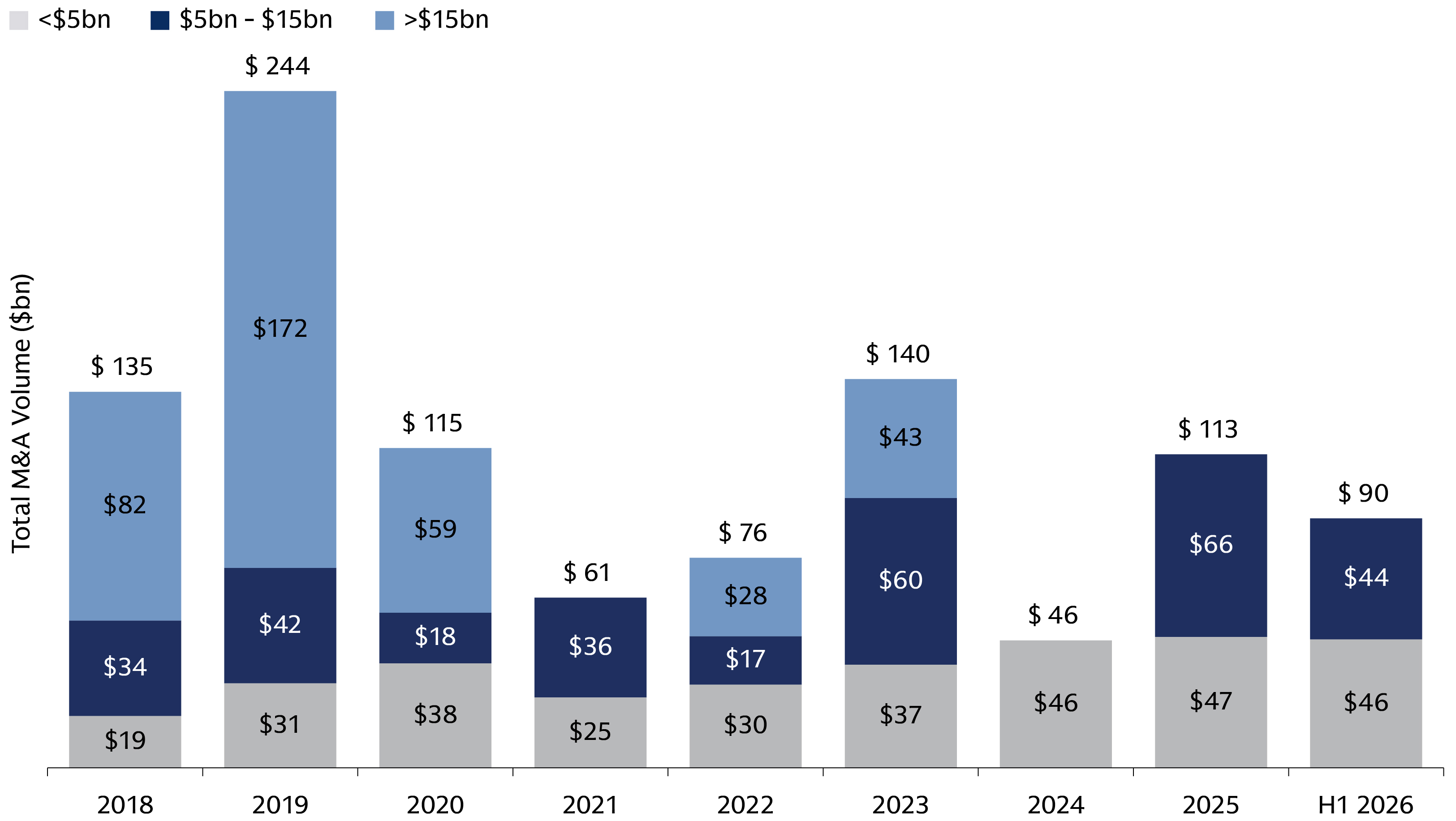
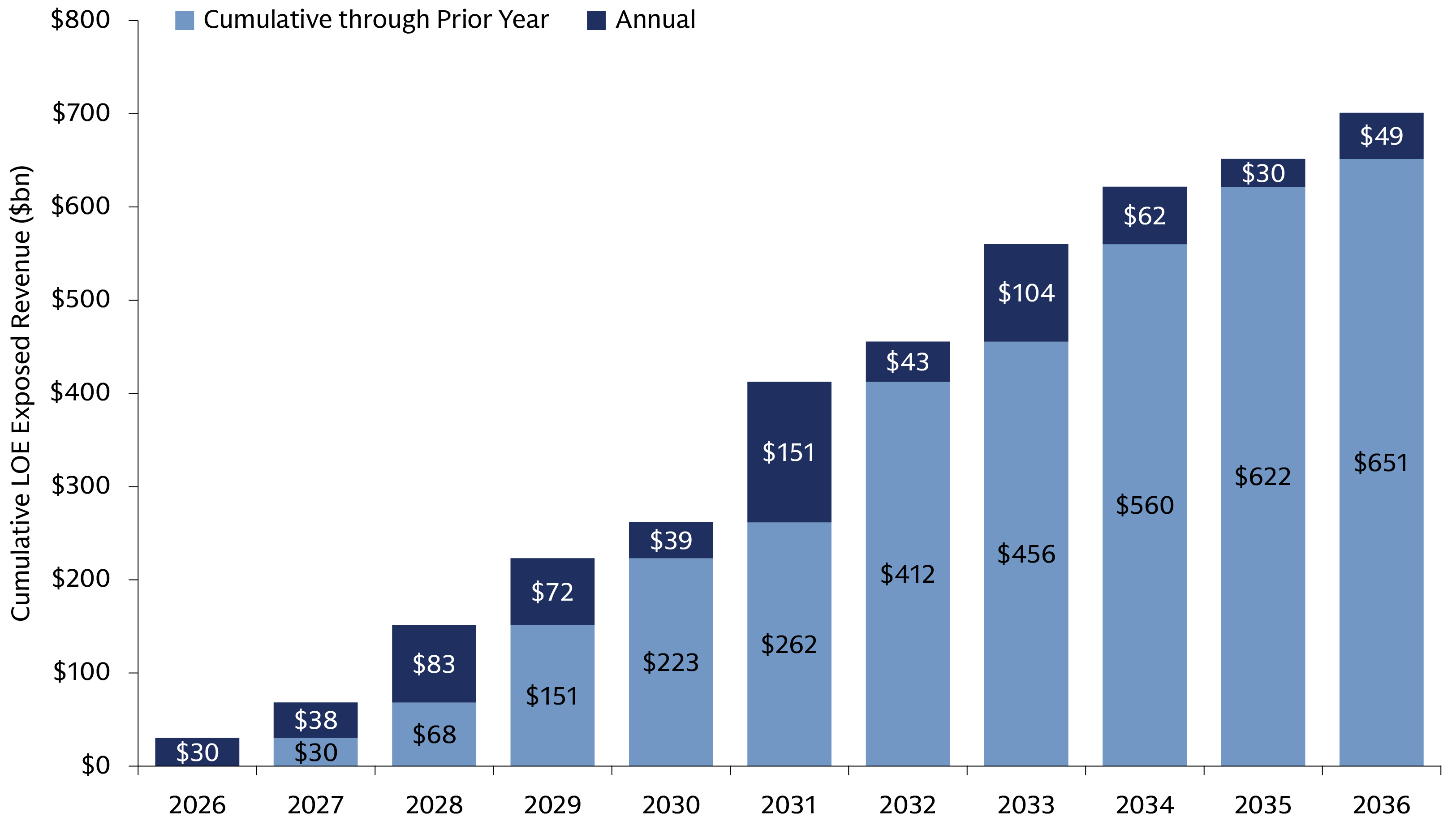
Source: LHS: Goldman Sachs Biotech Sector Team M&A Database, as of July 2026. Bolt-on is defined as deals under $15bn. RHS: Jefferies Biopharma LOE report, as of July 2026.
Private Equity, Value Creation Potential, and Diversification Appeal
Value creation in the pharmaceutical sector spans from industry giants to innovative smaller biotechs. Eli Lilly became the first pharma company to hit a $1tn market cap in November 2025, fueled by the massive success of its GLP-1 drugs for diabetes and obesity.6 Lilly leveraged this growth to fund strategic M&A, strengthening its pipeline. Conversely, smaller firms like Nuvalent Inc. drive value through breakthroughs; and in July 2026, GSK acquired Nuvalent for $10.6bn—at a 40% premium—to gain access to its lung cancer therapeutics to target tumors that acquired resistance mutations and have spread into the central nervous system.7
We believe we are in the early innings of the AI transformation of life sciences. We expect continued evolution in the way companies discover, develop, and deliver medicines to patients. For the foreseeable future, we expect earlier-stage biotech company valuations will remain grounded in tangible assets like intellectual property and preclinical/clinical trial data, with value inflection points tied to scientific/clinical milestones, regulatory approvals, and projected peak sales of drug candidates. Consequently, private equity life sciences investors will remain focused on achieving clinical milestones and reasonable valuations compared to managing the volatility of the public markets or untethered valuations of AI/technology industries.
In addition to high value creation potential, life sciences is also a defensive asset class that is generally uncorrelated with broader market performance. The drivers of life sciences innovation, utilization, and payment are not linked to economic or market cycles. Companies succeed based on the outcomes of scientific and clinical experiments. Utilization is a function of underlying disease incidence and prevalence, while reimbursement comes from third-party payors such as insurance companies and governments. We believe these idiosyncratic characteristics make life sciences an attractive sector for investment, offering investors significant growth potential, uncorrelated returns, and favorable industry dynamics.
New Era for Life Sciences
The life sciences sector has entered a transformative era, underpinned by powerful synergies of scientific innovation, regulatory clarity, and "patent cliffs" compelling Big Pharma to replenish pipelines. Beyond deal dynamics, the industry’s fundamental reliance on achieving clinical milestones—rather than macroeconomic cycles—provides a unique, uncorrelated risk-return profile. In our view, private equity investors with strong capabilities to source deals and drive value creation will be well positioned to succeed.
1. UN, Goldman Sachs Global Investment Research. As of November 2024.
2. DCAT Value Chain Insights. As of July 9, 2026.
3. CNBC. As of January 7, 2026.
4. Goldman Sachs Global Investment Research. As of April 8, 2026.
5. Gilead Sciences, J.P. Morgan, Q2 2026 Biopharma Licensing and Venture Report. As of July 2026.
6. Reuters. As of November 21, 2025.
7. Novartis, Reuters. As of February 7, 2026