Real Reasons to Consider Core Fixed Income


Key Takeaways
1. “Real" really matters
Bond yields have moved meaningfully higher, but the more important development may be what those yields represent after accounting for inflation. While inflation remains top of mind for many investors, real income, or inflation-adjusted income, has improved across major developed bond markets, strengthening the starting point for core fixed income.
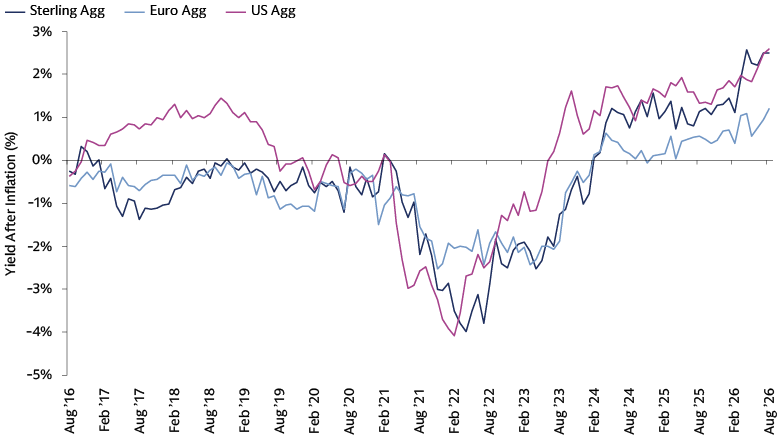
Source: Bloomberg. Real income calculated for each region as Index minus relevant Core CPI measure. As of July 31, 2026.
Because real yields influence valuations across fixed income, this improvement is not confined to a single sector or security type. The inflation-adjusted income available across core fixed income has risen meaningfully, strengthening the case for investors seeking high-quality income and diversification.
2. Let income do the work during volatility
But what about volatility? It is a fair question. We are closely watching several dynamics: the path of central bank policy remains uncertain and diverges across regions, fiscal pressures may push government bond yields higher across markets, and a re-acceleration in inflation from tariffs or supply shocks cannot be ruled out. Investors should expect headline-driven moves to remain a feature of bond markets. Our latest outlook reflects this nuance: we favor a pro-income stance while cautioning against strong outright views on duration.
The reason is fundamental: at today's yield levels, a core bond portfolio may not need rates to fall to seek attractive returns. Income can do the heavy lifting. Investors focused on recent price swings may be overlooking how much the starting point has shifted in their favor.
The Bloomberg Global Aggregate Index illustrates the broader point. Following the rise in yields over the last several years, income has become a more meaningful contributor of fixed income returns, reducing investors' reliance on falling rates to generate positive total returns.
For investors considering where to put money to work, the opportunity today extends beyond passively owning an index. We believe higher starting yields have improved the case for core fixed income, while creating meaningful differences in value across sectors. How investors allocate within core bonds may matter just as much as the decision to own them.
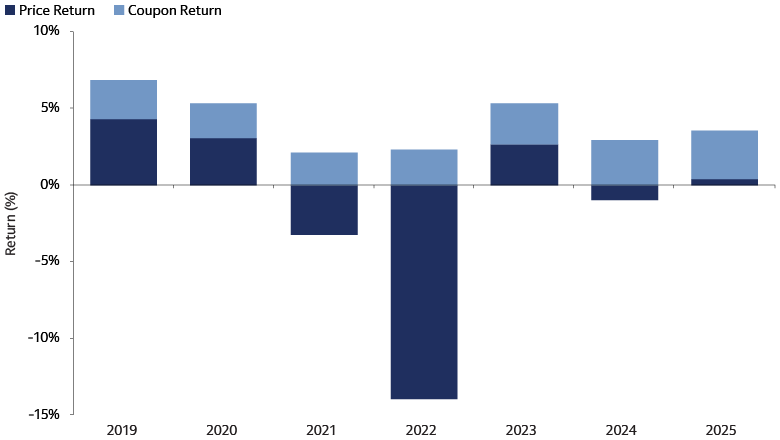
Source: Bloomberg PREP. Calendar year data through December 31, 2025. For illustrative purposes only.
3. Finding opportunity within core fixed income
Our approach to core fixed income is active, seeking excess returns through rigorous relative value analysis across high-quality fixed income to identify attractive carry opportunities while maintaining diversification across the investment-grade universe. In our view, several themes are shaping our positioning:
- Build for carry within the core
We see opportunities in areas where investors are being paid more for a similar level of credit risk. Today, the securitized credit portion of the opportunity set stands out on a relative value basis within investment grade, offering spread pickup over comparably rated corporates while potentially benefiting from structural loss protection.
- Diversify within fixed income
Government, securitized assets, and corporate bonds each respond differently to macroeconomic conditions. Actively allocating across these building blocks may provide more balanced sources of income and diversification than static index weights. Today, we are cautious about outright government duration, preferring the additional carry available in selected corporate and securitized assets where we believe investors are better compensated for risk.
- Stay selective
Index-level spreads are tight, but dispersion within credit is elevated, rewarding managers who distinguish between issuers, not just sectors.
- Use active flexibility
Static allocations are poorly suited to a volatile market environment. We believe active management allows portfolios to adjust exposure and capitalize on dislocations as opportunities emerge.
We are ready to help you evaluate today’s fixed income opportunities and the role core fixed income can play in portfolios.