Elections, Policy, and Portfolio Implications




观点概览
In an election cycle, the investment question is not who wins, but what a win may change.
Why the 2026–27 Election Cycle Matters
National elections are a routine feature of the investment backdrop; some cycles demand more attention than others. We believe the next 15 months bring another concentration of elections. Market relevance, in our view, is uneven:
US Midterms
A Fiscal-Optionality Event: US midterms fall on November 3, 2026. Market attention is on fiscal policy, as trade, foreign policy, and immigration are now primarily executive-driven. In our view, a divided government implies limited fiscal change. In contrast, maintained unified Republican control is the less anticipated scenario, potentially introducing a wider range of fiscal and interest rate outcomes.
European Elections
A Divergence Story with France in Focus: Europe faces a crowded electoral timeline, including Spain’s November 2026 snap polls and 2027 general elections in France, Italy, and Greece. We believe the key market risk is not the election of a specific party, but the potential for fractured parliaments unable to execute critical fiscal consolidation. As governments navigate elevated debt-servicing burdens, any deviation from credible consolidation paths may lead to volatility across the euro, sovereign and corporate bonds—including bank debt—and domestic equities.
Emerging Markets
Discipline and Dispersion: Emerging markets including Nigeria, Argentina and Poland are among the countries to go to the polls over the coming year. The central investment focus is on whether incoming administrations adopt or sustain the orthodox economic frameworks currently taking hold across EM economies.
Our full publication details each of these regions and the potential investment implications we may see.
High-Impact Policy Channels
Elections reach markets through two effects on different timelines.
The short-term effect is event risk: uncertainty rises into the vote, market volatility can increase, and some capex, hiring and M&A activity is deferred. This drag typically fades once the result is known, allowing risk premia across assets to compress and paused activity to resume.
The lasting effect is the post-election policy regime, which shapes growth, inflation, corporate profits, fiscal credibility, and sector leadership.
We are focused on four main channels and provide a deeper dive in the full publication download.
1. Fiscal policy: The channel bond markets price
2. Regulation and industrial policy: A stock-selection and sector-rotation channel
3. Immigration: A supply-side variable
4. Trade, technology, energy, and geopolitics largely sit above the election cycle
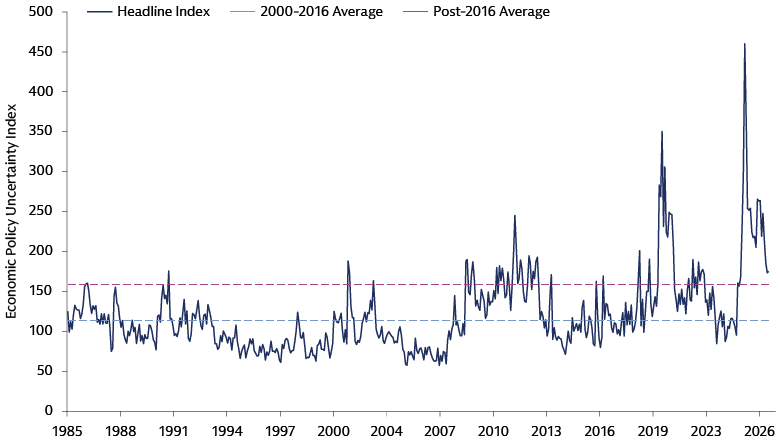
Source: Macrobond, Goldman Sachs Asset Management, Economic Policy Uncertainty. As of September 2026.
Beyond the above key policy levers, it is also worth monitoring new channels through which elections matter. This includes central bank independence, which has most recently been questioned in the US and Japan. So far, independence appears intact: the Fed has pivoted to hiking, and the BoJ has adopted a swifter pace of tightening despite political pressure for easing. Market-based inflation expectations remain contained, suggesting this risk is not affecting markets, though it could re-emerge.
The Investment Playbook: Build for Resilience, Not an Election
Most secular investment themes—AI infrastructure, defense, energy security, and supply-chain resilience—are relatively agnostic to election outcomes. Navigating elections therefore means leaning into what is strategically entrenched while hedging what is genuinely election-dependent.
In our view, investors should map exposures to the key policy levers—fiscal policy, regulation, competitiveness, and geopolitical risk—to surface unintended concentrations. Investors should understand which holdings are owned because of secular growth drivers and which are effectively tied to a political outcome.
Our asset-class views below are guided by two principles: building resilience before a vote and retaining flexibility to act after the result.

Position for divergence: We expect wide fiscal deficits and heavy government borrowing to keep pushing long-end yields higher, independent of the election calendar. We favor expressing diverging fiscal paths through relative-value and curve-rate exposures rather than directional duration bets tied to a result. Staying dynamic matters: Greece and Portugal demonstrate that fiscal credibility can be rebuilt, while countries facing persistent political fragmentation or renewed fiscal expansion may continue to experience higher risk premia. We would also watch for potential spillovers from sovereign-bond to credit markets. Select EM debt, in our view, can add income and diversification where election results reinforce credible policy frameworks.

Fast to respond, often overpriced: Currencies are often the first markets to respond when political developments alter expectations for growth, inflation or fiscal sustainability. Recent examples include the yen's response to Japan's reflationary shift, the zloty's appreciation following Poland's pro-European pivot and the euro's sensitivity to concerns around French fiscal credibility. As bond markets focus on debt sustainability, currencies may become the fastest and most liquid mechanism through which political credibility is expressed. In our view, this favors diversified currency exposures and disciplined currency options positions rather than concentrated directional bets on individual election outcomes.

Own structural beneficiaries; be selective within sectors: Election effects typically influence sectors more than broad equity indices, making security selection increasingly important. We stay mindful of country-specific risk and favor businesses benefiting from structural investment programs supported by geopolitical priorities, national security objectives, and economic competitiveness initiatives. For example, across many developed economies, defense spending commitments have become increasingly bipartisan and strategically embedded, making the sector less election-sensitive than investors often assume. We separate companies that depend on subsidies or tax credits from those that stand on their own earnings. We remain more cautious on business models whose earnings depend heavily on subsidies, tax credits, or policy support that may be delayed, narrowed, or reversed following an election. Overall, we believe policy uncertainty emphasizes the case for diversification across regions, sectors, and styles.
Bottom Line
The 2026–27 cycle matters, but in our view the question is not who wins. It is which policy channels are genuinely election-dependent, which are structurally embedded, and where outcomes could move fiscal credibility, sector leadership, or geopolitical risk premia. We see this as pointing to a two-part conclusion. First, build resilience before the vote: own what is strategically entrenched, hedge what is genuinely election-dependent, and avoid concentrated bets on any single result. Second, stay nimble to act after the vote, once uncertainty falls and the policy picture becomes clear.
In a world of rising political fragmentation and structurally higher policy uncertainty, the objective should not be to build portfolios for a particular electoral outcome. It should be to build portfolios that can withstand a range of outcomes while retaining the flexibility to exploit opportunities once uncertainty has been resolved.