Introduction to Secondaries

What are secondaries?
Secondary investors buy existing ownership stakes in private market assets from other investors. Assets transacted can range from a single company in a transaction alongside the General Partner, to an entire portfolio of funds in a transaction sold by a Limited Partner who owns stakes in the funds.
Secondaries activity has steadily risen over the past decade as the strategy is increasingly embraced by leading institutional LPs and GPs and recognized as an effective portfolio management tool for investors who are overallocated to private markets or wish to consolidate their manager relationships. As the market has expanded, it has become diversified across underlying strategies, from buyouts and venture capital to real estate, infrastructure, and private credit. As the range of transaction structures has expanded, secondary firms have evolved to become providers not just of liquidity but of bespoke capital solutions to GPs and LPs.
Potential Reasons to Invest
1. Opportunity to acquire assets at a discount
Secondaries investors provide liquidity to primary investors in illiquid assets. This liquidity has value for the sellers; accordingly, secondary assets typically transact at a discount to their net asset values. Purchasing partnership interests at a discount can be a source of returns beyond the value creation made in the underlying asset. The discount varies over time based on the quality of the underlying portfolio and market conditions and may be especially wide in times of market stress. The ability to create value by executing a complex transaction can also enhance return in this strategy.
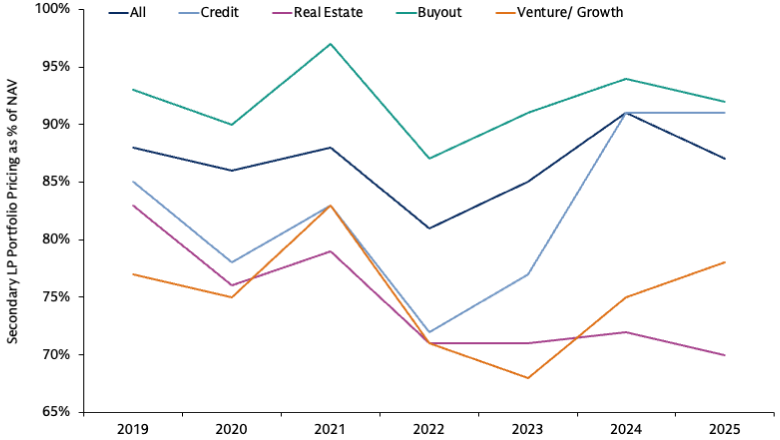
Source: Jefferies, “Global Secondary Market Review”, as of January 30, 2026, data on global secondary activity.
2. Accelerated, diversified exposure
Since secondary funds buy interests in existing funds, they offer investors private assets exposure diversified by vintage year, strategy, industry, fund manager and geography, among other factors. By providing investors with exposure to more mature private asset portfolios, secondaries funds are typically able to return capital more quickly than a typical drawdown private equity investment fund. Secondary funds also provide exposure to prior vintage years—a benefit that is especially valuable to newer private markets programs or those in ramp-up mode. Evergreen private markets funds likewise offer accelerated, diversified exposure; however, unlike evergreen funds, secondary funds do so without a liquidity sleeve that acts as a drag on returns.
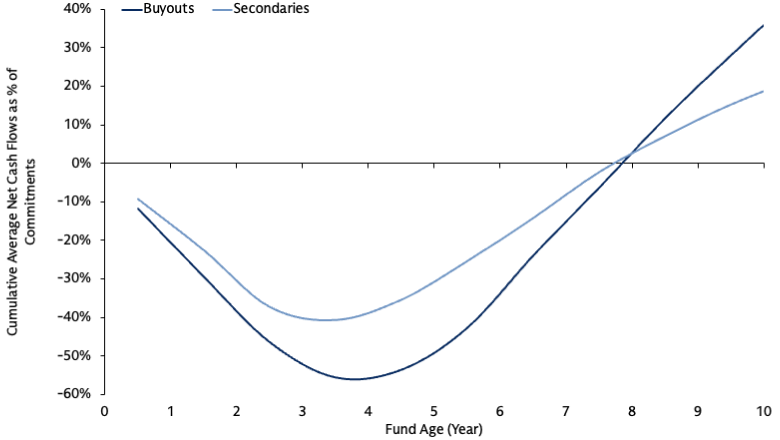
Source: Cambridge Associates, as of Q3 2025. Average across funds of vintages 2000-2019. The J-curve refers to the cumulative net cash flow seen by an investor, which for private equity investments is typically negative in the first several years after the initial commitment due to capital being drawn down for investments and generally becomes positive after capital is returned and the fund becomes net cash flow positive. Performance J-curve note: The performance J-curve refers to the negative performance typically seen by an investor in the early years after a primary commitment is made. This is because management fees and expenses often represent a relatively high percentage of the total capital called from investors in the first few years of a fund as investments must be identified, diligenced, and negotiated before capital is called and invested. This effect is mitigated as additional investments are made and commitments are more fully invested, and any gains from investments are reflected in net asset values.
3. Risk mitigation
Because secondary funds invest in existing privately-owned assets, they can potentially mitigate some of the risk of primary funds, in which investors commit to new partnerships that have not yet started investing at the time of commitment. Secondaries can mitigate “blind pool risk”—the risk that comes from not knowing which assets will ultimately be in the portfolio. As part of the process of diligence and transaction negotiation, the secondaries manager evaluates and values underlying assets. This gives the manager an opportunity to reprice assets for both investment-specific considerations and the overall macro/market environment, to target an attractive potential rate of return. Pricing can also consider the health of the underlying fund’s investment organization, evaluating how organizational factors may impact investment outcomes in the future.
Historically, secondary funds have enjoyed lower loss ratios than primary funds across a variety of strategies.

Source: Preqin. As of May 21, 2026. Includes funds in vintages 2000 to 2021 globally with latest performance reported on a track record of at least 5 years. Data on primary funds for each asset class excludes any underlying Secondary funds. Past performance is not indicative of future results. The returns are gross and do not reflect the deduction of investment advisory fees, which will reduce returns.