Disruptive Technology

Learnings from Earnings


23 March 2026 | 15 minute read
learnings-from-earnings_4Q25_16-9_1360x765.png
Disruptive Technology

Learnings from Earnings

23 March 2026 | 15 minute read
learnings-from-earnings_4Q25_21-9_1840x788.png
Disruptive Technology

Learnings from Earnings

23 March 2026 | 15 minute read
learnings-from-earnings_4Q25_3-1_2480x827.png
Author(s)
Avatar
Alexis Deladerriere
Co-CIO of Fundamental Equity and Head of International Developed Markets Equity
Avatar
Başak Yavuz
Co-CIO of Fundamental Equity and Head of Emerging Markets Equity
Avatar
Nathan Lin
Co-Head of China Equity, Co-Lead Portfolio Manager for China Equity Strategies
Avatar
Christine Pu
Co-Head of China Equity, Co-Lead Portfolio Manager for China Equity Strategies
We highlight key learnings from the 4Q 2025 earnings season including robust mega-cap earnings, expectations for significant artificial intelligence capital expenditure, deliberate choices by consumers, and divergence across regions.
Key Takeaways
1
S&P 500 Resilience and AI Spending Surge
Earnings growth was primarily driven by the Magnificent 7, which outperformed the rest of the index, and a massive projected surge in 2026 hyperscaler capital expenditure.
2
Consumers Move to Optimize
Consumers across all income brackets are remaining resilient but have become highly deliberate, strategically stretching their paychecks by prioritizing essential needs over big discretionary buys.
3
Divergence Across Global Markets
Earnings growth in Europe is muted but the financial sector continues to provide support. Corporate profits are improving in Japan. Emerging markets, particularly in Asia, remain a bright spot.

Earnings Season Recap

The US 4Q 2025 earnings season has concluded on a strong note, with S&P 500 year-on-year earnings growth of over 14%.1 This performance significantly exceeded the projected 8.3%, marking the fifth consecutive quarter of double-digit earnings growth. Just under three quarters of companies surpassed expectations for both earnings per share (EPS) and revenues, demonstrating the breadth of corporate strength. Notably, the "Magnificent 7" reported earnings growth of 27.2%, substantially outperforming the 9.8% growth delivered by the remaining 493 S&P 500 companies.2

Sector performance was led by information technology, communication services, and healthcare, all of which achieved double-digit revenue growth and significant EPS upside. Financial sector results were bolstered by healthy loan growth, resilient net interest income, stable credit quality, and a resurgence in capital markets activity, alongside disciplined expense management. Several major financial institutions signaled the start of a major cycle in capital markets, fueled by a significant buildup in deal pipelines and improving macroeconomic conditions. Conversely, industrials and consumer discretionary sectors lagged, with earnings growth trailing the index average. Despite this dispersion, 10 out of 11 sectors reported earnings that exceeded initial forecasts.3

Key themes like AI and the "K-shaped" consumer intensified during the quarter. During earnings releases in the first two months of 2026, hyperscalers announced unprecedented levels of planned AI capex, which met with investor skepticism and caused market volatility. The consumer narrative evolved toward a more universal picture of a resilient but highly deliberate spender across income cohorts, prioritizing value while deferring discretionary purchases. The industrials sector signaled a general "status quo", navigating flat economic conditions while finding pockets of secular growth, primarily tied to the all-encompassing AI buildout.

The AI Investment Wave Reaches New Heights

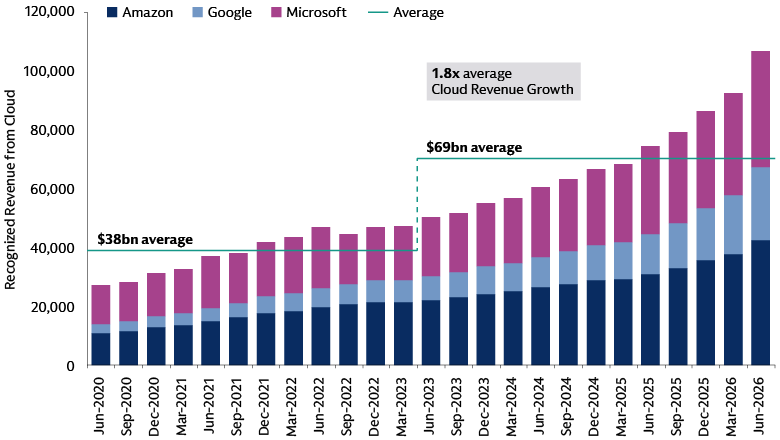
Going into the earnings season, consensus expected hyperscaler capex to grow by just under 40% in 2026; updated guidance revealed that growth is now projected to surge by an astounding 70%. This comes after two years of already aggressive spending, pushing total hyperscaler capex to a projected $737 billion this year, a nearly fivefold increase from $160 billion in 2023. The new commitments have reinvigorated investor debate about the sustainability of (and returns on) these investments.

Hyperscaler spending continues while investors express concern: Amazon announced projected capex of approximately $200 billion for 2026, a significant jump from $142 billion in 2025.4 The market took it negatively - the announcement overshadowed a solid quarter and a robust AWS backlog, triggering an 11-12% post-earnings stock sell-off as investors questioned the timing of returns on such a massive outlay. Similarly, META announced plans to invest about $125 billion in capital projects for its AI systems,5 and Microsoft’s capex grew 58% year-over-year as demand for its Azure cloud services continues to outstrip supply.6 Even Nvidia, which delivered another exceptionally strong quarter,7 saw its stock face pressure from fears around the long-term sustainability of the capex cycle.

The "picks and shovels" boom intensifies: The surge in demand for AI infrastructure components accelerated further. The memory sector became a focal point, with Korean manufacturers like SK Hynix and Samsung reporting exceptionally strong earnings.8 A significant supply-demand imbalance of memory chips is now expected to persist into 2027, leading to the unprecedented emergence of multi-year, long-term agreements that signal growing pricing power for manufacturers. This boom was also evident across the hardware ecosystem. Amphenol’s IT & Datacom segment grew an incredible 110% year-over-year organically.9 Data storage providers Western Digital and Seagate posted robust results,10 locking in customers with long-term agreements. Underscoring the entire trend, TSMC, the go-to supplier for AI logic chips, sharply raised its capex plans and long-term revenue growth targets, citing AI as a core secular driver.11

AI investment broadens: Tesla announced it is dramatically increasing its capex to over $20 billion to support its strategic pivot to becoming a “physical AI” company, investing in compute, robotics, and its robotaxi business.12 Nvidia also highlighted this broadening, with data center revenue from Sovereigns more than tripling and its “physical AI” segment already contributing significantly to revenues. Furthermore, data center demand has become a unifying bright spot across the broader economy. In building products, Trane Technologies reported “over 100% growth” in data center-related orders for two consecutive quarters.13 In a soft chemicals sector, companies like Ecolab and Linde noted that exuberant investment in data centers was a key growth driver.14 Even auto suppliers like BWA are diversifying, rallying on news of new turbine offerings for data centers.15

Hyperscaler AI capex reaches new heights Hyperscaler AI capex reaches new heights

Source: Company announcements during Q4 2025 earnings reporting season. As of February 27, 2026.

The Consumer Narrative: From K-Shaped to Universally Deliberate

While the previous quarter solidified the narrative of a "K-shaped" economy, 4Q painted a picture of a US consumer who, across all income levels, is not breaking but actively optimizing. The theme of a "resilient but deliberate" consumer was a constant in management commentary. Households are stretching their paychecks by prioritizing value, promotions, and essentials over impulse or big-ticket discretionary purchases.

  • Value and essentials reign supreme: The trend of consumers gravitating toward value, which benefited off-price retailers in 3Q, has now broadened. Even higher-income shoppers are exhibiting value-seeking behaviors, leaning into private label brands and discount formats offered by retailers like Walmart and Costco. Food retailers with clear value propositions saw strong performance, with Walmart noting that consumers responded positively to lower pricing and Sprouts emphasizing price reinvestment to address affordability challenges.16 Off-price retailer TJX continued to be a clear standout, benefiting from this broadening of value-seeking behavior.
  • Big-ticket discretionary remains the pressure point: The primary area of consumer weakness remains in larger, deferrable purchases. A challenging housing market, with turnover at multi-decade lows and high mortgage rates, has led consumers to delay significant projects. Retailers such as Home Depot and Lowe’s cited softness in categories like appliances, furniture, and large-scale remodels, forecasting a flat home improvement market through 2026.17 While they believe demand is stabilizing, it is not yet accelerating. This pressure was also seen in durable goods, with commentary from Eastman Chemical highlighting that an estimated 80% of consumers are facing affordability challenges.18
  • Emerging factors: tariffs and Agentic AI commerce: Two factors became more prominent this quarter. First, the impact of tariffs began to manifest more visibly in pricing. Amazon’s CEO confirmed that tariffs are starting to push up product prices, with sellers increasingly passing costs to customers.19 Second, "agentic commerce" (AI-enabled shopping) started moving from a narrative to tangible results. Walmart is seeing early success with its OpenAI-enabled 'Sparky' assistant, which is driving average order values 30% higher than for non-users, signaling a tangible shift toward more personalized, intent-based commerce.20

The Broader Economy: Green Shoots and Pockets of Strength

  • Signs of cyclical recovery and manufacturing inflection: The US industrial sector is showing early signs of emerging from a multi-year "malaise," supported by a surprise positive inflection in ISM (Institute for Supply Management) data. This shift has triggered an investor rotation into previously lagging areas like chemicals, where some companies saw significant stock outperformance despite soft underlying financials. In the semiconductor space, analog players like Texas Instruments and Microchip Technology indicated that inventory digestion was largely complete, with the former guiding for a rare sequential revenue increase in Q1 2026 - a milestone not seen in 16 years.21
  • Bifurcated sector performance and secular tailwinds: Performance across the sector remains a "tale of two cities" depending on end-market exposure. Companies tied to residential housing continue to face headwinds from high mortgage rates and low turnover. In contrast, businesses with secular tailwinds like Trane Technologies are seeing exceptional growth in commercial HVAC, with order growth exceeding 50% driven by data center and AI infrastructure demand. Similarly, automotive suppliers like Aptiv are pivoting toward non-auto opportunities, such as data center power solutions, to drive future growth.
  • Management sentiment and macro outlook: Despite pockets of strength, most US management teams remain "cautiously optimistic" and are guiding to flattish economic conditions for the year until demand stabilization becomes more consistent. Companies are navigating cost pressures from rising raw materials (e.g., copper) and high memory costs (DRAM) driven by the AI super-cycle, though most expect to pass these costs through to customers. While tariffs remain a concern for margins, they are currently viewed as a manageable execution discipline rather than a shock to demand, with manufacturers utilizing diversified sourcing and selective pricing to mitigate impacts.

International Earnings Observations

While outside the US the earnings season has not yet fully concluded, most companies in the regions below have reported, and we would like to share the following observations:

  • Bright spots in Europe amid dispersion: Earnings growth remains muted, with overall profits hovering around zero. Financials are doing most of the heavy lifting while many other sectors lag. Dispersion has been very high, with earnings misses punished sharply and limited upside reward for companies that beat expectations. But selective bright spots persist, notably in data‑center, electrification, and automation exposure, while consumer, energy, and housing‑linked areas remain cautious.
  • Resilience in Emerging Markets but selectivity required: Earnings expectations are holding up very well (at 25%), supported by resilient macro fundamentals. Country and regional dispersion dominates, reinforcing the importance of selective exposure rather than broad EM beta. Earnings commentary in India has been increasingly positive, aligning with recovering GDP growth. Mid‑cap momentum is improving, and we see positive earnings revisions emerging beneath the surface. In the IT services sector, companies are seeing marginal acceleration, although not yet a material rebound, with AI currently acting more as a tool for productivity-led savings rather than a primary driver of business growth.
  • AI tailwinds and tariff headwinds in Asia: Profit growth is improving in Japan, led by non‑manufacturing sectors, with banks benefiting from higher rates and margins. AI and data‑center investment is a clear tailwind, supporting earnings momentum across electrical machinery and related supply chains. Tariff exposure remains a key headwind, creating divergence across autos, industrials, and healthcare equipment. In China, we see supportive earnings backdrop and structural growth drivers as we head further into 2026, with innovation occurring across sectors.

Spotlight on China’s Equity Landscape

The narrative surrounding Chinese equities has shifted from a recovery in sentiment to a focus on fundamental, earnings-led growth. As part of our 4Q 2025 Learnings from Earnings, we sat down with Co-Heads of China Equity, Co-Lead Portfolio Managers for China Equity Strategies, Christine Pu and Nathan Lin to discuss the structural drivers propelling the market forward, from the global scaling of AI and humanoid robots, to China’s elevating global standing in healthcare and a "going global" phenomenon of Chinese consumer brands. They also highlight how technological self-sufficiency and demonstrated innovation are creating a fertile environment for alpha generation.

1. China equity market delivered strong returns in 2025 has maintained momentum into 2026. What factors drove this performance, and what is the outlook for the remainder of the year?

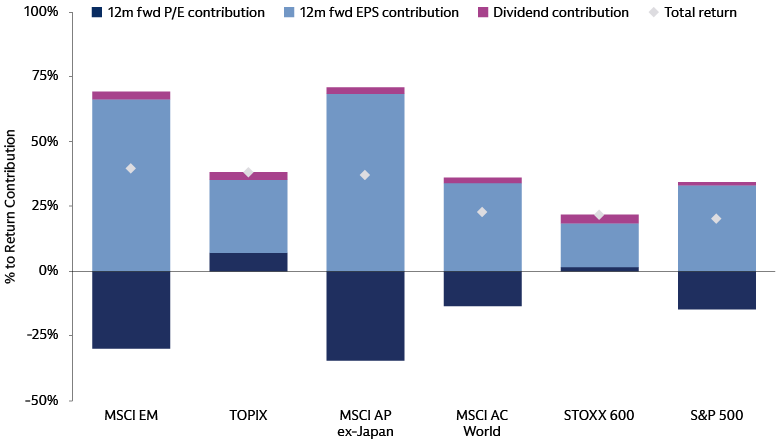
China’s equity market was indeed a standout performer in 2025, delivering stronger returns than most developed markets. This strength was driven by a recovery in investor confidence and breakthroughs in AI and high-end manufacturing. Targeted policy support and supply chain advantages bolstered resilience against external pressures, such as tariffs. Investors recognized China's ability to innovate and adapt, as well as improved earnings visibility of its corporate universe. Looking forward, we expect market upside to become increasingly earnings-led rather than valuation-driven, reflecting improving fundamentals rather than multiple expansion. In our view, earnings growth is likely to be concentrated in “new economy” sectors benefiting from innovation, while more traditional sectors appear to be approaching cyclical troughs.

Estimates project mid-teen earnings growth for 2026–2027 across both onshore and offshore China indices.22 This growth is increasingly supported by international expansion, which diversifies revenue streams and stabilizes corporate profits against domestic volatility. Industry consolidation and a reduction in destructive price competition driven by policy efforts are enhancing pricing discipline. As a result, losses in previously dilutive segments are narrowing and returns on equity (ROE) are stabilizing. In our view, a shift toward higher-quality fundamentals and differentiated performance creates a favorable environment for active alpha generation via active management.

Looking forward, we expect market upside to become increasingly earnings-led rather than valuation-driven.
Avatar
Christine Pu
Co-Head of China Equity, Co-Lead Portfolio Manager for China Equity Strategies

2. What will be the central investment story for China this year?

Technological innovation is central to China’s 2026 outlook, with market focus shifting toward targeted segments with clear monetization paths. China has now become the world’s second-largest R&D spender, allocating approximately 2.8% of its GDP to research,23 positioning it as a global leader in patent applications,24 and annual STEM graduates.25 Momentum is robust in semiconductors and AI hardware, sectors vital for technological self-sufficiency and high-end manufacturing. While local GPUs do not yet match the world's most advanced training chips, the gap is narrowing in AI inference and large-scale distributed workloads.

The humanoid robotics industry is also evolving rapidly. Localization of components like motors and control systems, supported by New Energy Vehicle (NEV) supply chains and policy, is accelerating this development. Near-term opportunities lie primarily with upstream component suppliers. The 2026 CCTV Spring Festival Gala showcased this progress, featuring private-sector humanoid robots with sophisticated movement and control, highlighting China's narrowing hardware and whole-body control gap.

3. How has China’s AI ecosystem evolved, and what factors are accelerating its adoption?

China’s AI ecosystem reached an inflection point in early 2025 with the launch of DeepSeek’s R1 reasoning model, marking a shift toward globally competitive, commercially viable Large Language Models (LLMs). Several Chinese models now rank among the top tier in reasoning and coding by prioritizing architectural efficiency over compute intensity, gaining global traction through low pricing and permissive licensing. We expect the AI application layer to develop faster in China than elsewhere, driven by a large, digitally native population and deep commercial activity within internet platforms. By integrating AI into commerce, logistics, and enterprise services, Chinese giants are leveraging low inference costs to unlock new revenue streams, optimize costs, and reinforce their competitive market positions.

We expect the AI application layer to develop faster in China than elsewhere, driven by a large, digitally native population and deep commercial activity within internet platforms.
Avatar
Nathan Lin
Co-Head of China Equity, Co-Lead Portfolio Manager for China Equity Strategies

4. How is China's energy infrastructure serving as a strategic enabler for its AI development?

China’s extensive, low-cost power infrastructure has emerged as a strategic enabler for scaling AI development. In 2025, the nation’s power generation reached approximately 10 trillion kilowatt-hours, more than double that of the US, providing the high-density energy essential for AI training, inference, and cooling.26 To support this demand, China added over 500 gigawatts of new capacity in 2025 alone, with renewables like solar and wind now accounting for nearly half of total installed capacity.27 Furthermore, State Grid and China Southern Power Grid plan to invest roughly RMB 5 trillion over the next five years to modernize the grid for AI-driven industrial needs.28 Low electricity costs provide a structural differentiator, allowing Chinese firms to economically deploy larger clusters of less advanced chips, thereby sustaining AI scaling despite external hardware constraints.

5. How is China's healthcare and biotechnology sector evolving?

Chinese firms are transitioning from a historical focus on scale and cost efficiency, shedding their reputation for imitation. Instead, they are leveraging strengths in R&D, clinical trial execution, and international collaboration, elevating China’s global standing in pharmaceutical innovation. Today, China accounts for roughly one-third of global clinical trials, often conducted at faster rate and reduced cost vs developed markets. Many leading biotech firms are investing heavily in original research, launching novel therapies in oncology, cell and gene therapy, and rare diseases. The sector's acceleration is evident in the 1,250+ new drug candidates entering development last year, a volume nearing US levels, and a record $136 billion in out-licensing deals in 2025, more than double the 2024 figure. As biotech firms launch novel therapies in oncology and gene therapy, investor focus is shifting toward companies demonstrating strong innovation, disciplined execution, and financial resilience.

China Healthcare Figures in Focus
1/3
Global clinical trialsTake place in China, often at a faster pace than developed markets.
+1.2k
New drug candidatesEntered development in China over the past year.
$136b
Out-licensing dealsSigned by China drugmakers in 2025.

Source: Morgan Stanley Research, as of 2025.

6. What is the current state of domestic consumption in China and the global expansion of its brands?

China’s domestic consumption is stabilizing, with growth shifting toward service-oriented and digital sectors like travel and entertainment. A new generation of Chinese brands is successfully expanding globally, enhancing their earnings resilience. Notable examples include Pop Mart, which derived nearly 50% of its 2025 revenue from overseas, a rare example for a comic toy IP to break cultural walls and gain global appeal. Another example is Luckin Coffee, which surpassed Starbucks in terms of revenue in China and has now entered the US market. Additionally, the global success of action role-playing game Black Myth: Wukong, selling 20 million units in its first month, is one example of a broader trend of Chinese companies and intellectual property going global in an evolving consumption landscape.

FactSet Earnings Insight. As of February 27, 2026.
The company’s announcement during 4Q 2025 earnings reporting season.
The company’s earnings release. As of February 25, 2026.
The companies’ earnings releases. As of January 28, 2026, and January 29, 2026, respectively.
9 The company’s earnings release. As of January 28, 2026.
10 The companies’ earnings releases. As of January 28, 2026, and January 27, 2026, respectively.
11 The company’s earnings release. As of January 15, 2026.
12 The company’s earnings release. As of January 27, 2026.
13 The company’s earnings release. As of January 29, 2026.
14 The companies’ earnings releases. As of February 10, 2026, and February 5, 2026, respectively.
15 The company’s earnings release. As of February 11, 2026.
16 The companies’ earnings releases. As of February 19, 2026.
17 The companies’ earnings releases. As of February 24, 2026, and February 26, 2026, respectively.
18 The company’s earnings releases. As of January 28, 2026.
19 Amazon’s CEO Andy Jassy sharing his insights at the 2026 World Economic Forum in Davos week of January 19, 2026.
20 The company’s earnings releases. As of February 19, 2026.
21 The companies’ earnings releases. As of January 27, 2026, and February 5, 2026, respectively
22 I/B/E/S consensus estimates via Goldman Sachs Global Investment Research, As of March 7, 2025.
23 National Bureau of Statistics of China. As of 2025.
24 According to WIPO 2024–2025 data, China is the world leader in patent applications, with residents filing approximately 1.8 million patents in 2024, far exceeding the US and Japan.
25 Airswift. As of January 6, 2026.
26 S&P Global. As of January 19, 2026.
27 Bloomberg. As of January 27, 2026.
28 China Daily, State Grid Corporation of China.  As of January 22, 2026.

Author(s)
Avatar
Alexis Deladerriere
Co-CIO of Fundamental Equity and Head of International Developed Markets Equity
Avatar
Başak Yavuz
Co-CIO of Fundamental Equity and Head of Emerging Markets Equity
Avatar
Nathan Lin
Co-Head of China Equity, Co-Lead Portfolio Manager for China Equity Strategies
Avatar
Christine Pu
Co-Head of China Equity, Co-Lead Portfolio Manager for China Equity Strategies
Start the Conversation
Contact Goldman Sachs Asset Management for a detailed discussion of your needs.
card-poster