Fixed Income Separately Managed Accounts

- Comprehensive Fixed Income SMA Platform
- A Holistic Approach
- Proprietary Technology
- Dynamic Data-Driven Investing
- Experienced Team with SMA Focus
Comprehensive Fixed Income SMA Platform
Fixed Income Separately Managed Accounts (SMAs) may introduce more cash flow predictability and can typically be customized to meet individual needs and circumstances.
With a comprehensive solutions platform of core and satellite strategies along with a wide range of customizations, we combine disciplined risk management with a proprietary infrastructure of broad-based market access and coverage.
We have a relentless focus on alignment with client objectives and risk tolerances while being nimble enough to adapt to changing market conditions and client needs.
A Holistic Approach
We believe aligning client goals with portfolio risks produces better outcomes over market cycles. We also believe taking a holistic approach to fixed income SMA investing has the potential to produce enhanced yields and better risk-adjusted returns.
Portfolio analysis is not a point-in-time review. Ongoing surveillance and risk management is critical in order to provide clients with portfolios that meet their objectives over the long term.
Proprietary Technology
With a proprietary infrastructure that enables flexibility and speed, we can tailor optimized investment strategies that align with specific client needs, risk tolerance, credit duration, and financial goals.
Multi-factor portfolio optimization tools and automated modeling of trades are further reviewed by portfolio managers before implementation. Our technology enables us to make more informed decisions faster.
Dynamic Data-Driven Investing
Our investment process combines human elements with a data-driven portfolio management infrastructure, imposing disciplined risk management and client alignment.
Client goals and guidelines come first, with each portfolio set with unique parameters, preferences, and overlays set at inception.
With real time and dynamic liquidity data streaming into portfolio management tools, we determine optimal allocations that seek to maximize income for each client within a given risk budget. We layer on fundamental credit views, relative value analysis, and implementation based on market conditions.
Ongoing portfolio and risk management, thought leadership, and client engagement allow for deep understanding and agile support of client needs.
Experienced Team with SMA Focus
With decades of experience and a dedicated SMA focus, we believe our tenured team is a key differentiator in the industry. Goldman Sachs Asset Management has navigated market events with customized fixed income SMAs for over 25 years.
Based in New York City, our team—comprised of portfolio managers, strategists, engineering professionals, and dedicated client portfolio managers—leverages technology to enhance relative value analysis and execution efficiency. Every portfolio benefits from multi-team oversight, data-driven insights, and a global perspective to manage risk across state, local government, and corporate issuers.
Our approach combines quantitative analysis, market experience, and fundamental credit research to identify relative value and construct portfolios aligned with client expectations.
At a Glance
- $220+
- BillionFixed Income SMA AUS
- 25+
- Years' Investing Experience
- 55+
- ThousandAccounts
- 120+
- Collective Years of Market Experience
- 36%
- of the United States Represented
- 8
- Languages Spoken
Source: Goldman Sachs Asset Management as of December 31, 2025. Assets Under Supervision (AUS) includes assets under management and other client assets for which Goldman Sachs does not have full discretion. The "United States Represented" item refers to where the FI SMA team has lived.
Our Offerings: Core Fixed Income
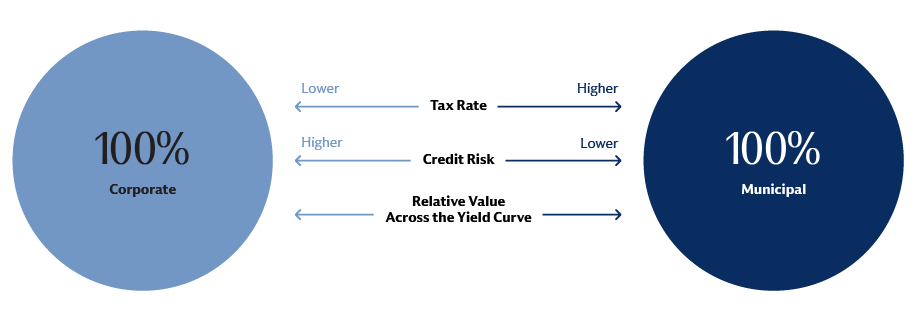
The Fixed Income Tax Aware strategy is a managed portfolio that invests across tax-exempt municipals, taxable municipals, investment-grade corporate credit, and U.S. Treasuries. The strategy aims to construct each portfolio to enhance after-tax yield based on the client’s individual tax circumstances and duration target. The team maintains top-down risk management constraints, though asset class composition can range from 0% to 100% in either municipals or corporates. Portfolio Managers will consider ongoing tax-loss harvesting opportunities as part of the strategy.
Tax Aware Strategy Flexibility
Source: Goldman Sachs Asset Management. As of December 31, 2025. For illustrative purposes only.
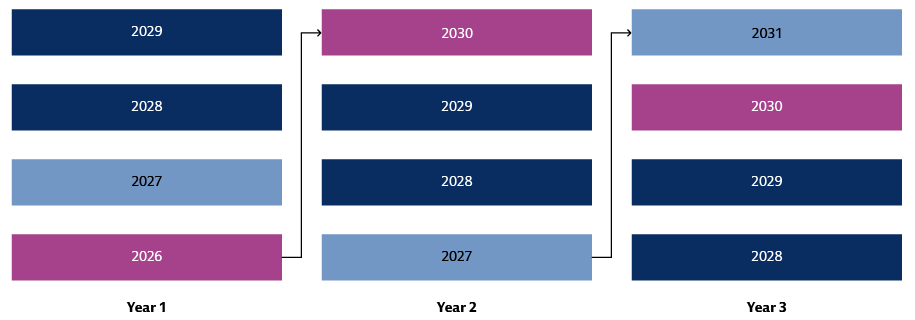
The Muni Bond Ladder strategy seeks to deliver consistent cash flows while diversifying an investor’s capital across multiple maturities, targeting a specified duration.
The Treasury Bond Ladder strategy seeks to invest in U.S. Treasuries to deliver consistent cash flows while diversifying an investor’s capital across multiple maturities, targeting a specified duration.
Bond Ladders
Source: Goldman Sachs Asset Management. For illustrative purposes only.
The Custom Muni Ladder strategy seeks to enhance individual efficiency by considering factors such as state-level tax, alternative minimum tax restrictions, and ongoing tax-loss harvesting opportunities against a specified duration target.
Custom Bond Ladders
Source: Goldman Sachs Asset Management
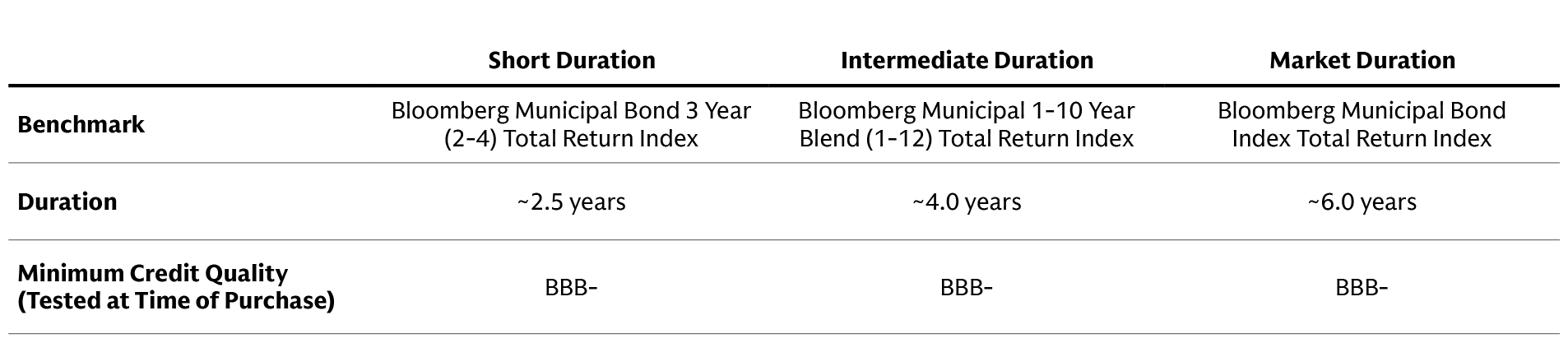
The Active Muni strategy seeks to enhance after-tax returns and tax-exempt income by seeking the best relative values across the yield curve and sectors within a specified benchmark.
Active Municipal Bond Portfolio Benchmarks
Source: Goldman Sachs Asset Management. As of December 31, 2025.
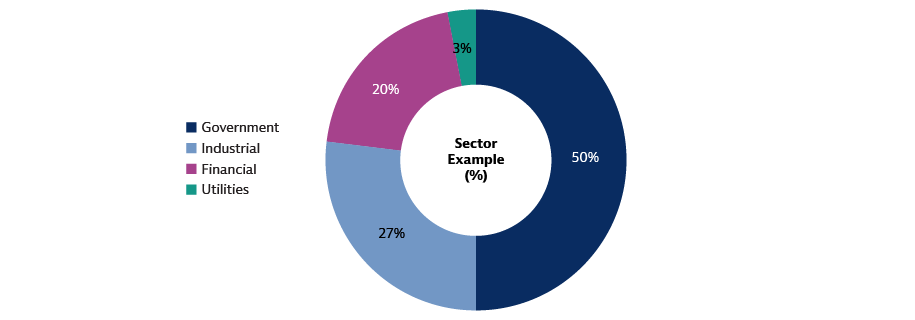
The Investment Grade Government/Corporate Fixed Income strategy invests in investment-grade government and corporate bonds. The strategy employs active credit oversight and duration management, and focuses on capital preservation, current income, and attractive risk-adjusted returns.
As of December 31, 2025
Examples are for illustrative purposes only and will vary at time of implementation. Sector data based on sample portfolio as of December 31, 2025. Sample guidelines are for informational purposes only and offered solely as a reference. It does not guarantee the above will be same at the actual time of investment. This material is not intended to be used as a general guide to investing, or as a source of any specific investment recommendations, and makes no implied or express recommendations concerning the way any client’s account should or would be handled. Targets are subject to change and are current as of the date of this document. Portfolios and benchmarks are not rated by an independent ratings agency. Goldman Sachs Asset Management may receive credit quality ratings on the underlying securities of portfolios and their respective benchmarks from the three major rating agencies: Standard & Poor’s, Moody’s and Fitch. Goldman Sachs Asset Management calculates the credit quality breakdown and overall rating for both portfolios and their respective benchmarks according to the client’s preferred method or such other method as selected by Goldman Sachs Asset Management in its sole discretion. The applicable method may differ from the method independently used by benchmark providers. Securities that are not rated by all three agencies are reflected as such in the breakdown.
For illustrative purposes, Goldman Sachs Asset Management converts all ratings to the equivalent S&P major rating category when reporting the credit rating breakdown. Ratings and portfolio credit quality may change over time. Unrated securities do not necessarily indicate low quality, and for such securities the investment adviser will evaluate the credit quality. Targets are objectives and do not provide any assurance as to future results. Diversification does not protect an investor from market risk and does not ensure a profit. There is no guarantee that objectives will be met. Past performance does not guarantee future results, which may vary.
Our Offerings: Satellite Fixed Income
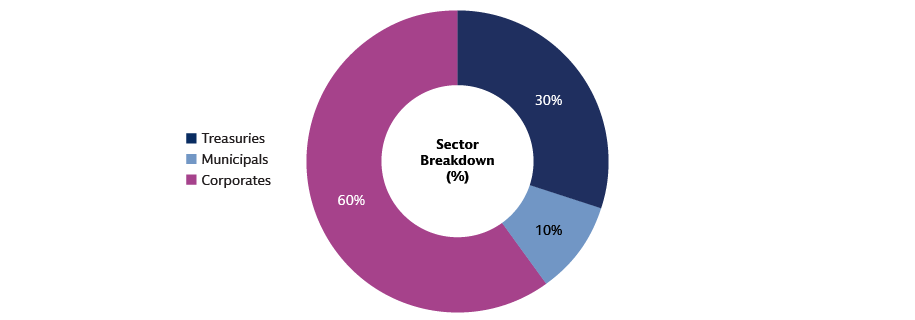
The Ultra-Short Fixed Income strategy seeks to provide enhanced income relative to traditional primary liquidity solutions by investing across investment-grade corporates, municipals, and treasuries. It is a short-term “cash plus” solution for investors looking to gain enhanced income above cash over the course of a market cycle.
Ultra-Short Fixed Income Sector Distribution
Source: Goldman Sachs Asset Management. As of December 31, 2025.
The Dynamical Municipal Income strategy is an actively managed portfolio that integrates individual, high-grade municipal bonds with a well-diversified pooled vehicle focused on tactical market exposures and opportunistic investments in medium- to lower-rated municipal bonds. The strategy aims to capitalize on credit opportunities, changes in interest rates, and market dislocations by providing exposure to both high-quality individual bonds and select below-investment-grade municipals.

Source: Goldman Sachs Asset Management. As of December 31, 2025.
Portfolio Managers aim to construct diversified portfolios with yields representative of the broader preferred market, while placing greater emphasis on variable rate securities to balance duration risk and limit interest rate volatility. The team maintains top-down risk management constraints while assessing tax treatment, underlying credit quality and security level relative value within the Preferred and Hybrid market.
Sector Allocation (%)
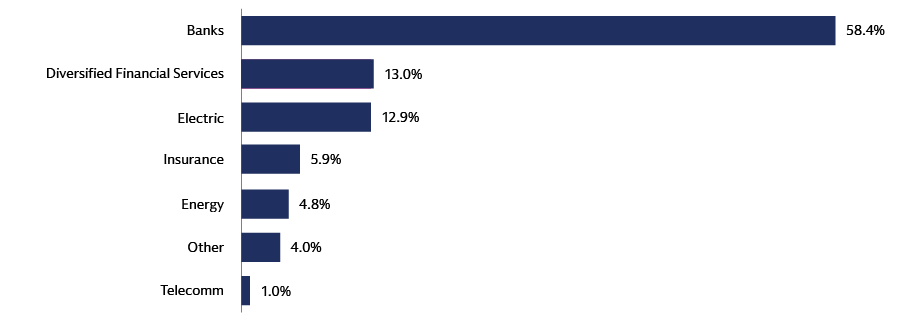
Source: Goldman Sachs Asset Management. As of December 31, 2025. Portfolio holdings and/or allocation shown above are as of the date indicated and may not be representative of future investments. Future investments may or may not be profitable.
Common Questions
Learn more about fixed income SMA strategies and how they can work for you.
What is a bond?
A bond is a loan from an investor to the issuer. The issuer borrows money in exchange for paying interest over the life of the bond plus the return of principal at maturity1. Maturities generally range from 30 days to 30 years with some maturities shorter or longer than this range.
What is yield and how does it correlate with price?
Yield is the annualized return, expressed as a percentage, an investor receives over the life of the bond and is calculated based on the interest payments the bond pays relative to its market price. Interest rates and bond prices have an inverse relationship -- as yields move higher, prices (or market value) will move lower.
What is duration and how does it impact a portfolio?
Duration is a measure of price volatility as interest rates rise or fall, also known as interest rate risk. The overall duration of a portfolio is determined by the duration of all its individual securities. Since rates and prices are inversely correlated, when interest rates rise, a higher duration portfolio will exhibit greater mark-to-market losses than a lower one (e.g., as interest rates increase by a certain percentage, a bond’s price will change inversely by the same percentage. For a 1% increase in interest rates, the value of the portfolio would decrease 1% for each year of duration.)
How does investment grade fixed income contribute to a diversified portfolio?
Investment Grade (“IG”) fixed income potentially provides a three-pronged benefit to portfolios by 1) generating a stable source of income by providing regular cash flows, 2) serving as a source of liquidity for rebalancing into risky assets, or as needed for other purposes, and 3) providing a hedge against equity risks and dampening portfolio volatility in risk off environments. Due to its reliability, IG fixed income is considered the “sleep-well” portion of the asset allocation.
How does the fixed income SMA team customize portfolios designed to meet client needs?
The GSAM fixed income SMA platform allows clients to access the municipal and corporate market in a simplified approach. Our strategy keeps the investment objectives of principal preservation, low volatility, and predictable tax-exempt income at front of mind when constructing portfolios of fixed income securities. We provide a tailored approach for each unique client, as individual portfolios are managed with respect to the client’s state of residence, tax liability, credit exposure, risk tolerance, income needs, and any other prevailing specifications.
1Payment of interest and principal is subject to the credit of the issuer.
Our Leadership Team






Documents
Explore More