What is Private Credit?

What is Private Credit?
What makes private credit different is the way the loans are usually structured. In public credit markets, banks arrange loans and either sell them as bonds that trade on public markets or share them among a group of lenders in what’s known as syndication.
With private credit, loans are usually held by a single or a small group of lenders until they’re fully repaid. This model, the most common in private credit, is known as direct lending.
Why would a borrower seek a private credit loan rather than a public one?

Some companies need a loan too large for their local bank, but too small to secure from a bigger bank or to issue bonds the way a large corporation can.

Private credit borrowers work directly with their lenders, which can let them move more quickly and give them greater confidentiality by eliminating the need to issue public filings, obtain a corporate credit rating or go on a roadshow to the potential lenders in a syndicate.

In the event of a downturn, this close relationship means borrowers have greater flexibility, which can help them weather the storm. It also may help the borrower work out a solution more tailored to their unique financing needs than they could find in the public markets.
These benefits – combined with the vacuum left by the banks when new regulations tightened lending conditions after the Global Financial Crisis – have helped foster explosive growth in private credit over the past decade and a half. In 2011, private credit assets under management (AUM) was at $357 billion.1 By the end of 2025, it hit $1.8 trillion.2
How Does Private Credit Work?
Alternative asset managers form private credit funds and make them available to investors. Investors usually provide most of the capital in these funds and rely on the asset manager to select and manage the underlying credit investments. The manager may invest some of its own capital in the fund as well.
Private credit funds generally fall into two categories: traditional closed-end funds, also known as drawdown funds, and open-end funds, also known as evergreen or perpetual funds.
Closed-end or drawdown funds are illiquid investment vehicles, meaning investors cannot easily convert their stake in the fund into cash. Instead, investors make a legal commitment up-front for the full amount they would like to invest and they cannot withdraw it for the full life of the fund – typically around a decade.
However, investors do not actually provide the capital they’ve committed until the manager identifies loans to add to the portfolio and calls upon them to do so in what are known as capital calls. As these underlying loans pay interest, the manager delivers those interest payments – called “distributions” – to investors in the fund. At the end of the life of the fund, investors will have received distributions amounting to these interest payments plus their initial commitment.
Evergreen, or open-end or perpetual funds, offer investors liquidity on a periodic basis. Investors immediately provide the total amount of their investment in the fund, unlike the gradual capital calls of a drawdown fund, and the money gets put to work. The fund is usually fully invested at the time investors commit their capital.
Any returns from the underlying credit investments are put into new investments rather than immediately going back to investors, so the returns start generating their own returns – known as compounding – and the fund exists in perpetuity. Evergreen funds give investors periodic opportunities to withdraw their money – or redeem – during the life of the fund, usually at least on a quarterly basis. Investors agree up-front to an aggregate limit on these redemption requests. The limit is usually no more than 5% of the total value of the assets in the fund, known as net asset value (NAV), in any given quarter. Known as a redemption cap, these limits help ensure that the fund manager doesn’t have to sell at a loss simply because many investors want their money back at the same time.
Many private credit funds in the U.S. operate via what’s known as a business development company, or BDC – a type of fund that is listed on a stock exchange and regulated under U.S. law. Most businesses can reinvest profits in the business itself, but BDCs must distribute 90% of their earnings to investors. They also must file financials publicly on a quarterly basis, offering regular visibility into how investments are performing.
What Does Private Credit Invest In?
Private credit is issued across the risk-return spectrum.
- Asset-backed finance typically comes with the least risk. Why? In a standard direct loan to a corporation, the lender has a legal claim to all the assets belonging to the business. If the company defaults or declares bankruptcy, the lender may assume ownership of these assets so that they can recover their money.
With asset-backed finance, by contrast, the loans are backed by an asset that has value independent of the company that owns or operates it. So, for example, a loan to a telecommunications company might be collateralized by the cell phone towers that company uses. Should a default occur, the lender would own those cell phone towers, which often have value no matter who operates them.
- Senior loans sit highest in a company’s capital structure. That means they are first in line to be repaid in the event of a default. This makes them a relatively stable source of regular income payments.
- Subordinated credit – also known as mezzanine credit – sits below senior loans in the capital structure. That means investors will likely get less of their money back in a bankruptcy or default because senior loans are prioritized first. To compensate for this extra risk, subordinated credit will often feature a higher interest rate.
- Opportunistic credit – also known as distressed or, sometimes, special situations investing – sits lowest in the capital structure, so it’s last in line for repayment. To offset this risk, it will often include a small portion of equity (or ownership) in the business, which may boost the return the investor receives over time.
Much of the private credit universe can be categorized as sponsor-backed or sponsor-less debt.
- Sponsor-backed loans are those where the borrowing company is owned or managed by a private equity firm, the sponsor. This can provide an added level of security, as the private equity sponsor is financially invested in the success of the company and often offers operational expertise that can help it perform well.
- Sponsor-less loans are those where the borrowing company is generally owned by the management team or the founder.
Why Invest in Private Credit?
Private credit can offer a higher return than public credit.
Historically, private credit has outperformed publicly traded debt. One reason for that may be the illiquidity premium: investors often demand a higher return when their money is locked up for a longer period of time.
Average yield, last 10 years
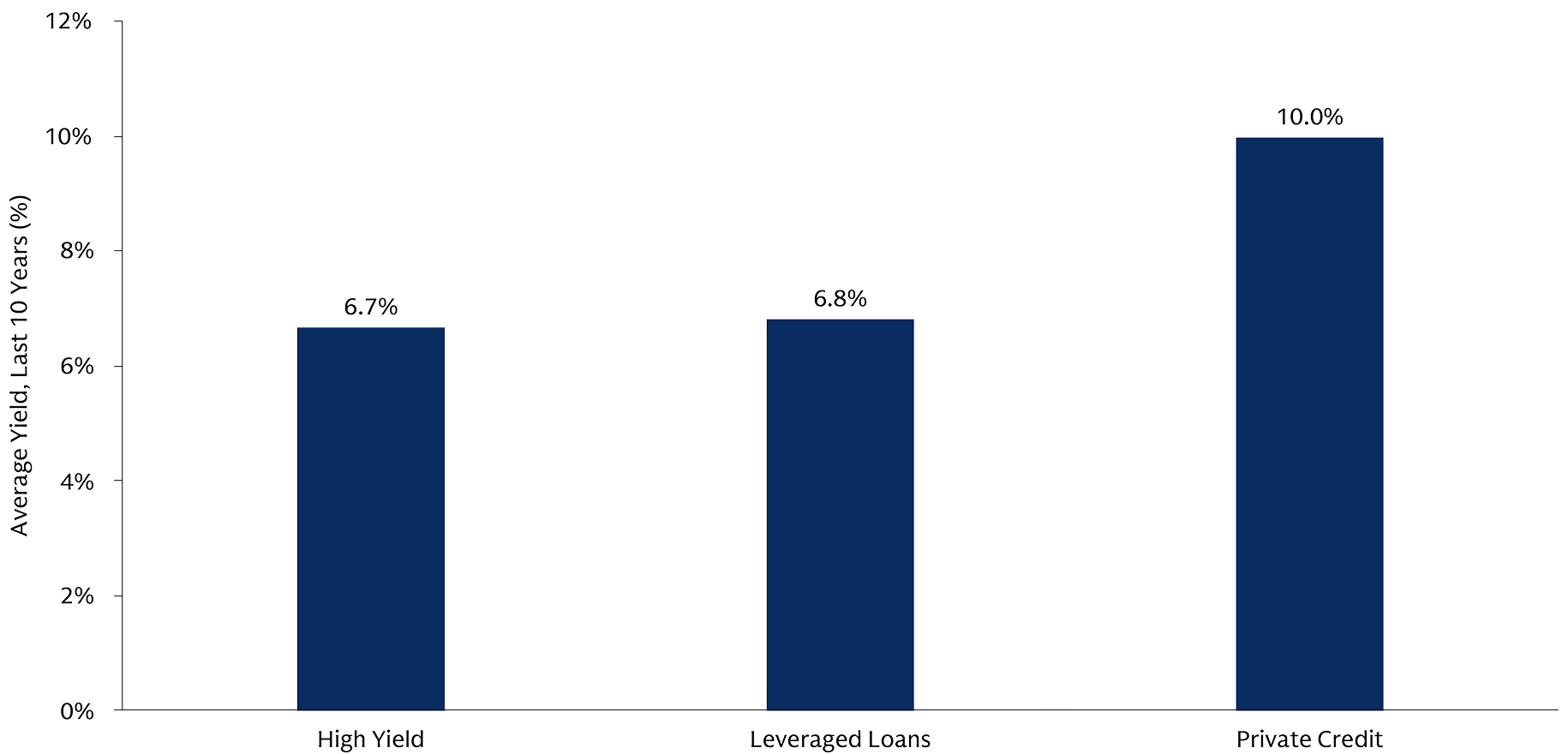
Source: Federal Reserve, LSTA, Cliffwater. Private credit yield proxied by the Cliffwater Direct Lending Index. Quarterly yield data as of September 30, 2025, and loss ratio data as of December 31, 2025.
Private credit can offer resilience.
Historically, private credit’s loss ratios – or the amount of money lent out that doesn’t get repaid – have been comparable to or lower than publicly traded bonds or loans issued to companies with a similar credit risk profile.
Why is this? Several factors may be at work. Private credit loans are often floating rate, which means that the interest rate adjusts alongside central bank rates. That means they may be less sensitive to the risks of interest rate changes than traditional public market bonds with a fixed interest rate. They’re also less sensitive to market fluctuations than traditional public market bonds because they are not traded.
Average credit loss
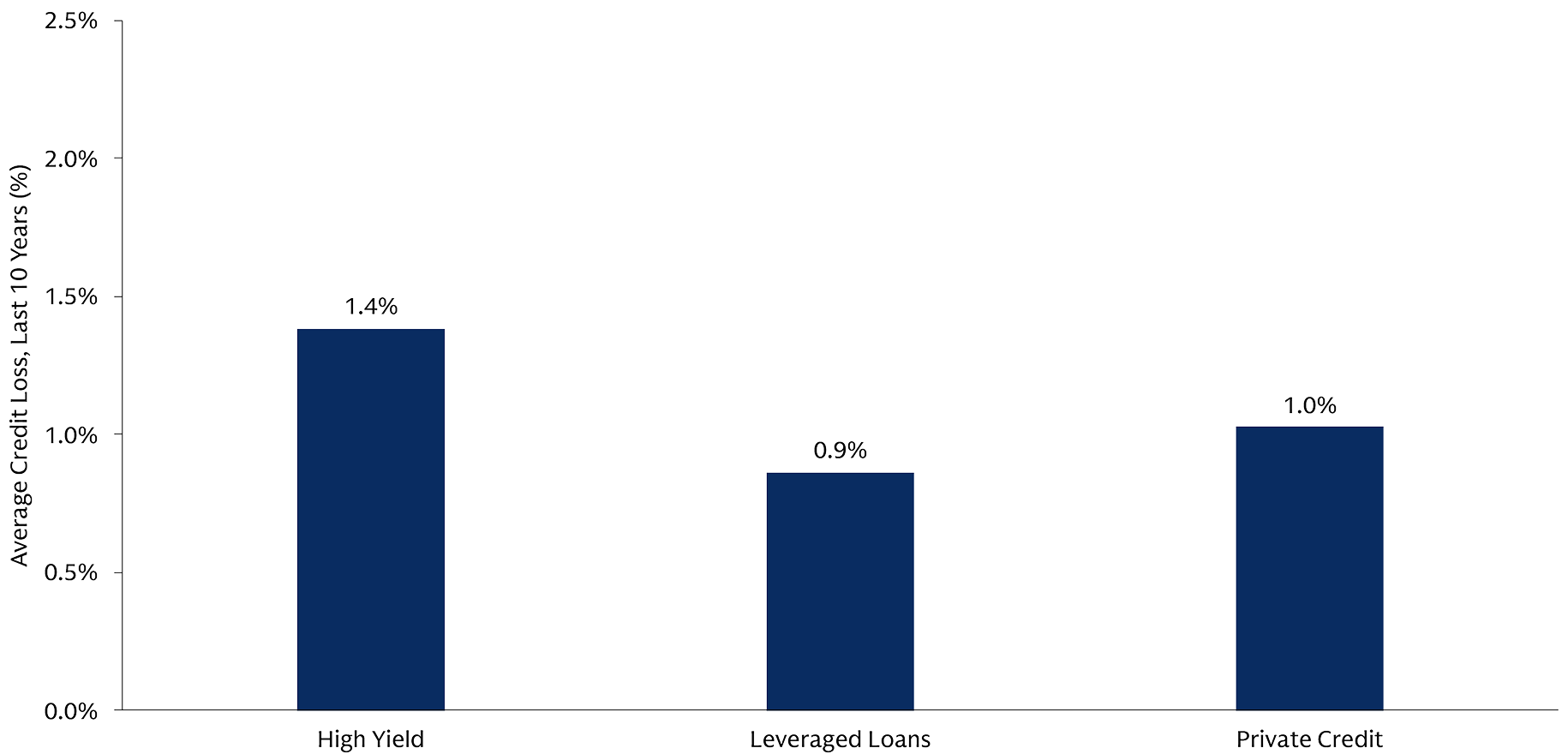
Source: Federal Reserve, LSTA, Cliffwater. Private credit yield proxied by the Cliffwater Direct Lending Index. Quarterly yield data as of September 30, 2025, and loss ratio data as of December 31, 2025.
Another reason? The due diligence process. Private credit managers go under the hood of prospective borrowers, scrutinizing company records – sometimes more closely than may be possible with the syndicated loans banks manage, where multiple lenders can have competing priorities. Many have a multi-stage approvals process before proceeding with an investment.
Managers may also set up structural protections that the borrower must follow to secure financing, such as limits on the amount of debt the company can take on overall.
Private credit taps a diversified opportunity set.
The bigger the private credit market grows, the broader the range of companies it serves. That lets managers target investments that move with the economic cycle, against it, or perform across the cycle.
Private credit can also give investors exposure to transactions that may be too complex for public markets. Plus, managers have the freedom to select investments they think will perform well without needing to invest broadly to match a market index.
Private credit assets under management
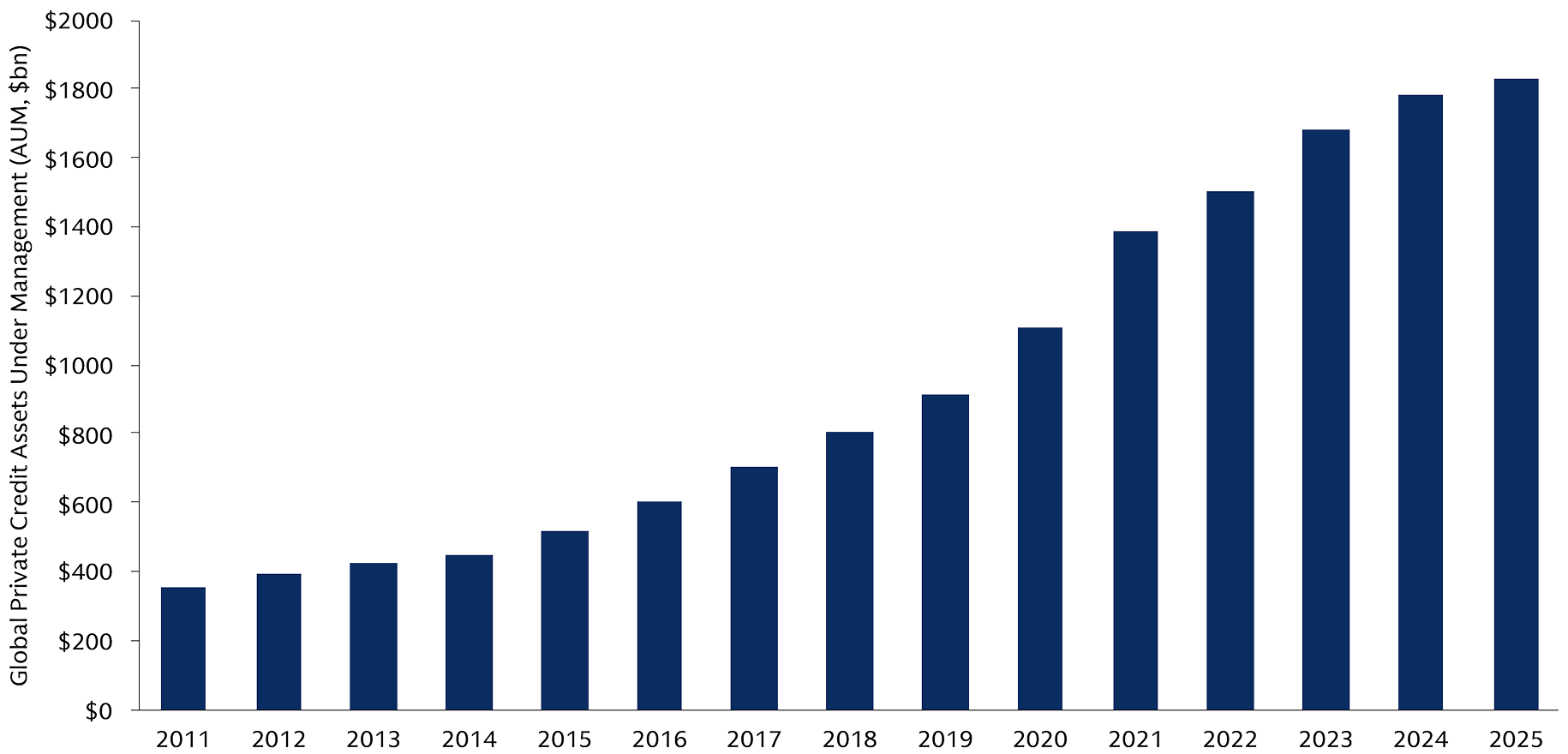
Source: Preqin, data as of July 2026.
What to Consider When Investing in Private Credit
Several characteristics of private credit merit consideration.

Evergreen funds allow investors to withdraw money on a periodic basis, but private credit as a whole is less liquid than publicly traded bonds. Consider your liquidity needs as you determine how private credit can fit into a portfolio.

Any credit investment, public or private, could experience default and sustain losses due to market or macro factors. The borrower-lender relationship may help offset credit risk, as the private credit manager and the company can work together to support the latter’s recovery. And because private credit is non-traded, it’s less impacted by swings in market sentiment.

Because private credit funds don’t trade in the public market, there is no consensus market price for the loans that they hold. Instead, fund managers run their own process to determine the value of these investments. It may be worth considering how the manager of a fund approaches valuation.
Frequently Asked Questions
* All content Goldman Sachs Alternative Asset Management unless otherwise noted, August 28, 2026.
1 Source: Preqin, data as of July 2026.
2 Source: Preqin, data as of July 2026.