What is Infrastructure?

What is Infrastructure?
This ranges from transportation systems, such as railways and toll roads; to utilities and energy, such as solar and natural gas; to digital infrastructure, such as data centers and fiber-optic networks; to the circular economy, such as water and waste management.
Private market managers are increasingly funding and building out these assets as public debt burdens mount and government investment in infrastructure declines. This is creating an enormous growth opportunity for infrastructure investing: assets under private management have surpassed $1 trillion and are expected to approach $3 trillion by 2030.1
Another factor unlocking opportunity? The expansion of infrastructure to support some of the biggest changes happening in our world today. The AI revolution, the energy transition, and the push for homegrown power and industrials all rely on infrastructure investments. Listen to leaders of our infrastructure investing business discuss this opportunity.
How Does Infrastructure Investing Work?
Private infrastructure investing generally occurs in four ways:
The manager – known as a General Partner (GP) – assembles capital commitments from a group of Limited Partners (LPs). The GP identifies infrastructure assets for the portfolio and draws down investor capital to put behind them, as well as contributing some of their own capital. The manager is responsible for building, maintaining, improving, and exiting these assets and distributing the returns they generate to investors. After exit, the manager closes the fund.
Investors put their capital in a fund that often has a fully formed portfolio of infrastructure assets already in place, unlike in drawdown funds, where the manager gradually calls on investors to provide the capital they’ve committed as they identify assets to add to the portfolio. Because the portfolio is already fully formed, investors get immediate exposure to those assets and their money is put to work right away.
Returns from those assets get reinvested in other assets, so the fund continues in perpetuity – which is why these funds are also known as perpetual funds.
Investors have periodic opportunities to cash out, usually on a quarterly basis and with some limits. Those limits are designed to ensure that the manager sells the assets at the optimal price they can command rather than selling simply to meet a rush of investor requests.
Investors put their capital behind building, buying, or managing specific infrastructure assets. The capital they’ve committed goes on the capitalization table of the company that holds the asset and their returns come from the asset’s performance rather than a pool of investments in a fund structure.
Investors and a fund manager together put their capital behind building, buying, or managing specific infrastructure assets – sometimes directly in the holding company, sometimes via a fund that holds just one asset. The returns come from the asset’s performance rather than a pool of investments in a fund structure.
What Kinds of Infrastructure Do Alternative Asset Managers Invest in?
Infrastructure managers invest across a wide range of sectors that power a wide range of essential functions.
These include:
- energy transition solutions, such as renewable energy, grid resilience, and storage;
- digital infrastructure, such as fiber-to-the-home, data centers, managed service providers, and telecom carveouts;
- transport and logistics, such as supply chain logistics and rail, aviation and maritime infrastructure and services; and
- circular economy, such as waste, water and wastewater, food infrastructure, utility services, and other industrial infrastructure.
Infrastructure managers also distinguish between brownfield and greenfield assets.
- Brownfield assets are assets or operating companies that already exist, such as an airport or toll road.
- Greenfield assets are entirely new assets or platforms that the manager builds – for example, a new data center operating company.
These types of infrastructure investments occur across both equity and debt.
Infrastructure equity investments give investors ownership stakes in infrastructure assets, with each different strategy providing different levels of income, appreciation, and liquidity, or the ease with which an investment can be converted into cash.
Core strategies invest in infrastructure projects that deliver long-term regular revenue streams, such as toll payments on a state highway system that the manager has secured through a contract with the state government. These revenue streams serve as income for investors.
The steadiness of these payments makes Core strategies relatively low risk, but unlikely to deliver much capital appreciation from improvements in the assets. Assets in Core strategies are usually held from 15 to 20 years.
Core-plus strategies invest in infrastructure projects that combine long-term, regular revenue streams with the opportunity to deliver some capital appreciation. A manager might expand a network of electric car charging stations, for example, and then collect regular payments from the cars that use it. Assets in Core-plus strategies are usually held from seven to 10 years.
Value-add strategies also invest in infrastructure projects that can offer long-term, regular revenue streams, but the majority of the return comes from the capital appreciation as the manager optimizes the asset even further. For example, if a manager acquired a fiber-optic network that powered the internet in one region, they might fund its expansion into another and grow its customer base.
This focus on improving these assets means investors in these projects are often looking to sell rather than just to collect regular payments. That means they often have a shorter hold period – usually from five to eight years.
Opportunistic strategies invest in greenfield infrastructure projects that need major development, with most of the returns coming from the sale of these assets, usually after a three- to six-year holding period.
A manager might build a renewable power pipeline and sell it to another asset manager, or build an entire network of data centers and sell them to a large tech company.
Infrastructure fund managers will usually target their investments around assets that are the same size.
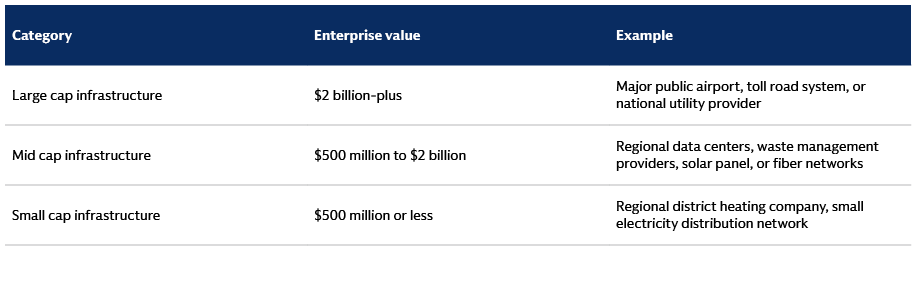
Infrastructure debt investing means lending money to build, buy, or improve an infrastructure asset such as a toll road, an airport, a solar farm, or a water utility. A lender can also lend against the value of an asset that already exists – to refinance existing borrowings, for example.
In return, the lender receives interest payments and expects the full value of the initial loan to be repaid over an agreed period. Terms vary widely: some loans run for a few years, while some project financings extend 20 years or more, reflecting the long operating lives of the assets.
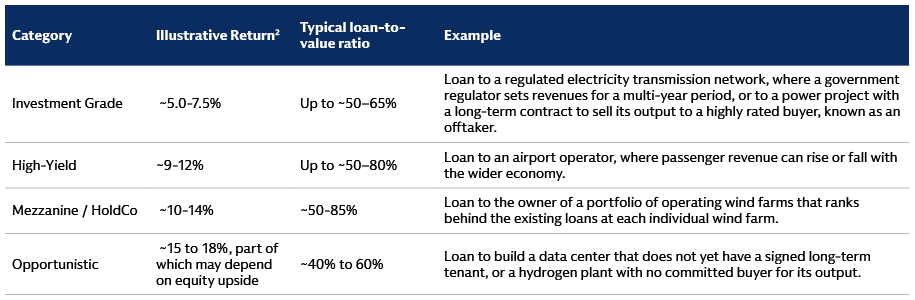
Infrastructure loans generally fall across four categories, each with a different risk-return profile that depends on several factors. These factors include:
- Ability to generate future revenues. Does the asset have contracted or regular sources of revenue? Or do revenues fluctuate based on market demand?
- Criticality. Does the asset support services that are essential to society, such as a water network? Or is it helping to pioneer new, unproven technology?
- Construction phase. Greenfield assets that have yet to be built carry construction risk, so they are generally seen as riskier than brownfield assets that are already operating.
- Loan-to-value ratio. Assets that are financed with more borrowed capital are generally viewed as riskier, while assets that are financed with less borrowed capital are seen as less risky.
- Seniority. Senior-secured lenders are paid first. Subordinated lenders are paid only after them, so that risk gets priced in.
Investment grade infrastructure debt is rated BBB-/Baa3 or higher by a credit ratings agency. It is the lowest-risk of these four categories, so lenders accept a lower interest rate.
Opportunistic debt carries the most risk, so lenders seek a higher return to compensate for that risk.
High-yield and mezzanine / HoldCo debt sit in between.
Many infrastructure loans are floating rate, which means the interest rate moves up and down with market interest rates.
Infrastructure debt has historically experienced lower default rates and higher recoveries than similarly rated corporate debt.3 There are several potential reasons for this. One is that infrastructure loans often support assets that are essential to society and receive steady cash flows in the form of regulated or contracted revenues.
Another reason is that infrastructure loans are structured to protect the lender’s claim. These loans are often made to a separate, ring-fenced company that owns the asset and secured against that asset and the cash it generates. If a telecom company goes bankrupt, for instance, the infrastructure lender would have a legal claim on the cash flows from the cell towers and would be shielded from the company’s bankruptcy – a protection that also benefits investors.
Why Invest in Infrastructure?
Infrastructure may offer inflation protection. Infrastructure operating companies often have long-term contracts with the government that adjust with inflation. That’s because building and administering these projects lasts years – sometimes more than a decade.
For example, imagine an operating company that builds and runs a public metro system for a city. Building it will take years, and it’s possible that inflation will raise the costs of the construction materials needed to lay down the rail lines and set up the platforms. And even after the metro system gets built, fares will need to be raised periodically to keep pace with inflation.
Operating companies negotiate built-in price escalators to take these contingencies into account. Those benefits get passed back to infrastructure managers, potentially providing a steady source of inflation-linked income.
Plus, some strategies offer investors the chance to combine regular income payments – such as toll road fares – with capital gains – such as renovations to the toll road plazas – that make the underlying operating company more valuable when it is exited.
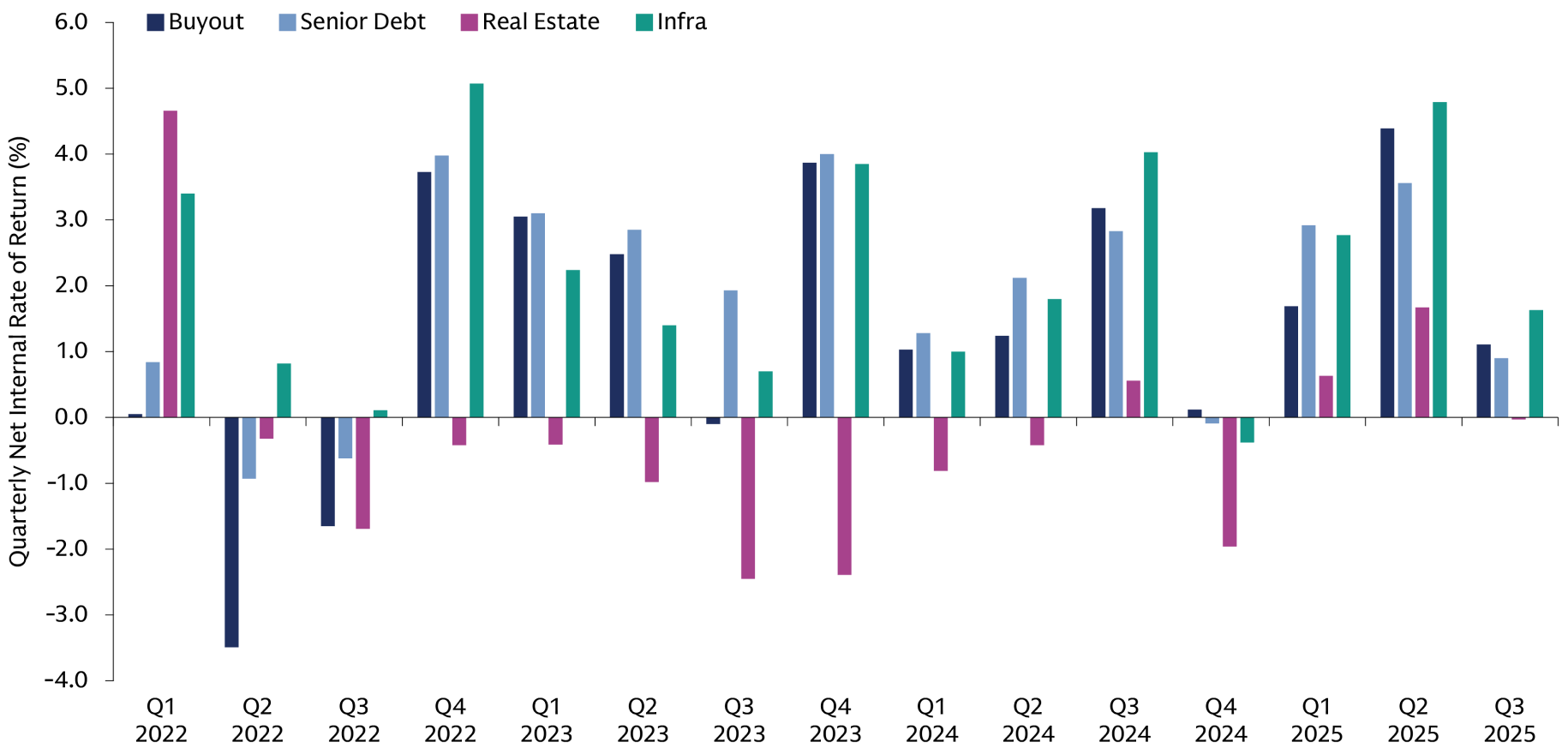
Infrastructure net internal rate of return (IRR) vs. other asset classes (2022-2025)
Source: MSCI Burgiss, as of Q3 2025. Past performance does not guarantee future results, which may vary.
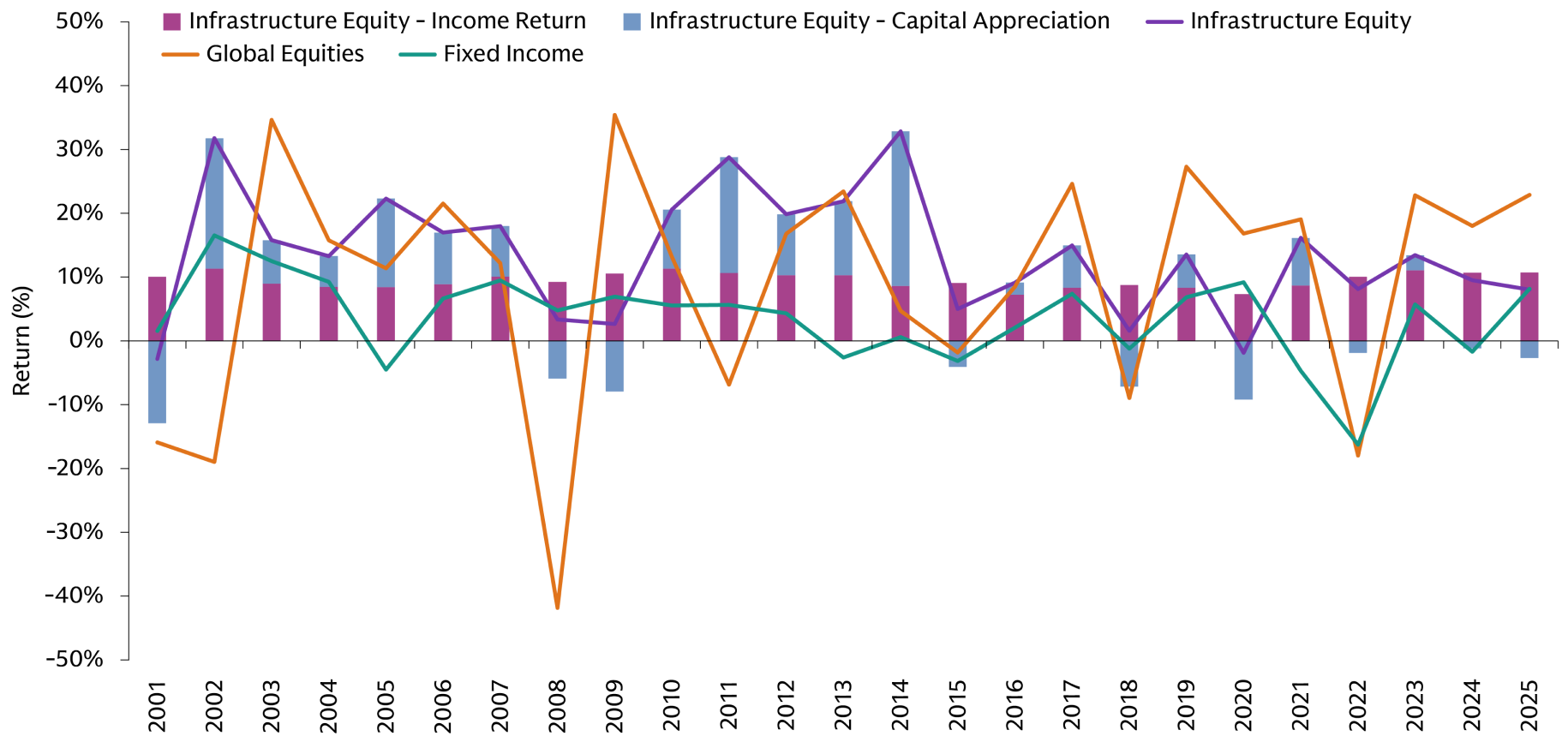
Infrastructure may be less correlated to broader market cycles. Infrastructure operating companies often enjoy limited competition and stable demand. That can buoy performance regardless of what’s happening in the broader economic backdrop.
Why is this? These operating companies offer services that are essential to keep the world up and running. Infrastructure helps people commute to work and school, access water and power, and connect with each other online. That means it is constantly in use and, often, that the operating companies providing these services have few competitors and the support of regulation – offering even more stability.
Infrastructure return vs. public equities and fixed income
Source: EDHEC, MSCI, Bloomberg, and Goldman Sachs Alternatives. As of December 2025. Infrastructure Equity (as well as Capital Appreciation & Income Return breakdowns) is represented by the EDHEC Infra 300 index (LCU). Global Equities are represented by MSCI ACWI Gross Total Return index (USD); Fixed Income is represented by Bloomberg Global Aggregate Total Return Index (USD).
Infrastructure benefits from long-term shifts in the ways we live and connect. Major changes in how the world runs are unlocking new opportunities in infrastructure. The advent of AI is creating opportunities for investing in data centers, cell towers, and other digital infrastructure. The energy transition is creating the need for wind turbines, solar panels, and energy storage systems. And shifts in global trade relations are rewiring transport and logistics networks.
Major Global Trends Unlocking Infrastructure Opportunities
Technology
- ~$7.6 trillion of AI infrastructure capital requirements between 2026 and 2031 across compute, data centers, and power.
Resource Usage
- $30 trillion of cumulative power sector investment required between 2026 and 2035 to meet the long-term temperature increase goal of United Nations Environment Programme.
Trade Realignment
- Trade volumes for global merchandise expected to increase 4.1% in 2027, but trade patterns are realigning, requiring increased investment in port and logistics infrastructure.
Demographics
- Population aged 65+ is projected to make up ~15% of the world's population in 20 years, potentially shifting public spending priorities and increasing demand for private infrastructure funding.
Sources: 1) Goldman Sachs Global Institute, Goldman Sachs Global Investment Research NVIDIA projections (as of March 3, 2026) Note: Forecasts and expectations are based on material assumptions subject to change. Assumes NVIDIA accounts for 75% of total compute spend in each period. Assumes 5% YoY compute growth past the projection period (2031). Uses VR200 (Rubin) chip as baseline spec ($80.5K per GPU [incl. node costs] and 3,000 W per package) across all years. Assumes 1.2 PUE, $15mn per MW for data centers, and $2,500 per kW for new power. Assumes 15% of required data center space is brownfield (i.e., excluded from calculation) in 2026, growing to 30% in 2031. Totals may not sum due to rounding; 2) International Renewable Energy Agency (IRENA), World Energy Transition Outlook 2026: 1.5C Pathway, October 2026; 3) World Trade Organization, Global Trade Outlook and Statistics, October 2026; 4) UN, World Population Prospects (2024) – processed by Our World in Data. “Number of people aged 65 and over – UN WPP” [dataset]. United Nations, “World Population Prospects”; United Nations, “World Population Prospects – Interim Update” [original data].
What to Consider When Investing in Infrastructure

Some infrastructure investments – such as major works like bridges, airports, or subsea fiber-optic cables – take years to build. To get these projects to completion, managers need to provide a consistent stream of capital. To achieve that, they lock up investor capital in products that offer less liquidity than most public securities.
Evergreen funds usually offer investors some access to liquidity, but usually only on a quarterly basis. Traditional drawdown funds do not start delivering returns until later on in the life of the fund, sometimes more than a decade after the initial investment. Consider your liquidity needs before investing.

Infrastructure often benefits from regulatory support but – by that same token – may experience regulatory risks. Tax credits that were factored into the scoping of an infrastructure project could get rolled back, for example, causing delays or requiring additional capital. Changes in energy laws could require managers of certain assets to tap new sources of power. Consider whether your manager has a track record of successful exits under different regulatory regimes.

Demand for AI infrastructure is growing as major tech companies rapidly scale their investment in data centers and other related infrastructure. That in turn creates increased demand for power to support these assets. Most infrastructure assets enjoy relatively limited competition, but digital infrastructure operates differently. Consider whether your manager has assembled a diversified portfolio of assets to help mitigate this risk.
Frequently Asked Questions
1 Source: Preqin, “Private Markets in 2030,” October 16, 2025.
2 As of September 1, 2026. For illustrative and educational purposes only. The returns shown reflect high-level assumptions based on current market outlooks and are not intended to represent actual returns.
3 Source: Moody’s, Infrastructure Default and Recovery Rates, 1983-2022.