Finding Investment Opportunities in the Global Response to Water Stress




Key Takeaways
The world’s water supply is under stress. Demand is surging, driven by a rapidly growing global population and water-intensive industries such as agriculture and energy production.1 Yet the water supply is finite and under threat from aging infrastructure, pollution, the effects of climate change and extreme weather events.2 There is also a geographical mismatch between areas with abundant water and those with the greatest demand.3 Rarely a day goes by without a headline that underscores the urgency of the crisis, from major global cities on the verge of running dry to how the artificial intelligence (AI) boom is contributing to surging demand.4 Heightened awareness of the scale of these challenges is generating increased investor interest in the water theme. In our work with clients around the world, the question we hear more often now is not whether to invest in water, but how.
We believe there is a clear, long-term secular economic trend that underpins the investment case in water. This trend is rooted in water’s indispensable role in the global economy and the dependency that runs deep in many industries, either directly through their primary businesses or indirectly through their supply chains. In our view, an approach that connects the drivers of the underlying challenges faced by governments and companies with the solutions that are being developed and implemented can help investors navigate the risks associated with water stress and identify potential opportunities in public and private markets.
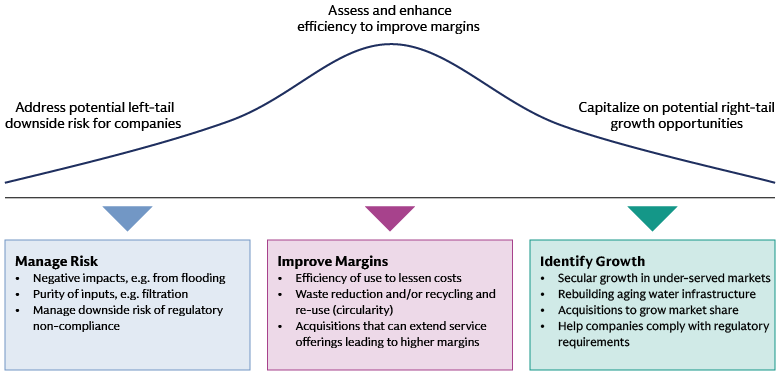
When evaluating water-related investment opportunities, we ask three key questions:
- Do they address potential downside risks for companies or governments?
- Do they enhance efficiency to improve margins?
- Do they provide access to secular growth driven by increased demand?
This approach can help investors assess opportunities and identify the economic drivers of value for a particular company or asset.
Source: Goldman Sachs Asset Management. As of April 6, 2026. For illustrative purposes only.
Rebuilding Aging Infrastructure
After decades of underinvestment, the world’s aging water infrastructure needs urgent expansion and renewal. The total investment required to achieve this goal globally and provide resilient, sustainable, and up-to-date drinking-water and sanitation systems stands at $13.2 trillion by 2040, according to the World Economic Forum, an indication of the scale of long-term investment opportunities in this area. To reach this spending target, annual investment would need to more than double from the current level of about $380 billion per year.5 Given the scale of this task, it stands to reason that governments are leading the way, accounting for about 85% of annual spending in the water sector, according to the World Bank.6
In developed markets, spending on water infrastructure is on the rise. We expect this trend to continue as the confluence of rising power demand, higher temperatures, extreme weather events, aging infrastructure, and heightened regulatory scrutiny drive tailwinds for investment in water reliability. The push to repair and build out infrastructure will benefit companies across the economy.
Utilities that successfully upgrade their infrastructure could benefit from reduced operational costs through improved efficiency in their networks, the ability to provide more reliable service to customers, greater resilience to the impacts of climate change and extreme weather events, and enhanced regulatory compliance. Increased infrastructure spending underpins growth across the water sector. This includes the “pick-and-shovel” companies that help others achieve objectives such as improving the resilience of their operations or mitigating their impact on the environment, as well as smaller firms that develop innovative technologies and solutions.
For investors, rebuilding and upgrading infrastructure will create opportunities across asset classes such as fixed income, public equity, and private equity. The fixed income opportunity is the broadest, in our view, extending beyond public and private utilities to corporates in other sectors, governments, agencies, and state-owned enterprises that issue labeled (green, blue and social) and conventional bonds to finance water-related projects and activities.
Case Study: Investing in the Blue Economy with Green and Blue Bonds
Issuers have been using labeled bonds to finance water-related activities since this market was in its infancy. The first edition of the Green Bond Principles in 2014 included the provision of clean and/or drinking water in its list of projects eligible for financing with green bonds.7 Since then, this list has grown to include sustainable infrastructure for drinking water and wastewater, urban drainage systems, and other forms of stormwater management.8 More recently, blue bonds have further expanded the range of eligible water-related projects to areas such as marine ecosystems, coastal climate adaptation, and preventing marine pollution.9
In 2025, for example, a multi-utility company issued Italy's first blue bond. This five-year private-placement bond will be allocated for the development and maintenance of water resources. The proceeds of the bond are earmarked for managing and developing water networks, water supply and sewer systems, as well as wastewater treatment plants.10 The company seeks to reduce water loss by deploying automatic systems to find leaks as well as new pipelines and smart water meters.11 The urgent need for action to address this problem is clear: globally, about 30% of water is lost before it reaches customers because of leaks in distribution networks.12 These activities are aligned with blue-finance guidelines from the International Finance Corporation.13
Allocating to water-focused bonds offers several potential portfolio benefits, such as currency diversification. Compared with the broader green bond market, where the euro is the dominant currency, our analysis shows that a greater proportion of bonds eligible for a blue portfolio are denominated in US dollars. Bonds eligible for a blue portfolio also have a higher aggregate credit rating, and therefore different risk-return characteristics, than the global corporate aggregate index.14 Labeled bonds also offer transparency on the use of proceeds, including reporting on the deployment of capital to eligible projects as defined in industry standards.
Managing Downside Risks
The water crisis poses a range of potentially severe risks to companies. Droughts can slow or halt production in agriculture, which is by far the most water-intensive industry globally.15 Water scarcity can cause supply-chain disruptions and drive-up operating costs across industries such as energy and manufacturing that rely on access to a reliable supply of water. With governments tightening rules on water usage in many countries, poor water management could expose companies to regulatory and reputational risks.
Identifying companies at risk from water scarcity and related issues is an essential part of investing in this theme, but the importance of water throughout the global economy means they are not always easy to spot. Analysis by Goldman Sachs Asset Management’s Sustainable Investment Platform shows that 19% of the total revenue of all companies in the MSCI ACWI IMI index, a proxy for the global public equity market, has a high or very high dependency on water. Water dependency, in this case, refers to the reliance of companies’ business operations and revenue generation on various types of services including water flow regulation, supply, purification, and flood control. Outside the water sector itself, companies in areas such as food and beverage, pharmaceuticals and consumer products are the most dependent on water, followed by electric utilities, energy producers, and companies in the chemicals, metals and mining, and paper industries.16
The importance of water-dependent revenue and risks for many companies is driving increased investor interest in this theme. This can be seen in an analysis of the questions put to companies on their quarterly earnings calls. While broad sustainability-related questions from analysts on these calls are declining, water remains a key topic for many industries. Our analysis shows that utilities, materials companies, and energy producers face more water-related questions than other industries.17
Case Study: Helping Companies Protect Vital Water Infrastructure
As governments and industries respond to the challenges created by water scarcity, they fuel demand for the products and services of “pick-and-shovel” companies that help others achieve objectives such as improving the resilience of their operations or mitigating their impact on the environment. Some of these companies are helping utilities detect leaks and reduce water loss, a key objective of the blue bond issued by the utility described in the previous section. Others provide products and systems that help prevent damage to critical infrastructure such as pipes, water intakes, and sewage overflows, bolstering operational continuity. We believe these companies offer equity investment opportunities in public and private markets.
For example, a privately held US-based company provides water-management solutions that protect critical assets and water ecosystems. Most notably, it produces traveling water screens that are a key piece of water-intake infrastructure for companies in sectors such as water treatment, power generation and manufacturing. The company’s screens and other products help prevent damage to infrastructure, while also protecting waterways and aquatic ecosystems. It offers new equipment, rebuilds, replacement parts, and ongoing service.18 The business provides a platform for continued product-line extension through both internal innovation and add-on business acquisitions, in our view. By coupling innovation and acquisition with a highly regarded existing platform, we believe the company has the potential to outpace its underlying markets.
Privately held companies are active throughout the water value chain, creating opportunities for investors. We are seeing increased focus on water from institutional, high-net-worth, and other investors who are responding to the drumbeat of headlines about underinvestment in the sector, the rising damage from drought and flooding, and the water demand associated with data centers and AI. The underlying demand drivers and increased spending and focus from industrial water users, utilities, and other stakeholders are driving significant growth for private businesses that are well placed to tackle these increasing customer needs. Private companies allow investors to gain exposure to the sector at potentially attractive rates of return compared with traditional public or infrastructure-style investments.
Improving Profit Margins
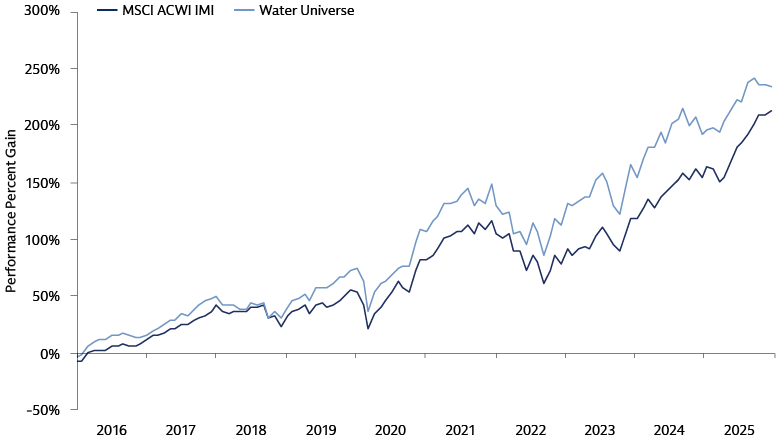
The momentum that is building in water-related investing is reflected in the performance of publicly traded water companies. In our analysis, providers of water services and products in the MSCI ACWI IMI index outperformed the overall index over the past decade.
Source: Goldman Sachs Asset Management Sustainable Investment Platform, MSCI. Data as of June 1, 2025.
Note: The chart compares the performance of publicly traded providers of water services and products in the MSCI ACWI IMI with the parent index. The universe of water companies was constructed based on FactSet’s Revere Business Industry Classification System (RBICS) segments covering the following areas: water treatment and purification, water infrastructure, water technology, water conservation, desalination, water management, and water utilities. Past performance does not* predict future returns and does not guarantee future results, which may vary.
The broad spectrum of companies with exposure to water risk underscores the potential market for water-related products and services. Companies in the water sector, including utilities, wastewater managers, and providers of water technology are responding by investing in their operations to meet rising demand. This is reflected in the steady increase in global corporate water-sector capital expenditure over the past decade, both in amount and as a share of overall corporate capex.
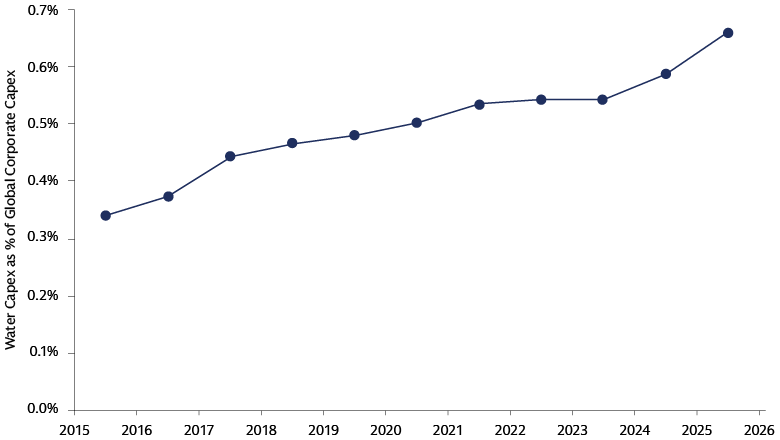
Source: Goldman Sachs Asset Management Sustainable Investment Platform, MSCI. Data as of June 1, 2025.
Note: The chart shows global capital expenditure by publicly traded providers of water services and products in the MSCI ACWI IMI. The universe of companies was constructed based on FactSet’s Revere Business Industry Classification System segments covering the following: water treatment and purification, water infrastructure, water technology, water conservation, desalination, water management, and water utilities. The data is as of June 1 each year. This date was chosen because June is the month with the minimum average distance to the latest reported financial year end. Local currencies have been converted to United States dollars.
This increased spending has translated into consistent, above-average growth for many "pick-and-shovel" companies, including those whose products and solutions are designed to help governments and industries increase the efficiency of their operations, reduce costs, and cut waste. For investors, the task is to identify the "pick-and-shovel" companies that are winning a growing share of this expenditure over time. In our view, companies that offer a broad range of products and solutions are better placed to capture this spending. We think investors should focus on several key areas when considering these solution providers for investment, including:
- Robustness of underlying market growth
- The company’s ability to expand its market share or outgrow the market thanks to its product portfolio and strong execution
- Companies that form a critical link in the value chain and/or solve a key pain point for their customers
Thanks to the secular growth theme driving water investment, the product and service providers in this sector potentially offer consistent earnings and lower volatility than some other themes in sustainable investing, thereby contributing to the diversification of sustainable investing portfolios. Another source of diversification comes from relative exposure to AI. The performance of companies in some traditional environmental investing categories is increasingly being affected by the development of AI. Clean energy, for example, is increasingly being seen as a key source to meet surging power demand for data centers. As a result, market sentiment regarding AI can have an impact on clean energy stocks. While water demand associated with AI is also expected to increase, the connection with the AI theme is not yet a driver of share prices in the water sector, in our view. As a result, allocating to water could potentially increase diversification compared with traditional tech-heavy sustainable investing portfolios.
Case Study: Improving Operational Efficiency and Reducing Costs
A publicly traded US-based company designs, builds, and services a wide range of engineered products and solutions for the full water cycle, including collection, distribution, use, and return to the environment. Its comprehensive line of products, technologies, and services is designed to help companies and municipalities enhance the efficiency of their water operations, bring down costs, and boost their resilience. For example, its digital water solutions use advanced monitoring, analytics, and decision intelligence to optimize systems for drinking water, wastewater, agriculture, and water treatment.19
We believe the company has done a good job of delivering consistent organic growth and building a service footprint that provides comprehensive solutions. In addition to providing exposure to an attractive end market, the company’s management has driven service revenues, expanded margins, and shed businesses that proved unprofitable or didn’t fit the company’s profile. The company is also adept at identifying acquisition targets, notably small technology companies capable of enhancing its portfolio, in our view.
In addition to public equity, the company has also tapped the green bond market, raising $1 billion with its debut issuance. The proceeds were earmarked for projects to improve water accessibility and affordability, as well as water-systems resilience.20
Identifying Growth Opportunities
At the cutting edge of the water value chain, innovative new businesses, many of them privately held, are developing technologies and solutions to address needs across the water sector in areas such as smart water meters, treatment and purification, and desalination. We are seeing these companies remain in private hands longer, which creates potential opportunities for private equity investors. As they grow along with the global market for water technologies, some of them may become acquisition targets for companies higher up the value chain.
Many companies may not want to allocate the time and resources, or assume the risk, required to develop new technologies and solutions. In pursuit of improved efficiency and reliability, however, some choose to acquire the developers and apply the solutions to their own systems and operations. This creates a natural path to exit for private equity investors and makes these technology developers a potentially attractive investment. Public equity investors could gain access to these technologies and solutions when the developers are bought up by listed companies and incorporated into their portfolios.
Case Study: Helping Agriculture Manage Water Use With AI-driven Solutions
Investment opportunities can potentially be found at the confluence of water-related investment themes, such as agriculture and AI. Agriculture is the world’s biggest water consumer, accounting for about 70% of freshwater withdrawals globally. More than half of the world’s food production is in areas where total water storage is declining or unstable.21 Solutions to make agricultural water use more efficient are in growing demand.
At the same time, data-center developers are under increasing pressure to compensate for their water footprint by investing in projects that aim to make a positive impact on water stress. Where farmers are unable or not incentivized to invest in water-saving solutions, data-center developers could step in to finance their installation. For farmers, this could result in reduced operating costs, while for the data-center developers it could help offset their own water use.
One agricultural technology company that is beginning to participate in such arrangements is a developer of software-enabled instrumentation to help permanent-crop farms such as orchards and vineyards manage water use and nutrient inputs. The company’s one-stop digital platform gives food producers clear visibility of their operations, with in-field irrigation monitoring and control, and real-time AI-based agronomic recommendations that can be implemented automatically. This can significantly reduce growers’ costs on inputs and cut water usage.22 The company’s system reduces the amount of water needed for irrigation, saving farmers 132 billion gallons in 2024.23
Focus on Water
At Goldman Sachs Asset Management, we receive more requests every year from existing and prospective clients who are looking for effective ways to add water exposure to their portfolios. We believe the secular theme driving growth in the water sector will only gather strength as the headlines about water stress, extreme weather events, historical underinvestment in water infrastructure and demand from data centers and AI become more frequent, adding urgency to the investment case for water.
We think investors seeking water-related opportunities should look for companies that address one of three key needs: addressing potential downside risks, enhancing efficiency and reducing costs, and providing access to growth driven by increased demand. With this approach, we believe investors will better understand what drives a company’s value and what role it plays in the unfolding global response to water stress.
1 “Global Water Bankruptcy,” United Nations University Institute for Water, Environment and Health. As of January 20, 2026.
2 “Turning the Tide: A Call to Collective Action,” Global Commission on the Economics of Water. As of March 15, 2023. The commission is convened by the Dutch government and facilitated by the Organisation for Economic Co-operation and Development.
3 “Global Water Bankruptcy,” United Nations University Institute for Water, Environment and Health. As of January 20, 2026. Nearly three-quarters of the world’s population lives in countries that are classified as water-insecure or critically water-insecure, according to the report.
4 On the threat to cities, see “Global Water Bankruptcy,” United Nations University Institute for Water, Environment and Health. As of January 20, 2026. On concerns about AI and water, see “Watering the New Economy: Managing the Impacts of the AI Revolution,” Global Water Intelligence and Xylem. As of January 2026.
5 “Bridging the €6.5 Trillion Water Infrastructure Gap: A Playbook,” World Economic Forum. As of December 2025.
6 “Funding a Water-Secure Future: An Assessment of Global Public Spending,” World Bank Group. As of June 20, 2024.
7 “Green Bond Principles, 2014: Voluntary Process Guidelines for Issuing Green Bonds,” International Capital Market Association (ICMA). As of January 13, 2014.
8 “Green Bond Principles: Voluntary Process Guidelines for Issuing Green Bonds,” ICMA. As of June 2025.
9 “Bonds to Finance the Sustainable Blue Economy: A Practitioner’s Guide,” ICMA. As of September 2023.
10 Company press release. As of October 16, 2025.
11 Addendum to company’s Sustainable Finance Framework. As of September 2025.
12 “Bridging the €6.5 Trillion Water Infrastructure Gap: A Playbook,” World Economic Forum. As of December 2025.
13 “Guidelines for Blue Finance,” International Finance Corporation. As of September 15, 2025.
14 Goldman Sachs Asset Management, Bloomberg. As of January 31, 2026.
15 “Global Water Bankruptcy,” United Nations University Institute for Water, Environment and Health. As of January 20, 2026.
16 Goldman Sachs Asset Management, MSCI. Data as of October 31, 2025.
17 Ibid. Our analysis looked at the share of companies in the MSCI ACWI IMI index that faced at least one question on water over the period 2023-2025.
18 Company website. As of March 8, 2026.
19 Company website. As of April 8, 2026.
20 Company press release. As of June 29, 2020.
21 “Global Water Bankruptcy,” United Nations University Institute for Water, Environment and Health. As of January 20, 2026. Total water storage includes surface water, soil moisture, snow, ice and groundwater.
22 Company website. As of February 14, 2026.
23 Company 2024 Sustainable Practices Report. As of February 2025.