Investing in the Resource Security Supercycle




Key Takeaways
New Resource Reality
For decades, energy and critical mineral markets largely operated in a world where low-cost, reliable supply could often be taken for granted. That era is over. Geopolitical fragmentation, supply chain stress, and national energy goals are colliding with surging power demand from AI and electrification. Together, these forces have ignited a resource security supercycle. Securing reliable access to power, critical minerals, and strategic materials is now a priority for nations and corporations alike—sitting alongside supply chain resilience and national security as core pillars of a new economic security framework.
The result is a broad investment universe tied to some of the most significant capital spending programs currently underway across North America and Europe. Rather than simply a commodity theme, we view resource security as a long-duration investment theme anchored to the physical foundations of future economic growth. Here we explore how this theme is evolving and the types of companies that stand to benefit most.
Evolving priorities: from energy transition to "all-of-the-above"
The resource security imperative described above is already reshaping energy policy. Debate has shifted from a singular focus on transitioning away from hydrocarbons to a more pragmatic "all-of-the-above" model, where energy security, rather than decarbonization alone, leads to diversity in energy pathways to maximize system resilience.
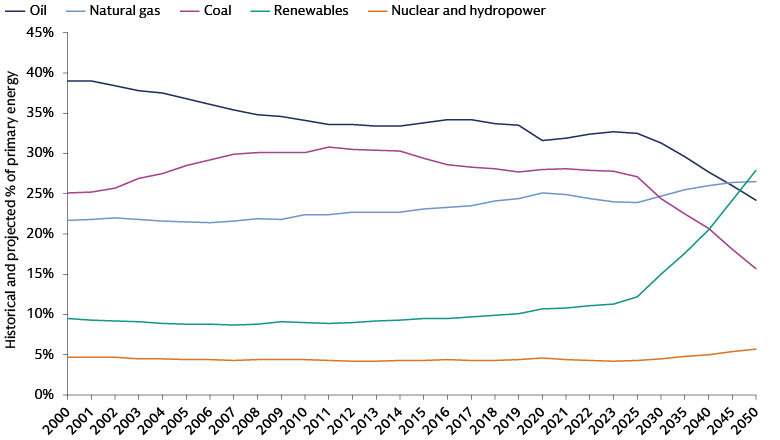
- Oil continues to play a critical role in the global energy system, despite no longer being woven into every economy the way it once was. As long-term demand growth gradually slows, oil companies are focusing on returning capital to shareholders, becoming more discerning about capex, and diversifying their business models.
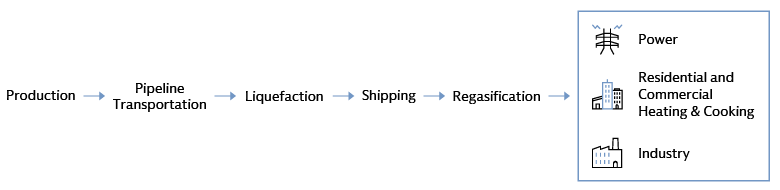
- Natural gas is a reliable energy source that continues to take share from coal, diesel, and heavy fuel oil in the international energy mix—and liquefied natural gas (LNG) enables large quantities of gas to be delivered to international markets. Global LNG exports are set to increase by more than half by 2035.
- Renewables represent the fastest growing source of primary energy, which includes wind and solar power. The share of renewables in primary energy is set to surpass coal in the 2040s, helping to accelerate decarbonization.
- Nuclear power generation is helping to meet growing demand for low-carbon electricity, enhancing energy security and supporting climate goals.
Source: Goldman Sachs Asset Management, BP Energy Outlook 2025, BP Statistical Review of World Energy.
Energy shocks: echoes of the 1970s—but this time is different
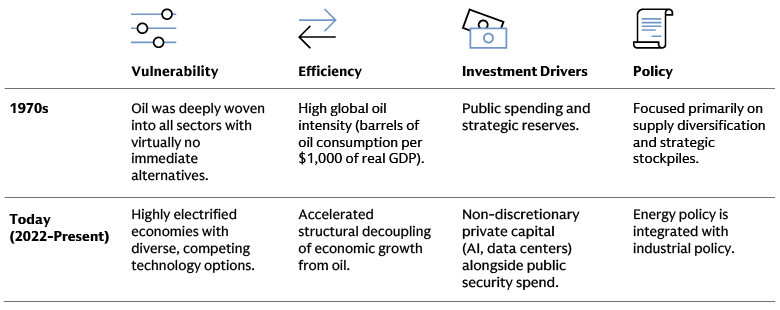
Economies have faced two major energy supply shocks in quick succession: the 2022 European energy crisis following Russia's invasion of Ukraine, and the near-halt of shipping traffic through the Strait of Hormuz in 2026—a chokepoint through which 20% of global oil supplies typically flow. While today's geopolitical landscape echoes the disruptions of the 1970s—most notably the 1973 Arab oil embargo and the surge in energy prices that followed—the landscape is fundamentally different, and, we believe, more manageable for economies and investors.
Source: Goldman Sachs Asset Management.
The start of a multi-decade capital investment cycle
The necessity of resource security is translating into capital deployment at historic scale. Global energy investment is expected to reach $3.4 trillion in 2026,1 with spending on both sides of the Atlantic representing one of the largest synchronized buildouts of energy and industrial infrastructure in decades.
In the US, rapidly rising electricity demand from AI, data centers, and manufacturing reshoring is driving investment into power generation capacity, transmission networks, and natural gas/LNG export infrastructure. Data centers alone could grow to consume up to 9% of US electricity generation annually by 2030, up from 4% in 2023.2 The capex cycle is largely private-sector-led, supported by federal tax incentives.
In Europe, decoupling from Russian hydrocarbons and the need for system resilience are channeling capital into cross-border interconnectors, utility-scale battery storage, and domestic clean-tech manufacturing. The scale of Europe’s electricity grid buildout intentions is substantial—€584 billion in grid investments are required by 2030 to meet an expected 60% rise in electricity consumption across the EU.3 Through its Critical Raw Materials Act, Europe also remains focused on securing supply of copper, lithium, cobalt, and rare earths vital for industries, including defense and aerospace.
"HALO" to irreplaceable physical assets
This historic wave of capital deployment outlined above is flowing directly into the physical foundations of the global economy. We believe this is creating investment opportunities in Heavy Assets, Low Obsolescence (HALO) companies built on hard to replicate physical assets (capacity, networks, resources, and infrastructure) where technological obsolescence is limited. Examples include grids, pipelines, utilities, transport infrastructure, critical machinery and long-cycle industrial capacity. The rapid growth in data centers to power AI, electrification, and digital infrastructure is also driving a surge in power demand at a time when many developed economies are already facing grid constraints and decades of underinvestment. This urgent need places a premium on companies that own the physical networks, pipelines, transmission assets, and generation infrastructure required to deliver dependable energy. Moreover, in an inflationary environment, HALO companies also possess strong pricing power and long-term contracted cash flows tied directly to economic security priorities.
Investing in Resource Security
Where do we see potential opportunities?
In our view, the investment opportunity set related to resource security extends far beyond traditional energy producers to encompass the entire ecosystem enabling reliable power and industrial self-sufficiency. We believe active management and cross-sector expertise is key to identifying high-quality companies with strong growth potential across the entire market capitalization spectrum. Below we identify areas of potential opportunity.
LNG and natural gas infrastructure
The US has emerged as a major LNG export hub and the nation’s export capacity could double by the end of the decade.4 We see operators of LNG export facilities and gas transmission networks occupying highly entrenched positions. By connecting supply basins directly to power generators, industrial hubs, and export terminals, their networks of pipelines and infrastructure form an almost un-replicable physical moat. This makes them prime examples of HALO companies. Driven by surging power demand from AI and rising LNG exports to US allies diversifying away from Russian gas, businesses across the LNG value chain are supporting both US domestic power needs and international energy security while generating highly predictable, long-term cash flows.
Source: Goldman Sachs Global Investment Research. As of July 2026.
Utilities and grid operators
Resource security is increasingly dependent on electricity infrastructure. Regulated utilities and grid operators sit at the center of a multi-decade effort to modernize transmission networks, improve reliability, and accommodate surging demand from electrification, manufacturing reshoring, and AI-related power consumption. Across both the US and Europe, the rapid expansion of data centers and industrial capacity is placing unprecedented stress on existing grids. This reinforces the urgent need for capital investment in transmission, distribution, and resilient power systems. We observe companies converting this non-discretionary energy-security spending into durable, regulated earnings, resulting in highly stable cash flows and long-term growth visibility.
Equipment and technology enablers
An important dimension of resource security lies in the specialized equipment and technology required to expand, modernize, and secure power systems. Equipment manufacturers and technology enablers provide the essential hardware, such as advanced turbines, grid equipment, and electrification solutions, needed to address the transmission bottlenecks currently constraining the energy transition. By supplying the physical components for synchronized public and private infrastructure programs, these technology enablers secure robust, long-cycle order backlogs and establish themselves as vital partners in the global resource security buildout.
Critical materials and industrial gases
Nations and corporations must also secure the materials required to build and modernize energy systems. For instance, we see select copper producers well-positioned to benefit from structural demand given the metal’s irreplaceable role in electric vehicles and building out AI-driven data centers. Firms manufacturing domestic steel and low-carbon aluminum are key partners capturing robust capital expenditure from companies constructing physical grid infrastructure and modernizing industrial facilities. Providers of specialized gases occupy highly defensive, high-barrier niches. Their products are indispensable throughout the semiconductor supply chain, advanced manufacturing, and the rapidly expanding aerospace sector, including rocket launches and satellite manufacturing.
A New Resource Reality
Just as manufacturing and supply chains have shifted,5 the resource landscape has fundamentally altered toward a reality defined by geopolitical uncertainty and a structural pivot toward security. We believe that the critical infrastructure, technology, and materials nations must invest in—regardless of economic conditions—create compelling opportunities for investors. We believe that as the themes of supply chain and resource security intensify, now is an opportune time to invest in companies aligned with them.6 Navigating these trends requires active, global managers who understand how these sectors interconnect.
1 International Energy Agency. As of May 28, 2026.
2US Department of Energy, Electric Power Research Institute (EPRI). As of June 2024.
3European Commission. December 2025.
4US Energy Information Administration. As of October 16, 2025.
5Goldman Sachs Asset Management. As of April 29, 2026
6Goldman Sachs Asset Management. As of April 8, 2026.