Modernizing 60/40 with Tail-Risk Hedging Strategies


Portfolio Manager Insights
The traditional 60/40 portfolio construction framework has been in question over the past few years. How has it evolved, and how should investors rethink its function in a modern framework?
The traditional portfolio construction framework relies on bonds providing both income and diversification during equity market downturns, and that still works across many macro regimes. However, recent periods of higher inflation, shifting monetary policy, and more frequent market shocks have challenged the reliability of that relationship. As a result, investors are increasingly seeking additional sources of diversification and downside protection beyond traditional fixed income. In a modern framework, we believe that institutional investors should focus not only on balancing asset classes but also on managing tail risks and optimizing the portfolio’s overall risk budget.
What role do tail-risk hedging strategies play in today’s portfolio construction framework?
Tail-risk hedging strategies are designed to help protect portfolios from severe equity market drawdowns while also maintaining little to no correlation with public equity in more benign periods. The strategies’ primary advantage only comes to the forefront in a total portfolio approach where the construction of the total portfolio adjusts to reflect the downside mitigation that hedges can offer as opposed to on a standalone basis. By managing downside risk during periods of market stress, these strategies may improve portfolio resilience and provide investors with greater confidence to stick to their long-term investment objectives. They can serve as a risk-management tool for the portfolio holistically by improving the total portfolio’s ability to bear risk across the cycle.
Why isn’t tail-risk hedging effective on a standalone basis, and where does it add the most value?
We believe that tail-risk hedging delivers only minimal return enhancement when added to a portfolio as a standalone allocation, even when the hedge is highly reliable. While reducing large losses can slightly improve portfolio returns over time, the direct return benefit is generally too small to justify the allocation on its own. We believe the greatest value comes when hedges are paired with increased exposure to core return-generating assets, such as equities. In aiming to manage downside risk, tail-risk hedges can create capacity for investors to take more equity risk, which can lead to meaningfully higher long-term portfolio returns.
Why would corporate defined benefit pension plans want to consider tail-risk hedging strategies today?
Many plans are enjoying some of their strongest funded positions seen this century and are increasingly focused on preserving those gains without disengaging fully from core return-generating assets. Tail-risk hedges by design may help protect against severe market drawdowns that could erode funded status at a time when sponsors are closer to achieving their long-term objectives.
Additionally, plans that are considering a pension risk transfer or full termination may find the strategy relevant, where reducing downside risk and limiting funded-status volatility becomes a key priority. In that context, tail-risk hedging serves as another lever within the asset allocation and risk management toolbox.
The protection and performance playbook of tail-risk hedging strategies
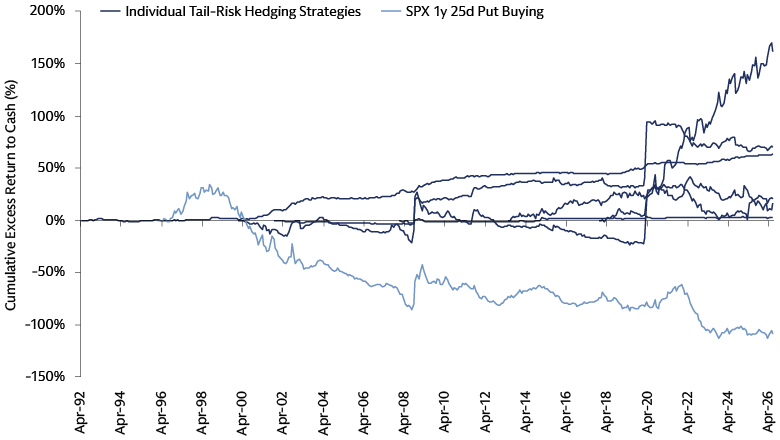
Source: Goldman Sachs Multi-Asset Solutions as of April 2026. Inception dates: Convex Rates as of October 1992, FX TRH as of October 2001, VIX Replication as of December 2007, Downvar as of January 2000, Dispersion as of November 2017, Rates Volatility Carry as of May 2013, and SPX 1y 25d Put Buying as of January 1996. For illustration purposes only. “SPX 1y 25d Put Buying” refers to a long-dated contract that gives purchaser the right to sell the cash-settled S&P 500 Index at a specific strike price 12 months from now, with a strike chosen at roughly a 0.25 delta value; it is typically used as a long-term portfolio hedge to protect a stock portfolio against severe market crashes, or as a directional bet on a major economic downturn over the coming year. Past performance does not predict future returns and does not guarantee future results, which may vary.
Enabling Structural Upside Potential with Stability
- Tail-risk hedging strategies aim to provide convex, positive returns during market drawdowns while remaining broadly uncorrelated with equities across the cycle
- We believe the strategy’s true value lies not as a standalone return driver but in enabling investors to take greater risk in core assets by reducing downside losses and improving portfolio resilience.
- We believe that for corporate pension allocators, the strategy is well-suited to serve as a risk management tool to provide funded status protection in market downturns while enabling sustained equity exposure.
Source: Goldman Sachs Asset Management as of July 2026. Past performance does not predict future returns and does not guarantee future results, which may vary.