Physical Climate Risk Is Now Front and Center for Investors




Key Takeaways
Extreme weather and climate events such as storms, heat, wildfire, drought, and changing rainfall patterns can affect the resilience of companies’ assets as well as how they operate, what they sell, and how much they spend. We have seen these physical climate risks become increasingly prominent in earnings presentations in recent years, indicating that they are no longer just long-term planning concerns. We believe companies and their investors need to understand how these risks are affecting financial performance, and how they can respond.
To help demonstrate the impact these events are having, we analyzed how companies talk about them on earnings calls. We looked specifically for comments linking physical climate risks and financial impacts in areas such as revenue, operating expenses, cash flows, physical assets, insurance costs, and business costs. We found that some asset-heavy sectors, led by utilities, address these financial impacts more often than others, and that the reported hazards vary widely by geographical region. These findings set the stage for future inquiry into the magnitude of the financial impacts, the ways investors can gain insight into these risks, and how they can integrate this information into security selection, portfolio management, and active ownership.
Analyzing corporate discussion of climate hazards
Physical climate risk refers to the business impact of weather- and climate-related events. Some, referred to as acute events, happen suddenly, such as hurricanes, windstorms, floods, wildfires, hail, cold spells, heavy snow or extreme heat. Others develop over time. These are known as chronic events and include rising average temperatures, shifting rainfall patterns, drought, sea-level rise, and changing snow or glacier conditions.
The impact of these events at times can be seen in the way companies explain their financial results. We reviewed transcripts of earnings calls from the past five years for the companies in the MSCI ACWI Index, a global stock market benchmark. By identifying comments referencing physical climate hazards, we narrowed in on comments that connected these hazards to financial effects. Our review yielded about 12,000 mentions of physical climate risk with financial impacts across 1,000 unique companies.
Earnings calls tell us what has already happened and can provide insight into where companies see impacts and how they are managing them. For the most part, companies – even insurers that are managing future risks – discussed current financial effects rather than long-term expectations. They described weather and climate hazards affecting revenue, operating expenses, cash flows, assets, and operating resilience. Across the full set of qualifying commentary, the financial channels mentioned most often were revenue and operating expenses.
Analyzing the language used on earnings calls has two main limitations. First, it can only measure what companies choose to say. A company that was exposed to physical climate risk but did not mention it on these calls would not appear in the results, and those that discussed risk in general terms without linking it to a specific financial line item were recorded as a mention without a financial effect. Second, this approach did not allow us to quantify the size of the impacts mentioned, to distinguish reversible from permanent impacts, or to attribute them to climate risk or chronic events as opposed to ordinary weather variability.
On this second point, we assumed for the purposes of this analysis that when a company chooses to mention potential or actual impacts of physical climate risk on an earnings call with analysts and investors, the impact can be considered material. We believe this is reasonable given the mostly scripted and legally vetted language typically used on these calls, which are designed to provide investors with the most relevant information.
Ranking sectors by performance links
The discussion of physical climate risk varied across industries in our analysis. We found that operating footprint and business model were the main factors determining companies’ reported exposure to chronic impact drivers or acute events. A subset of companies in these sectors explicitly linked these hazards to reported financial results. In our analysis, we classified hazards using the AR6 Climatic Impact-Driver framework developed by the Intergovernmental Panel on Climate Change (IPCC).1
Our analysis showed that capital-intensive sectors such as utilities, energy and materials were most likely to mention a link between physical hazards to financial performance, a finding consistent with fixed-asset bases exposed to location-specific hazards. Less capital-intensive sectors made this linkage less frequently, though it remained observable. Insurance was the notable exception because its underwriting result is directly exposed to physical events, particularly acute ones.
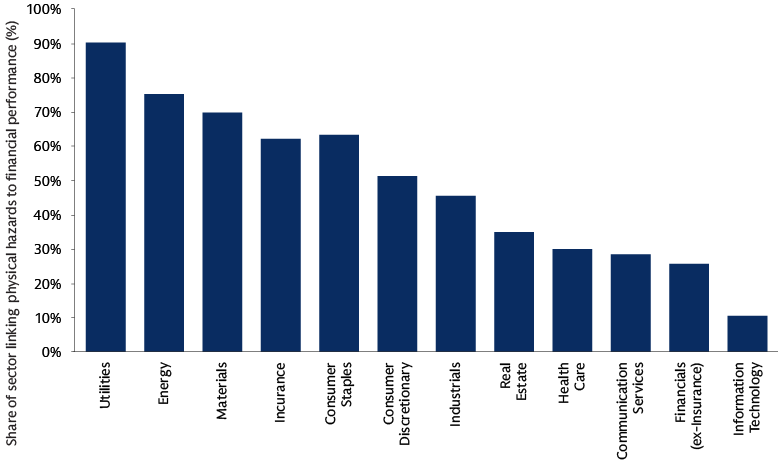
Source: Goldman Sachs Asset Management, MSCI, London Stock Exchange Group. Data as of June 30, 2026. Sectors are classified according to the Global Industry Classification Standard (GICS). The analysis was conducted on companies in the MSCI ACWI Index. Earnings-call transcripts were sourced via LSEG.
Locating the risks in income statements
We found that reported climate-linked financial impacts were concentrated in the income statement. Revenue was the most common channel affected, appearing in 68% of qualifying commentary. Operating expenses placed second with 17%. Asset-heavy companies often focused on wildfire, mitigation, resiliency, reliability, grid, damage and infrastructure. This suggests that companies with more physical infrastructure may be more likely to discuss climate hazards in terms of asset damage, reliability, resilience spending, or capital investment.
Less asset-heavy business models more often mentioned impacts in terms of demand, sales, pricing or volumes. Company comments often described the effects of unexpected weather and climate conditions on demand, volumes, production, pricing, and sales, indicating that physical climate risk can extend beyond asset damage to the revenue and operating lines. While the magnitude of these impacts is not yet quantified, it remains a priority area for our continued analysis.
Insurance and reinsurance companies stand apart because physical hazards are directly connected to the risks they underwrite rather than their direct assets. As a result, insurers placed upwards of 80% of qualifying commentary in operating expenses and only 10% in revenue. Their language was dominated by claims and catastrophe-loss terms, reflecting the economics of insurance. A major storm, wildfire or flood can directly affect claims costs and underwriting results. For the non-insurance companies, physical climate risk also carried an insurance dimension. Of the roughly 1,500 companies with any climate-linked commentary, 16% referenced the insurance market at least once. Almost half of these cited rising premiums, and around a quarter cited larger losses or non-renewal of coverage.
Mapping companies’ reported physical risk
Physical climate risk is highly location-specific. The most significant hazards in one region may be less prevalent or even absent in another. Based on operating location, North America accounted for the largest number of mentions of tropical cyclones, severe windstorms, and wildfires in our analysis. Precipitation ranked first in Asian emerging markets, while precipitation and drought ranked high in Latin America.
We also gained important insights into location risk by looking at commentary on revenue, which reflects sales disruptions. This approach proved especially useful for less capital-intensive industries. For example, some companies based in developed countries mentioned physical climate-risk impacts that originated in Asian emerging markets. This shows how using revenue to assess physical risk exposure can be complementary to looking at location exposure. In our calculations, after accounting for companies that generate a meaningful share of revenue outside their country of risk, some large developed market-based company mentions were reclassified as relating to Asian emerging markets. This enabled us to identify a more nuanced geographical distribution of company commentary on physical climate risks.
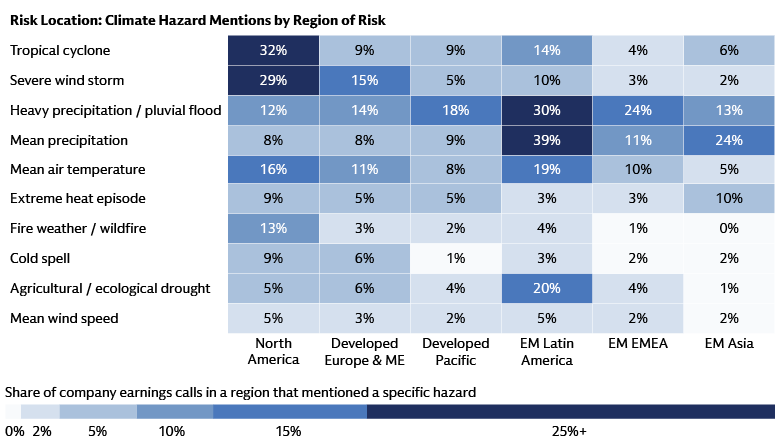
Source: LSEG StreetEvents, MSCI ACWI, FactSet GeoRev, Bloomberg. As of June 30, 2026. Universe: 2,212 called-ACWI issuers, 2021-2026. Cell = % of regions called-ACWI issuers with at least one qualifying disclosure.
Building a toolkit that is fit for purpose
Physical climate risk is no longer a distant threat or theoretical concern; it is already impacting companies’ business lines and reported results. Analyzing earnings-call commentary from company leaders shows how this risk is materializing today. Asset-intensive companies such as utilities more often mentioned climate hazards in terms of asset damage and capital investment, while less asset-heavy companies spoke more often of impacts in areas such as sales and pricing. The urgent need to address physical climate risk is driving the development of increasingly sophisticated tools and frameworks for assessment.
The main takeaway from our analysis is that investors can benefit from examining physical climate risk in two stages. First, a broad, top-down analysis using tools such as analysis of earnings-call commentary can help identify the sectors and regions where companies have most frequently mentioned climate-related financial impacts. Based on the results of this analysis, investors can be more thoughtful about the types of tools they deploy in a second stage of analysis to examine risks and impacts at a more granular level. This can involve a deeper dive into existing impacts and forward-looking analysis using data-driven tools and engagement insights to support security selection, portfolio construction, and active ownership. Used together, these inputs can help investors better assess exposure, encourage stronger resilience planning, and seek to protect long-term value.
1 The IPCC presented this framework as part of its Sixth Assessment Report (AR6). See “Annex VI: Climatic Impact-driver and Extreme Indices,” IPCC. As of 2021. The IPCC is the United Nations body for assessing the science related to climate change.