Replication Strategies: Past, Present, and Portfolio Potential




1. What are replication strategies?
Liquid alternative replication strategies are a subcategory of quantitative, factor-based investing. These strategies aim to closely mirror the risk and return profile of less liquid or harder-to-access alternative investments in a more transparent, liquid, and lower-cost format.
In recent years, we have seen replication strategies expand beyond hedge funds to encompass other alternative asset classes, including private equity. Both hedge fund and private asset replication share the same objective: providing efficient access to alternative return drivers through liquid, transparent, and scalable investment vehicles. The difference lies in what is being replicated.
Hedge fund replication focuses on identifying and capturing the broad market exposures and trading strategies that drive returns across different styles of hedge funds. Private equity replication seeks to capture the country, sector, and style characteristics of private companies by investing in listed securities. In this case, the underlying return drivers are private, but the building blocks are public.
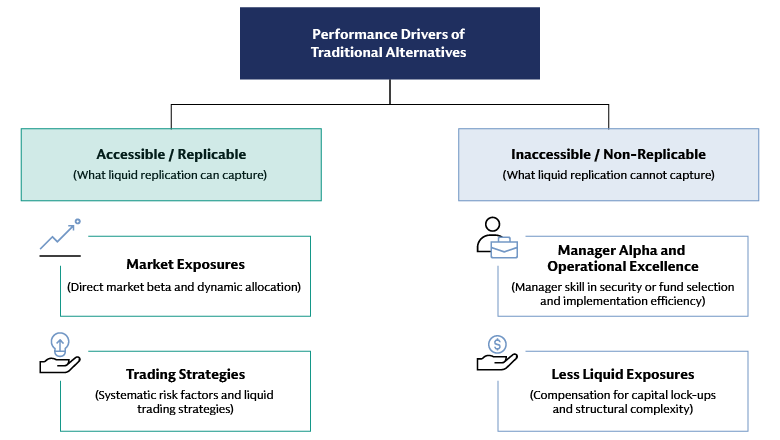
Source: Goldman Sachs Asset Management. For illustrative purposes only. As of June 2026.
2. How have approaches to replication evolved?
Our approach to replication has always begun by asking: what drives an asset class's returns, and can those drivers be systematically captured? This focus has not changed and remains central to how we evaluate replication strategies today. Nevertheless, the industry has evolved dramatically.
Two decades ago, replication was a scale challenge that involved collecting sparse data to understand broad hedge fund behavior. Today, we view replication as a depth challenge driven by exponential growth in data granularity across asset classes and access to high-performance computing.
Early replication – focused on hedge funds – took a top-down approach: a dozen key market factors, typically common indices, dynamically weighted by regressing against a top-line alternative return stream. With the expansion of available data, a more granular, bottom-up approach became feasible. Moreover, advanced statistical techniques, such as dynamic state-space modeling, improve the accuracy of reconstructing and capturing the economic exposures, investment decisions, and risk premia that underpin hedge fund performance.
Trading patterns – such as merger arbitrage, trend following, carry, value, and momentum – can be modeled as distinct factors alongside traditional market exposures. By combining these building blocks and estimating their changing importance through time, replication can now decompose complex return streams and track underlying alternative universes with greater precision.
Over the last decade, the return correlation between replication and the actual hedge fund universe has generally increased, signifying that models have become progressively more accurate in tracking the performance of the underlying asset class.
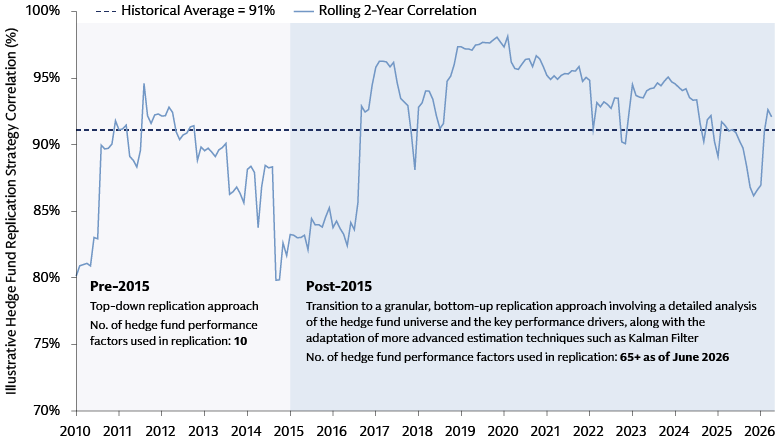
Source: Goldman Sachs Asset Management and Barclay Hedge. Past correlations are not indicative of future correlations, which may vary. As of June 2026. Correlation shown relative to the Barclay Hedge Fund Index.
As replication strategies expand into private equity, capturing exposure in this space is uniquely challenging due to the low frequency of reporting inherent to private markets. To overcome this hurdle, advanced statistical techniques can be applied to a combination of General Partner (GP) holdings and their investment performance. This seeks to enable construction of a dynamic, liquid allocation capable of tracking private assets exposure.
3. What potential advantages can replication strategies bring to portfolios today?
In addition to making alternative investments more accessible, replication offers several potential portfolio benefits. Liquid formats allow allocators to adjust positioning as market conditions and objectives evolve. Built on systematic, observable processes, replication delivers potentially greater transparency into portfolio construction and return drivers. This can improve governance, oversight, and integration within a broader asset allocation framework.
Rather than relying on the skill of a small number of individual managers, replication seeks broad exposure across investment styles, sectors, and markets, mitigating idiosyncratic manager-selection risk and delivering a more consistent investment experience. It also simplifies implementation and operational complexity, reducing the costs associated with due diligence and fund administration.
Use cases can also be asset-class specific. For example, private equity replication can serve as a liquidity sleeve within a broader private markets program: rather than holding low-yielding cash or fixed income while waiting for capital deployment opportunities, investors can maintain exposure to private-equity-like return drivers while preserving flexibility and liquidity.
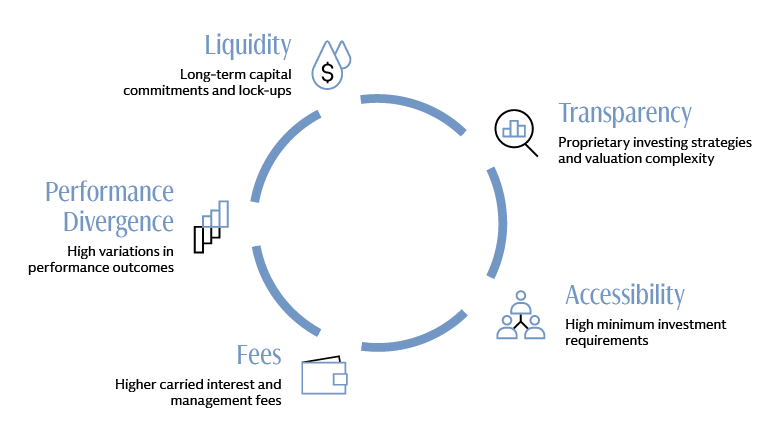
Source: Goldman Sachs Asset Management. For illustrative purposes only. As of June 2026.
We believe the potential benefits outlined above are particularly appealing in today’s environment. Elevated interest rates and inflation, persistent volatility, and prolonged private market exit timelines have boosted investor demand for liquidity, transparency, and cost efficiency. Replication can help address these dynamics by serving as an efficient liquidity sleeve, enabling investors to maintain target alternatives exposures through liquid, listed securities while preserving flexibility to meet capital calls.
Overall, we believe that replication strategies are a prudent way to access the portfolio benefits of alternatives while potentially reducing the performance cyclicality that may result from style timing or manager selection. In our view, this makes these strategies an appropriate solution for core alternatives allocations. We expect replication strategies will increasingly operate as building blocks within larger public-private portfolio frameworks rather than as standalone products.
4. How do data, technology, and research drive replication outcomes?
The success of any replication strategy relies heavily on advanced data and technology infrastructure. To achieve high tracking accuracy, we believe a replication platform must integrate comprehensive global databases covering trillions of dollars in assets under management across thousands of funds.
Furthermore, in the case of private equity more specifically, establishing strategic partnerships with leading data providers is critical to securing granular private equity characteristics data across tens of thousands of underlying companies. A deep pool of data, combined with advanced analytics, allows systematic models to remain highly dynamic across changing market regimes.
While successful replication requires access to sophisticated and timely data, it is a research challenge, requiring an ability to identify meaningful signals within vast and evolving investment universes and translate them into investable portfolios. Ultimately, an unwavering commitment to continuous research and innovation is what allows successful systematic models and processes to evolve alongside changing market dynamics while minimizing tracking error over time.
5. What does the road ahead look like for replication strategies?
We believe that the future of replication is likely to be defined by even greater granularity, customization, and integration of new data sources. As discussed, the objective is not simply to mirror historical returns, but to identify the underlying drivers of alternative investment performance and translate them into robust, investable portfolios. Achieving this requires a combination of extensive datasets, sophisticated quantitative techniques, deep market expertise, and the ability to continuously adapt as the underlying investment universe evolves.
In our view, future research in the hedge fund replication space is likely to center on three themes:
- Extracting more information from the growing hedge fund data ecosystem
- Improving the identification of dynamic exposures across hedge fund styles
- Developing more targeted replication approaches for specific hedge fund opportunity sets such as macro, relative value, and event-driven investing
For private asset replication, the next frontier may extend in two directions. The first may involve a more granular breakdown and understanding of the private asset universe. This may entail leveraging a growing pool of private asset datasets to enable even more precise replication of its underlying characteristics. In turn, this could lead to improved replication quality, mirroring the progress seen in hedge fund replication. Secondly, replication may extend to other private asset classes – such as private credit, real estate, or infrastructure.
Interested in exploring investment opportunities related to replication? We'd welcome the opportunity to discuss how replication strategies could fit within your portfolio.