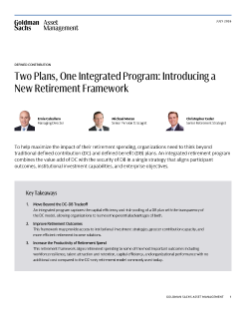
Two Plans, One Integrated Program: The Next-Gen Retirement Framework




The US retirement landscape is defined by two structurally imperfect models:
- DC plans: While maximizing portability and administrative simplicity, these plans shift the burden of retirement security entirely to the participant. Employees are forced to assume the roles of chief investment officer, actuary, and longevity risk manager, a transition that has frequently resulted in systemic under-saving, restricted investment access, and a lack of viable mechanisms for efficiently converting accumulated wealth into lifetime income.
- Legacy DB plans: While historically effective at delivering predictable outcomes, the traditional DB framework has become increasingly untenable for sponsors. Persistent asset-liability mismatches, historical interest rate volatility, and the lack of portability have transformed these pension obligations into volatile balance-sheet liabilities that many organizations can no longer sustain.
In a market defined by rigorous cost discipline, intensifying talent competition, workforce mobility, and heightened scrutiny of every major capital allocation, retirement spend deserves a more strategic test: What enterprise value is the organization buying with each retirement dollar?
- Are retirement contributions optimizing capital efficiency?
- Does the framework serve as a high-performance lever to attract, retain, and engage the workforce the organization needs?
- Is retirement a legacy structure being maintained or a forward-looking lever of enterprise value?
While neither model in isolation fully addresses the complexities of the modern retirement landscape, the implementation of a hybrid retirement framework offers a compelling solution. By integrating the value-added attributes of DC plans with the security and professional management of DB structures, organizations can establish a “two plan, one program” framework that could help optimize participant benefits, enhances retirement outcomes, and maintains cost neutrality.
Two Plans, One Integrated Program: Stronger Retirement Outcomes
This new framework is not a return to legacy pensions; it is a new way of thinking to leverage optimal plan design that could lead to improved retirement outcomes. It allows the DC plan to serve the roles for which it is naturally suited (individual savings and flexibility) while the MBCB plan performs the roles for which DC is ill-equipped (centrally built investment portfolio and longevity pooling for retirement income).
The mandate is clear: design for effectiveness, communicate for action, govern for optimization, and measure for results.
We encourage you to download the full publication to understand why we believe enhanced DC is the next-generation retirement framework.
Connect with your Goldman Sachs Asset Management DC or DB Specialist to learn more about how we can create stronger retirement outcomes together.