Unlocking Tax Efficiency: The Importance of Strategic Asset Allocation and Asset Location




Key Takeaways
Understanding Asset Class Tax Efficiency and Tax Treatment of Account Types Is Key
We recently explored the importance of managing your portfolio with after-tax returns in mind and examined the tax implications of active management. In this paper, we explore combining tax-aware SAA with asset location. An effective asset location SAA is built upon a foundational understanding of two key areas: the tax treatment of different asset classes and the unique tax rules governing investment accounts.
Asset Class Tax Efficiency: Different assets generate returns that are taxed at varying rates
- Tax-Inefficient Assets: These generate returns that are frequently and highly taxed, such as the interest from corporate bonds, which are often taxed at high ordinary income rates.
- Tax-Efficient Assets: These generate returns primarily through long-term capital appreciation. The tax is deferred until the asset is sold and is typically taxed at lower long-term capital gains rates. US growth stocks are a prime example.

Investment Account Types: Investors typically use a mix of accounts, each with a distinct tax profile
- Taxable (e.g., brokerage accounts): Offers maximum flexibility but minimal tax shelter. Interest, dividends, and realized gains are taxed annually.
- Tax-Deferred (e.g., Traditional 401(k), Traditional IRA): Contributions may be tax-deductible. Assets grow tax-free until retirement, when withdrawals are taxed as ordinary income.
- Tax-Exempt (e.g., Roth 401(k), Roth IRA): Contributions are made with after-tax dollars. All qualified withdrawals in retirement are completely tax-free.
Personalizing asset allocation across these accounts may be the key to unlocking better after-tax returns.
Insights Into Our Methodology
Consistent with our earlier papers, we adjusted tax-exempt capital market assumptions to create taxable capital market assumptions over a 10-year investment horizon. For fixed income, we adjust returns using ordinary income rates on coupons while attributing credit losses as an offset to capital gains. For equities, we adjust returns in three steps:
- We apply taxation on dividends based on the composition of qualifying and ordinary dividends.
- We reinvest after-tax dividends and update the cost basis.
- We annualize total returns after taxation. As our analysis covers the accumulation period, we do not incorporate any distribution taxes.
Using these taxable assumptions, we built SAA portfolios that consider asset location for a 60/40 benchmark investor. We tested various splits between taxable and tax-advantaged accounts, from 90% tax-advantaged/10% taxable to 10% tax-advantaged/90% taxable.
For each of these portfolios, we then compare the resulting allocations and expected pre-tax and post-tax returns to a simplified approach of allocating the same basic SAA (SAA optimized based on pre-tax returns) in each account. We repeated the analysis for investors at two different levels of taxation, High Tax Bracket (HTB) and Low Tax Bracket (LTB), and compared the benefits of asset location for each of these investors.
We show sample allocations for high-tax bracket investors with three different splits of taxable and tax-advantaged accounts (see full document). The balance available in tax advantage accounts is first allocated with most tax-inefficient assets filling up the account with any remaining allocations done in taxable accounts.
Our Observations and the Potential Benefits We See
Our analysis shows that a well-designed, tax-aware SAA with asset location may generate more than 45 bps of additional annual after-tax returns for high-tax bracket investors, compared to a traditional, tax-agnostic approach. The potential benefits vary based on the investor's tax bracket. The higher the tax bracket, the greater the benefit. High-tax bracket investors gain the most by reducing tax drag on inefficient assets. Even low-tax bracket investors may add up to 25 bps annually versus a location-agnostic approach. These extra returns can translate into a 10% and 5% increase in retirement savings for high-tax and low-tax bracket investors, respectively, over a 20-year period.
The potential benefits of asset location depend on the mix of tax-advantaged versus taxable assets and the investor's target allocation. These factors dictate how many tax-inefficient assets can be optimally placed and the capacity available to reduce 'tax drag' (the negative impact of taxes on returns). The exhibits below compare the benefits across different splits of accounts and for different target allocations. The first exhibit compares benefits for various splits of taxable and tax-advantaged assets for a 60/40 stock/bond benchmark. The second exhibit compares the benefits of various stock/bond allocations for a 50/50 taxable and tax-advantaged asset split.
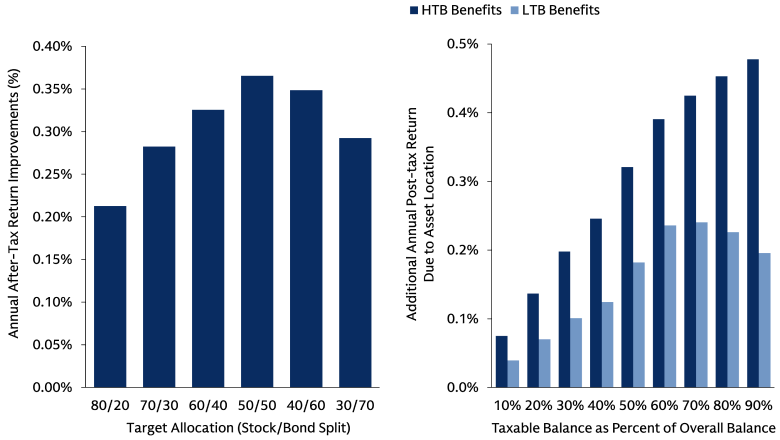
Source: Source: (1) Goldman Sachs Asset Management. As of December 31, 2025. Potential additional annual post-tax returns for an investor with a target allocation of 60% equities and 40% fixed income and different mix of taxable and tax-advantaged assets. HTB investors are assumed to be taxed at high tax bracket (see full document for tax rates) and LTB investors are assumed to be taxed at low-tax bracket. For illustrative purposes only. (2) Goldman Sachs Asset Management. As of December 31, 2025. Potential post-tax returns for a HTB investor with 50% taxable and 50% tax-advantaged assets and various target mix of stocks and bonds. For illustrative purposes only.
Growth stocks tend to be more tax-efficient than value stocks due to the deferral of capital gains and lower dividends. Depending on the tax-advantaged space available in accounts, a higher allocation to growth stocks can enhance after-tax returns. Additionally, strategically allocating growth stocks in taxable accounts and value stocks in tax-advantaged accounts may reduce the tax drag from value stocks.
For investors with larger taxable balances, we see an increasing allocation to growth and small-cap equity and a reduction in allocation to value equity as mentioned above. The above adjustments, along with reduction in allocation HY credit due to its tax inefficiency and high correlation with equities, can potentially increase post-tax returns without significantly increasing risk.

Source: Goldman Sachs Asset Management. As of December 31, 2025. Comparing post-tax returns and volatility of location agnostic and location-aware portfolios for an investor with 50% taxable and 50% tax-advantaged assets and a target allocation of 60% equities and 40% fixed income. The HTB portfolio is assumed to be taxed at high-tax bracket (see full document for tax rates) and LTB portfolio is assumed to be taxed at low-tax bracket. For illustrative purposes only.
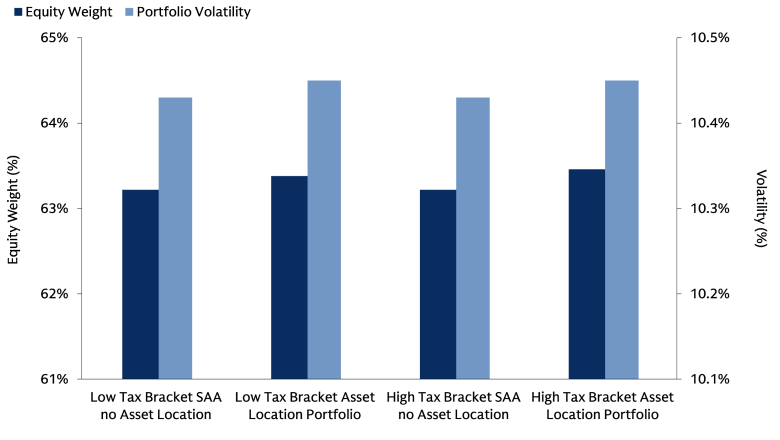
Source: Goldman Sachs Asset Management. As of December 31, 2025. Comparing volatility and equity weight of portfolios with and without asset location for an investor with 50% taxable and 50% tax-advantaged assets and a target allocation of 60% equities and 40% fixed income. The HTB portfolio is assumed to be taxed at high tax bracket (see full document for tax rates), and the LTB portfolio is assumed to be taxed at low tax bracket. For illustrative purposes only.
These granular adjustments, as demonstrated in the exhibit below, may contribute to the enhancement of post-tax return of a tax-aware and location-aware SAA.

Source: Goldman Sachs Asset Management. As of December 31, 2025. Illustrates the components of additional post-tax returns from tax-aware and location-aware SAA for an investor in HTB with 70% taxable and 30% tax-advantaged assets and a target allocation of 60% equities and 40% fixed income. For illustrative purposes only.
Considerations for Implementation
Practical implementation of asset location needs to take rebalancing costs into consideration. Rebalancing costs can be mitigated by using cash inflows to correct asset class imbalances. Furthermore, depending on the balance between taxable and tax-advantaged assets and target allocation, rebalancing costs can be further reduced by rebalancing first in the tax-advantaged accounts.
For investors that would like to enhance their after-tax returns using tax loss harvesting, asset location may provide an additional advantage by preferentially locating equity in the taxable accounts compared to a location agnostic asset allocation.
Largest benefits of asset location occur for investors with a mix of taxable and tax-advantaged assets, as well as balanced allocation. Younger investors who are most likely to have only tax-advantaged assets and more equity-heavy allocations will benefit as asset allocations become more conservative over time, and they accumulate taxable savings. For clients just beginning their savings journey or with lower incomes, the initial focus is on maximizing contributions to tax-exempt and tax-deferred accounts. Financial advisors should prioritize pre-tax asset allocation in these vehicles as a crucial step for accumulating wealth efficiently.
As clients achieve higher incomes, while a significant portion of their assets may still reside in tax-exempt accounts, taxable accounts begin to play a more prominent role. For these clients, focusing on combining a tax-aware SAA along with asset location may offer potential benefits and enhance their after-tax wealth.
Combining tax-aware SAA with asset location may maximize your clients’ after-tax returns
Failing to account for taxes in strategic asset allocation is a costly oversight. A simple, tax-agnostic approach that implements the same allocation across all account types is suboptimal and reduces post-tax returns. This paper aims to demonstrate that a holistic, tax-aware SAA that thoughtfully incorporates asset location can generate tax alpha, leading to higher after-tax returns and greater terminal wealth.
The optimal strategy, however, is not one-size-fits-all. It demands customized implementation based on an investor's specific tax situation, account balances, and long-term goals. By adopting this sophisticated framework, investors may achieve significant additional value and more effectively achieve their financial objectives.