Unlocking the Hedge Fund Opportunity Set




Key Takeaways
We recently outlined the case for hedge funds in today’s market environment, arguing that their uncorrelated streams have become a portfolio imperative rather than an optional allocation. But conviction in hedge funds alone is insufficient. Here we address the critical "how" that follows the "why," offering a framework to navigate hedge fund access constraints and consider ways to turn implementation into a competitive advantage.
The Implementation Challenges — Closed Doors and Tightening Terms
More closed: While the case for hedge funds is compelling, implementing exposure is more challenging. Top-tier managers are frequently closed to new capital. Over a third (34%) of flagship funds of the largest 100 hedge fund managers are closed to new investment, representing close to half (48%) of flagship hedge fund assets.1 These constraints are most visible in the quant, macro, and multi-strategy categories, all of which have seen stronger performance and fundraising success in recent years.
Importantly, less capacity availability does not automatically translate to quality. Hedge funds with lower assets under management (AUM) tend to have more capacity available and returns for top-quartile (75th percentile) boutique managers with less than $5 billion in AUM have been broadly comparable to those of their larger, more established peers.2 The primary challenge for allocators is not a lack of talent, but rather having the dedicated internal resources and deep sourcing networks required to effectively identify high-performing managers given the wide performance dispersion across the hedge fund universe.
More onerous terms: Alongside capacity, fees are a key consideration. While hedge fund fees saw a period of compression in the 2010s, they started to rise again in 2019, and there has been a gradual uptrend concurrent with stronger performance. The average management fee climbed from 1.46% in 2019 to 1.64% in 2025, while the average performance fee rose from 16.4% in 2019 to 17.8% in 2025. Allocators must also navigate pass-through fee structures—now near-universal among multi-managers—which allow hedge funds to pass on incremental expenses like PM compensation, real estate, and travel at their discretion.
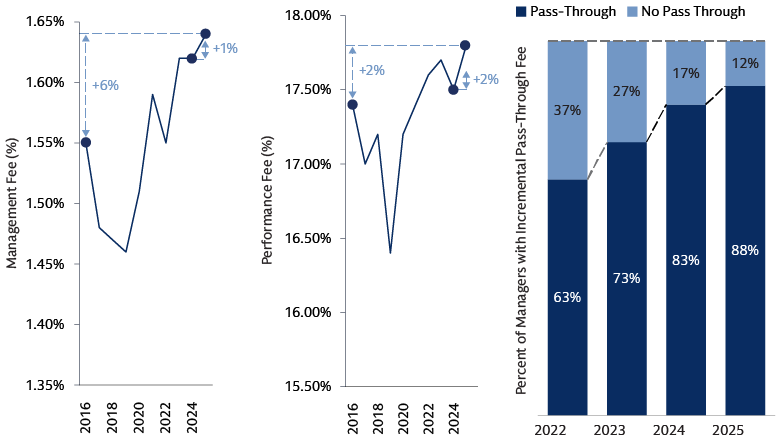
Source: Management and performance fees. Goldman Sachs Global Banking & Markets, Prime Services, Hedge Fund Insights & Analytics. Management and performance fees based on Goldman Sachs Annual Allocator Surveys 2013-15 and 2017-2025. As of January 2026. Pass-through fees based on Goldman Sachs Global Banking & Markets. Prime Services. The Multiplier Effect: 2025 Edition. As of October 2025.
In addition to costs, managers have added more onerous liquidity terms to their funds, the majority of which have done so during the last three years.3 The most common change to liquidity terms has involved the introduction or lengthening of investor-level gates: the effect of this has been to increase the total time it would take an allocator to fully redeem their investment to an average of 27 months, versus a prior average of just seven months.
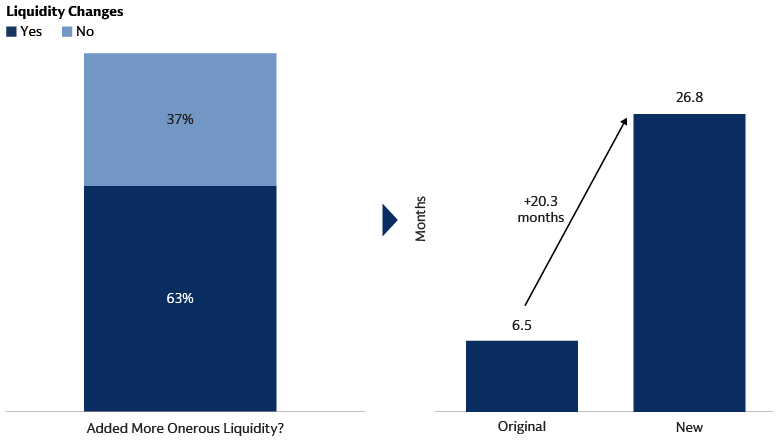
Source: Goldman Sachs Global Banking & Markets, Prime Services, Hedge Fund Insights & Analytics. The Multiplier Effect: 2025 Edition. As of October 2025.
The Potential Solutions — Casting a Wider Net and Structuring for Success
We see ways to solve hedge fund implementation challenges: first, by casting a wider net based on an allocator's own resources and their specific investment objectives, and second, by turning implementation into a competitive advantage by optimizing how exposures are structured.
Considerations when casting a wider net
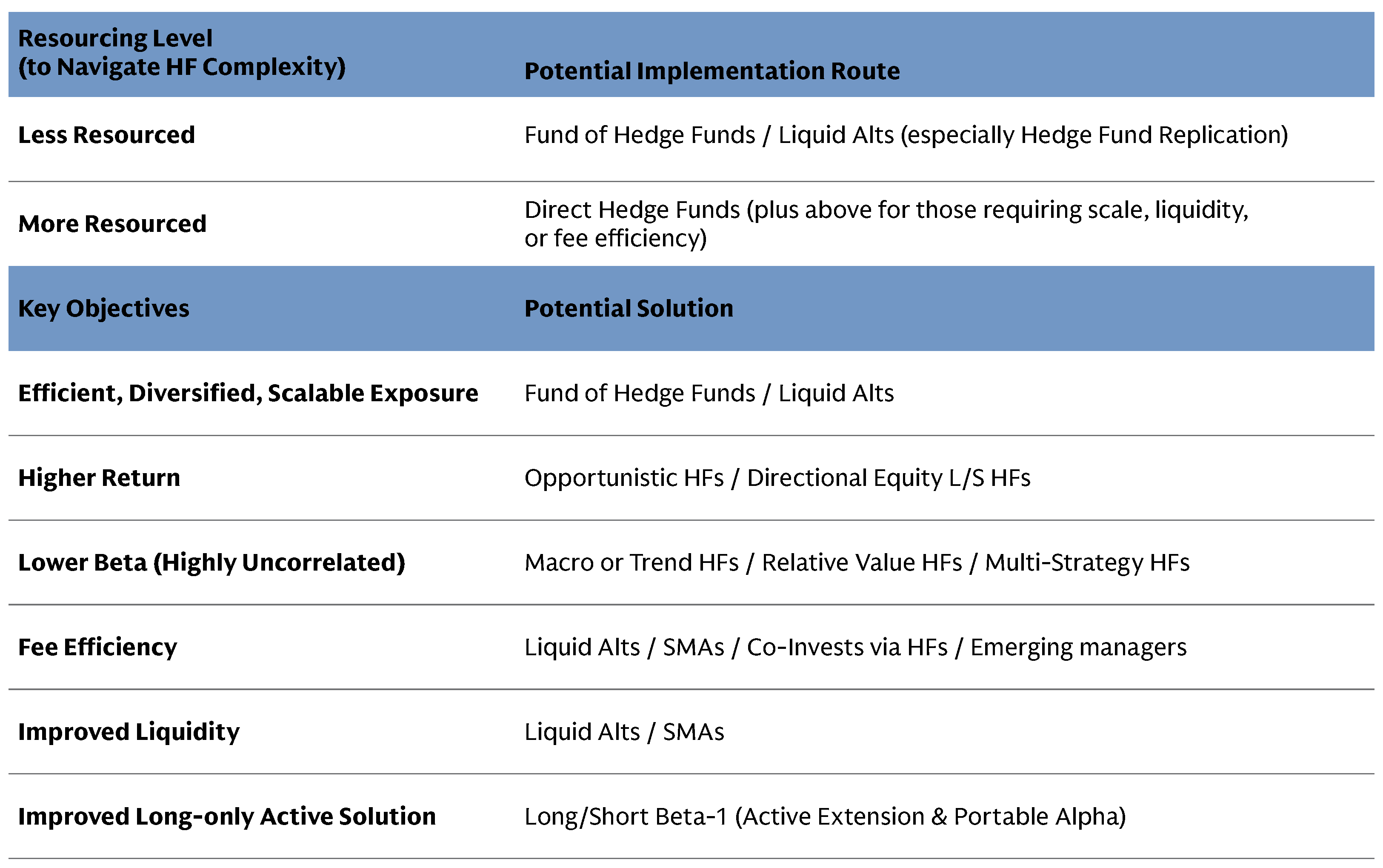
To navigate the implementation challenge (tougher to access, more onerous terms), we suggest allocators cast a wider net across fund types (multi-strategy and specialized hedge funds), access points (commingled and SMAs, co-investments), and vintages (established and newer). The exact way of utilizing these pillars should be determined by specific return, risk, liquidity, style, and fee objectives along with the degree to which allocators are resourced internally.
On the resourcing level, those that are more constrained may opt for access solutions like funds of hedge funds or liquid alternatives (especially liquid replication) strategies to solve the implementation challenge in a turn-key way. Others with dedicated, specialized investment teams and infrastructure often choose to invest directly in hedge funds.
On the objectives level, it’s important to map out one’s specific return, risk, liquidity, style, and fee targets. Once these parameters are established, allocators can more effectively assess the optimal implementation and define the precise role these strategies should play within their broader asset allocation.
Source: Goldman Sachs Asset Management.
Spotlight on SMAs

Allocator adoption of SMAs offering ticker-level transparency is on the rise given the incremental capital efficiency and portfolio construction benefits the structure offers over commingled funds. However, SMAs are typically not a universal solution. High-quality boutique hedge fund managers willing to offer SMAs are harder to find and harder to underwrite. Additionally, operational complexity is higher, shifting some responsibilities from the fund manager directly to the allocator. Consequently, we view this structure as primarily viable for sophisticated allocators who possess the capital and commitment to build and maintain robust operational infrastructure.
Implementation as a differentiator
Casting a wider net can expand the hedge fund opportunity set, but access alone is not enough. In our view, the ability to structure and manage hedge fund exposures effectively can be as important as the ability to identify compelling managers in the first place.
Manager selection remains critical. Yet, in a market where capacity is limited and terms are increasingly customized, identifying a strong manager does not necessarily mean an allocator can access that manager in the right vehicle, on suitable terms, or at a meaningful scale. Those outcomes often depend on the depth of an allocator’s relationships, diligence resources, operational capabilities, and ability to act when opportunities arise.
This is where implementation becomes a differentiator. A commingled fund may be the most appropriate solution in some cases. In others, an SMA, co-investment, or customized mandate may offer a better fit for an allocator’s objectives. The advantage is not simply having multiple access points available; it is having the capability to assess the trade-offs and use the right structure for the opportunity.
A portfolio-level approach can also help allocators move beyond evaluating each hedge fund investment in isolation. Liquidity, transparency, fees, and risk exposures can be considered collectively, rather than inherited manager by manager. This may help avoid unintended concentrations, improve alignment between the hedge fund portfolio and broader liquidity needs, and ensure that the economics of an allocation are proportionate to the value being delivered.
Capital efficiency and portfolio fit are other considerations. Hedge fund allocations are often treated as a standalone sleeve alongside equities and fixed income. But for those seeking greater capital efficiency and improved long-only active results, long-short beta-1 solutions can be utilized. These unique portfolio constructs enable allocators to import more activeness (i.e., hedge funds) into their long-only exposures in a more capital-efficient way helping to solve the long-only passive and active problem.
For allocators able to build and maintain these capabilities internally, this can create an opportunity to access a wider range of return sources and construct hedge fund portfolios more deliberately over time. However, developing the required sourcing network, investment and operational infrastructure, and structuring expertise can be difficult and costly to replicate. For those without the internal scale or specialist resources to do so, partnering with a well-resourced asset manager may provide a practical route to broader access, institutional due diligence, and more flexible implementation.
In summary, the case for hedge fund exposure is among the most compelling it’s been since pre-global financial crisis, but the ability to implement it has never been more challenging. We believe the recipe for success is to cast a wider net across hedge fund type and access vehicle and to align with a strategic partner who can help you navigate the incremental complexities.
We are here to help you unlock the hedge fund opportunity set and strengthen your portfolio.
1 Goldman Sachs Global Banking and Markets, Prime Services. As of January 2026.
2 Albourne Database. As of December 2025.
3 Goldman Sachs Global Banking and Markets, Prime Services. As of October 2025.