What Impact Do Data Centers Have on Municipal Credit?



Key Takeaways
With data center development accelerating across the country, we are often asked what impact these projects have on municipal credit. It is an important question without a single answer, as projects vary broadly in their impact on local economies, budgets, infrastructure, and tax and spending policies. Our view is that near-term municipal credit risk is generally limited, particularly because these projects are privately financed, with local governments retaining control over zoning and incentives. The more important credit question is the medium- to longer-term impact if data center growth creates revenue concentration, shifts infrastructure costs to taxpayers, or constrains local flexibility around power, water, and land use.
While municipalities typically encourage industrial development as a source of economic growth, job creation and tax revenue, data centers offer both opportunities and challenges. Data centers can expand the tax base and support redevelopment of underutilized properties, but often require significant power, water, and infrastructure investment while creating relatively limited permanent employment. As a result, municipal impacts depend on project structure, location, tax policy, and the need for public support.
As active managers, we review these projects seeking to identify potential benefits and risks across states and localities. Our analysis focuses less on announced capital investment and more on the fiscal, economic, and resource impacts that ultimately drive municipal credit quality. We assess how data center development impacts municipal credit today and where longer-term risks may emerge, using projects in Virginia, Tennessee, and Ohio as examples.
The Growth of the Data Center
In late 2025, data center construction eclipsed office building projects in the US. In truth, data center projects preceded the quantum leap in AI projects for simple computing needs and, technically speaking, initially developed back in the 1940s. We are now seeing a rapid escalation in the construction of these centers, and the associated costs of development have exploded.
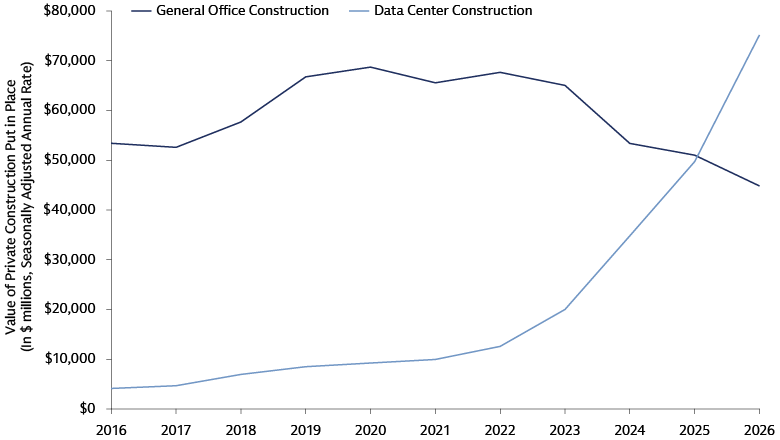
Source: US Census, Value of Private Construction Seasonally Adjusted Annual Rate. As of October 2, 2026.
Data centers are resource-intensive requiring significant amounts of water and power, raising concerns regarding cost and resource availability. The state of Virginia, in a December 2024 report, notes that data center employment, post-construction, is a fraction when compared to other industries. These challenges can limit or offset the potential economic benefits for the host municipality.
This has led to some public pushback;1 and many states have now implemented moratoriums on data center buildout until they conduct more analysis on the impacts. This includes states such as New York and Pennsylvania, but also Texas, which is viewed as more business-friendly, where the Governor issued a temporary moratorium until a more centralized plan around power and water can be developed. Texas is already home to more than 335 data centers with about 250 additional facilities planned.2 Recently, the Loudoun County Board of Supervisors in Virginia voted to pause the approval of new data centers for a year while it analyzes the zoning and strain on the power supply.
Three key considerations for assessing data centers in a muni context

Impact on resource availability and pricing, specifically electricity and water

Local opposition/support due to various economic considerations, as well as health and quality of life factors

Economic impact, including greenfield projects versus redevelopment of vacant properties; tax policy and budget impact
Data Center Impact
Loudoun County, VA – “Data Center Alley”
Loudoun County was one of the first places in the US to see significant data center growth, becoming a leader in data center development with the most facilities, square footage, and largest processing capabilities.3 The county has approximately 250 data center facilities, with IT load—the standard measure of a data center's size—of approximately 4 GW, representing a quarter of Dominion Energy's total Virginia sales.4
The county’s population reached approximately 450,000 by September 2026, nearly triple its population of 170,000 residents in 2000.5 However, the county’s largest employers remain governmental rather than tech companies. Reportedly, approximately 12,000 are employed in the data center ecosystem6 relatively small for a county that has added over 100,000 jobs in the last 25 years.7
Although data centers are not a major employment driver, they make up a large share of the county’s revenue. Most of these revenues are from property taxes, where the sector makes up half of collections. This is significant with data centers accounting for 38% of General Fund revenues, driven by significant growth in county tax base starting in 2022. Overall, the county tax base has expanded by 49%, and the General Fund budget is up 46% since 2021.8
The growth of data centers has benefited residents, who have had their property tax rate cut over time.9 The county has managed this growth well, showing fiscal discipline and growing reserves, allowing them to maintain AAA ratings from all three major agencies, most recently reaffirmed in 2026.10 This growth could start to moderate, with the County recently voting to move forward with a one-year moratorium on new data center permits.
Conversely, a decline or slowdown in data center-driven tax revenue — from overbuilding or new regulation — could materially impact the county's budget. Finally, we believe the power grid has begun to be stretched, impacting both power availability and cost for consumers in the county, which may have economic and political ramifications.
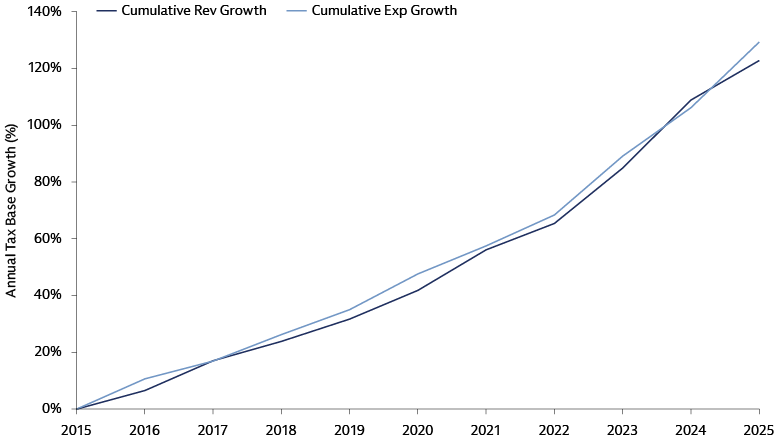
Source: Loudoun County audited financial statements. As of June 30, 2025.
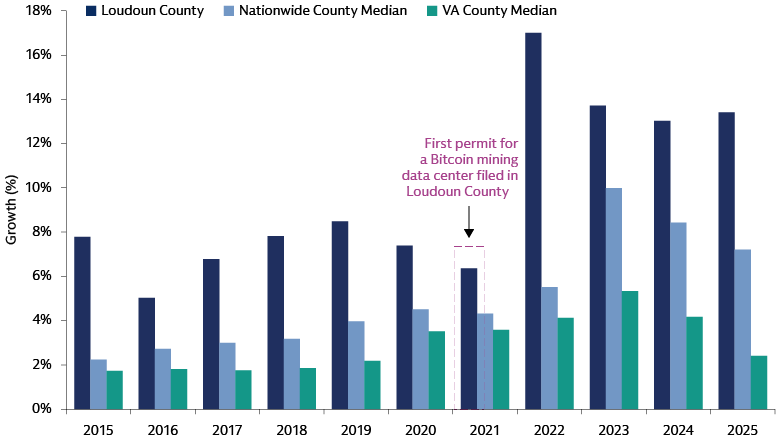
Source: Merritt Research Services. As of June 30, 2025.
Memphis, TN – SpaceXAI Facilities (Colossus 1)
Memphis is an example where a data center offered a chance for redevelopment, with SpaceXAI breaking ground in 2024 at a previously vacant factory. This allowed the company to build out the facility in record time, scaling up to roughly 340 MW of IT load with expansion of sister facilities expected to increase to 2 GW in the region.11
We believe Memphis is not currently viewed as a high-growth area, and the initial Colossus 1 facility was primarily a redevelopment project. The project has added 100 permanent jobs, and three sister projects in the area have been completed or are in process and could increase the permanent workforce.12 While local officials may have initially viewed the project as a way to repurpose a vacant industrial site, the data center sector has become a more meaningful component of the local economy.
SpaceXAI did not receive any formal economic development incentives and Memphis has not viewed the data center sector as a driver of their revenue and budget growth. In fact, the city’s General Fund budget is up a modest 17% over the last five years.13 While data centers have become a more visible part of the local economy, Memphis’ credit profile remains driven by broader economic and financial factors, and the city has maintained an AA category rating over a long period of time.14
Pike County, OH – PORTS-Pike Campus
The recently announced Pike County Ohio project aims to clean up and redevelop a former US Department of Energy (DOE) nuclear enrichment site. This project is designed to accelerate the cleanup process and ultimately turn the site into a data center with its own power plant, sponsored by SoftBank.15
The project broke ground earlier this year and is expected to open Phase I in 2028 and expand to 10 GW of IT load.16 Employment expectations of 2,500 permanent jobs expected at buildout is more meaningful to the rural area given the relatively small population of approximately 27,000 residents, below-average incomes, and dependence upon this site for employment growth.17
This project is in its early stage and carries more risk from an execution standpoint as it is far more complex than SpaceXAI’s projects in Memphis. Further, this project is located on federal land that is not subject to traditional property taxes. It is reported that negotiations are underway for a payment in lieu of taxes (PILOT) agreement,18 which would provide a monetary benefit to the county. If implemented, PILOTs can be a more stable source of income.
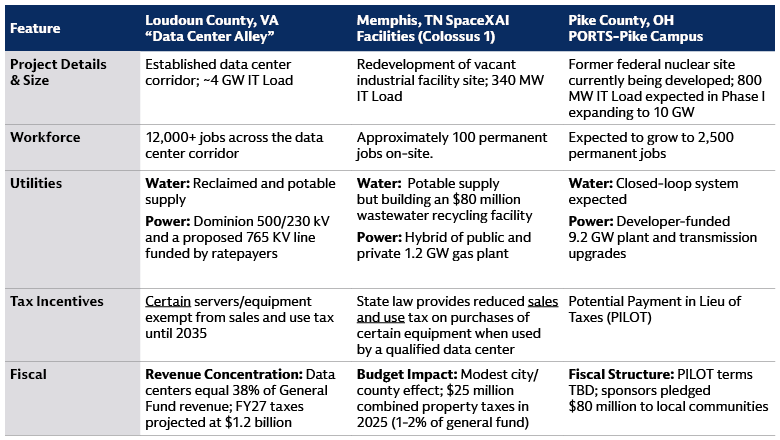
Tax incentives information for VA sourced from Code of Virginia § 58.1-609.3, TN from Tennessee State Law TCA § 67-6-206, and Pike County, Ohio, Board of County Commissioners, PORTS-Pike Technology Campus — Pike County, Ohio.
Power, Water, Noise, and more
In addition to public policy around taxation and spending, we consider the resource-intensive nature of data centers, which require significant amounts of power and water to operate. The utilities that supply these resources are financed in the municipal marketplace and may face financial pressure from increased infrastructure costs. Many states are actively reassessing how data center projects are permitted, with reviews increasingly focused on electricity and water availability, infrastructure needs, and other community impacts. In some jurisdictions, these concerns have contributed to permitting pauses or moratoria while policymakers evaluate whether existing utility and infrastructure frameworks can support further development.
Due to this, we are starting to see more “data center tariffs” at the same time as larger projects are shifting toward on-site power generation to reduce the impact on residential ratepayers. For Pike County, the plan includes the construction of a large power plant and significant transmission upgrades, which are expected to be financed entirely by private capital.19 However, it is too early to tell what impact this facility will have on water and natural gas.
Other considerations include noise, air quality, and even vibrations from equipment such as power generators. The appropriate location for these large projects is among the most important considerations. Data centers developed on existing industrial or commercial sites may provide an opportunity for redevelopment and additional economic activity. Conversely, projects located closer to residential areas may generate concerns related to noise, aesthetics, and overall quality of life.
Assessing Data Centers’ Impact on the Municipal Bond Market
The relationship between the data center industry and its host municipalities is at an important inflection point. For now, we believe the short-term municipal credit risk is generally limited where projects are privately financed, and local governments maintain policy flexibility. Over the medium to long term, however, the risk profile could become more meaningful if growth produces revenue concentration, higher utility costs, resource constraints, unresolved environmental concerns, or sustained political opposition. States and local governments will need clearer policies around taxation, resources, pollution, and zoning. Our job is to assess which projects may create durable fiscal benefits, which shift costs to residents or taxpayers, and where today’s limited credit risk could become a more material municipal issue over time.
1 Gallup, Americans Oppose AI Data Centers in Their Area. As of May 13, 2026.
2 The Texas Tribune, What you need to know about data centers in Texas . As of June 26, 2026.
3 Loudoun County, Virginia. Data Centers: The Loudoun Story. As of March 1, 2026.
4 Dominion Energy, Annual Report. 2025
5 US Census, Loudoun County Office of Management and Budget Virginia. As of July 2026.
6 Northern Virginia Technology Council, The Economic and Fiscal Contribution that Data Centers Make to Virginia.
7 Northern Virginia Technology Council, The Economic and Fiscal Contribution that Data Centers Make to Virginia.
8 Goldman Sachs Asset Management, City audits, Creditscope
9 Loudoun County, Virginia. Data Centers: Tax Revenues & County Budget.
10 Loudoun County, Bond Agencies Reaffirm Loudoun County’s Triple-A Ratings • Loudoun County, VA. As of May 14, 2026.
11 Built For AI. "Colossus 1 — Data-Center Profile." As of October 9, 2026.
12 Melissa Brown, "SpaceXAI to fill more than 100 jobs in Memphis, Southaven," WREG News 3, September 23, 2026, yahoo.com
13 Memphis audited financial statements. As of June 30, 2025
14 S&P affirmed Memphis rating at AA and moved the outlook to stable from negative on Aug 28, 2026. Moody’s affirmed Memphis rating at Aa2 on Aug 26, 2026 and left it on stable outlook.
15 Pike County, Ohio, Board of County Commissioners, PORTS-Pike Technology Campus — Pike County, Ohio
16 Pike County, Ohio, Board of County Commissioners, PORTS-Pike Technology Campus — Pike County, Ohio
17 Pike County, Ohio, Board of County Commissioners, PORTS-Pike Technology Campus — Pike County, Ohio and US Census Bureau.
18 WOUB Public Media. As of March 20, 2026.
19 Pike County, Ohio, Board of County Commissioners, PORTS-Pike Technology Campus — Pike County, Ohio