Technology in 2026: Dispersion, Diversification and AI’s Expanding Frontier


Key Takeaways
Our outlook for tech in 2026 is robust and we see an exciting set of expanding opportunities. However, the dynamic nature of AI innovation necessitates a nuanced investment approach. In our view, this involves greater selectivity within established segments like the Magnificent 7 due to diverging strategies, a focus on diversifying into broader AI infrastructure and areas like data governance and security, and an awareness of nascent frontiers such as robotics and physical AI. Diversifying across and within these evolving domains may lead to positive long-term investment outcomes.
The Magnificent 7 Are Moving Out of Sync
The Magnificent 7 companies1 now exhibit divergent business models and growth strategies, especially regarding AI and cloud infrastructure investment—a trend we highlighted in our investment outlook and continue to observe.
Meta and Google (along with OpenAI and Anthropic) are investing billions of dollars into developing and training most advanced frontier large language models (LLMs), a high-risk, high-reward approach aiming for super intelligence. To develop increasingly sophisticated models, their success depends on securing cutting-edge graphics processing units (GPUs) to enable the training of models. The market has so far favored those who achieve breakthroughs with state-of-the-art models, exemplified by Google's market cap surge after Gemini 3's release.
In contrast, Microsoft and Amazon prioritize building robust infrastructure for AI inferencing at scale. While this approach carries lower near-term risk and does not always require the latest GPUs, it faces long-term vulnerabilities if a competitor achieves a decisive technological leap or if model developers build proprietary infrastructure, bypassing current partners.
This dynamic, capital-intensive landscape—where model commoditization is a risk but outsized gains from breakthroughs are possible—offers fertile ground for active managers to generate alpha. Shifting fortunes and strategic pivots create unique opportunities for discerning investors.
Beyond the hyperscalers mentioned above, Nvidia benefits from explosive GPU demand, Apple aims to integrate consumer AI functionality into its devices, and Tesla pursues AI-driven autonomous driving. This illustrates the Magnificent 7's fragmented strategic focus with fundamentally different approaches reflected in unique investment patterns and greater stock dispersion.
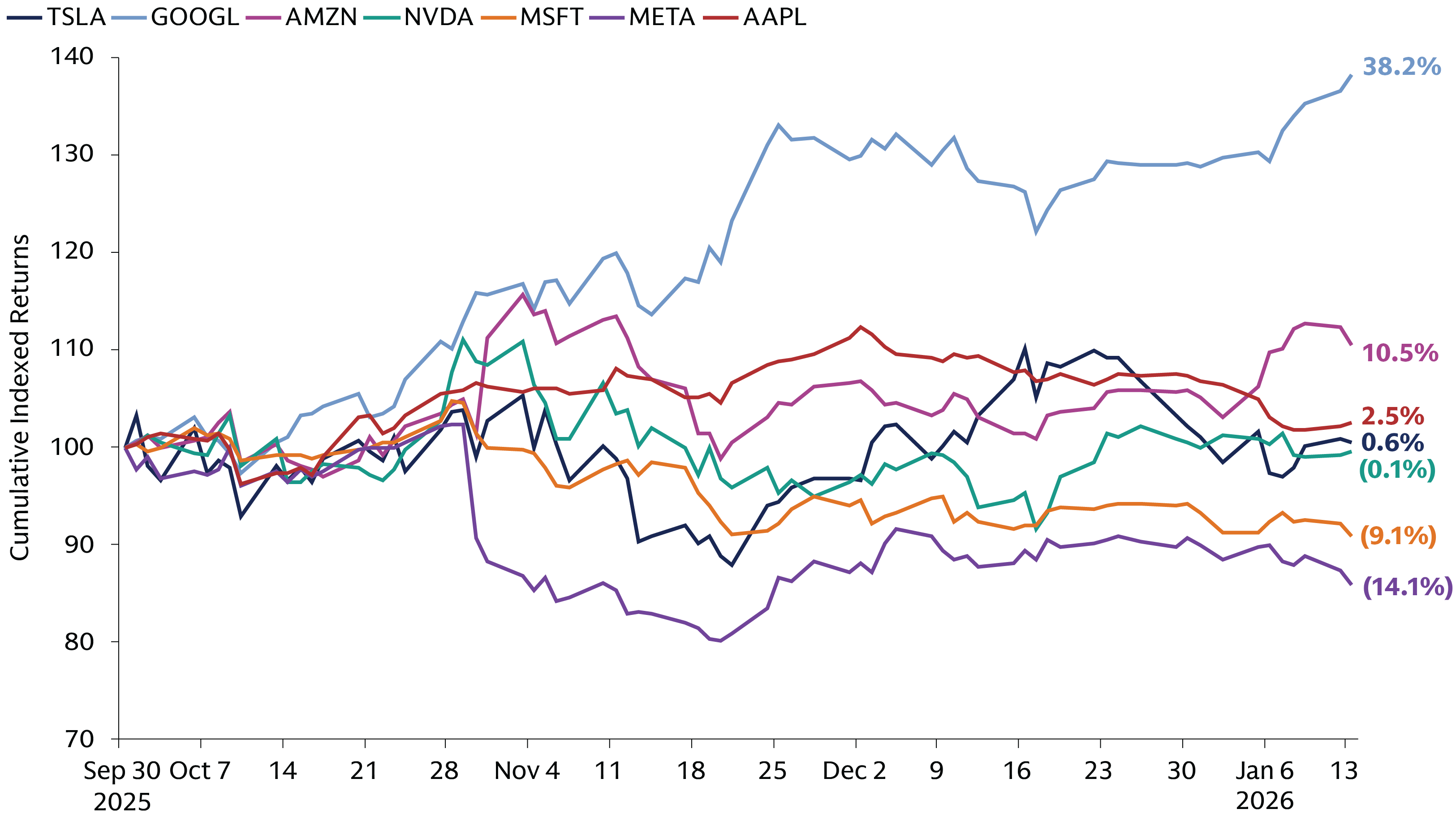
Source: Goldman Sachs Asset Management. As of January 13, 2026.
These differing strategies will significantly impact companies' capital allocation, margin profiles, and long-term growth trajectories, suggesting the once-cohesive Magnificent 7 narrative is being reconsidered. We anticipate continued divergence in stock performance across the AI ecosystem and elevated volatility as companies race for competitive advantages. In this rapidly evolving environment, selectivity, and an expert understanding of each company's strategy and overall sector dynamics is paramount.
Looking Beyond The Hyperscalers
Other than “frontline” AI plays, we believe other areas merit investors’ attention in 2026.

Next-generation servers and data centers are increasingly adopting fiber optic cables over copper. This shift is driven by fiber's superior bandwidth, signal integrity, energy efficiency, and higher density—all critical for the rapid, reliable data transfer demanded by AI and cloud computing workloads. Fiber optic cables can overcome copper's limitations (speed, distance, power, interference), enabling more compact, scalable, and cost-efficient infrastructure essential for future-proofing modern data environments.

Data and security are merging as companies prepare proprietary data for AI training while ensuring protection. Data governance is rapidly gaining importance amid dynamic threats. Processes like data cleansing, reliable dataset creation, and advanced identity frameworks are increasingly integral to AI operations, providing traceability and accountability to address operational and regulatory risks. Security remains a central pillar, as vulnerabilities from cyber attacks threaten model integrity and erode trust. We believe firms investing in integrated solutions—combining identity management, governance protocols, and sophisticated cybersecurity—are better positioned to achieve sustainable AI-driven growth.

We believe consumer technology is entering a phase of enhanced pricing power, fueled by machine learning and agentic AI integration. Companies are shifting to personalized, intent-driven experiences, monetizing through identity-aware features instead of simple price hikes. Membership programs and retail media exemplify this, using AI for personalization to improve advertising. These capabilities support predictable AI economics and tiered, usage-based pricing. In music streaming and social networking, for instance, we expect AI-driven discovery and recommendations to determine market leaders, as consumer models gain pricing power via personalization, measurable results, and disciplined AI deployment.
An AI on the Future
New investment frontiers are opening as AI innovation unfolds. We believe the convergence of robotics and physical AI, for instance, presents another compelling area. This acceleration is driven by advancements in sensor technology, edge computing, and adaptive algorithms, enabling machines to interact seamlessly with dynamic environments. Key applications include autonomous driving (critical for safety and scalability), evolving factory automation with adaptive, collaborative robotics, and nascent humanoid robotics gaining traction in logistics and healthcare for dexterous tasks. We believe investors should closely monitor these themes, as future leadership will depend on robust hardware-software integration and scalable solutions.
To navigate a more multipolar world and capture emerging technology opportunities in 2026 and beyond, we advocate for active diversification across industries and within various AI domains—including infrastructure, data governance, consumer technology, and robotics. The interplay of technological advancements, evolving business models, and critical data/security demands a nuanced, forward-looking investment strategy. Continuous monitoring of sector dynamics and the unique strategies pursued by major players will be essential for identifying future leaders and achieving long-term investment success.
1 The "Magnificent 7" is an informal term referring to a group of seven highly influential, large-capitalization technology-related companies—Apple, Microsoft, Alphabet, Amazon, NVIDIA, Meta Platforms, and Tesla—that have significantly driven recent stock market gains due to their market dominance, technological innovation, and strong financials.