What is Private Equity?

What is Private Equity?
Most companies are privately held, so the investable universe is far larger than it is in public markets.1 In fact, the number of public companies is slowly shrinking,2 with a growing number of businesses electing to stay private for longer,3 while the number of private equity-backed businesses has grown by roughly six times since 2000.4
What is the potential benefit to companies of working with a private equity manager?

Public companies operate under the scrutiny of public markets, where quarterly earnings results and short-term price movements can influence management’s decision-making. Private companies backed by a private equity manager can take a longer-term view, investing in strategic initiatives that may take years to realize their full value. This allows management teams to focus on building a stronger business over time.

Private equity managers often offer companies a toolkit of resources in addition to capital – whether that’s expertise in a specific industry, operational resources like procurement and customer success solutions, or a network of talent to tap for leadership roles.

Private equity managers have put their own capital behind a portfolio company and work closely with management to promote its success. That close-knit relationship often lets them make decisions more efficiently than in a public company, where managers must balance the interests of a broad public shareholder base.
How Does Private Equity Work?
- Traditional drawdown private equity strategy
- Evergreen private equity strategy
- Co-investment
- Secondaries
A drawdown private equity strategy is when a manager – known as a General Partner, or GP – pools capital from other investors – known as Limited Partners, or LPs – into a fund. The fund has a fixed life, usually about ten years or more, during which capital is invested, managed, and eventually returned to investors. Because investors generally do not receive any proceeds until the underlying investments in the fund are sold, these vehicles are highly illiquid – meaning that it’s difficult for investors to convert their stake in the fund into cash.
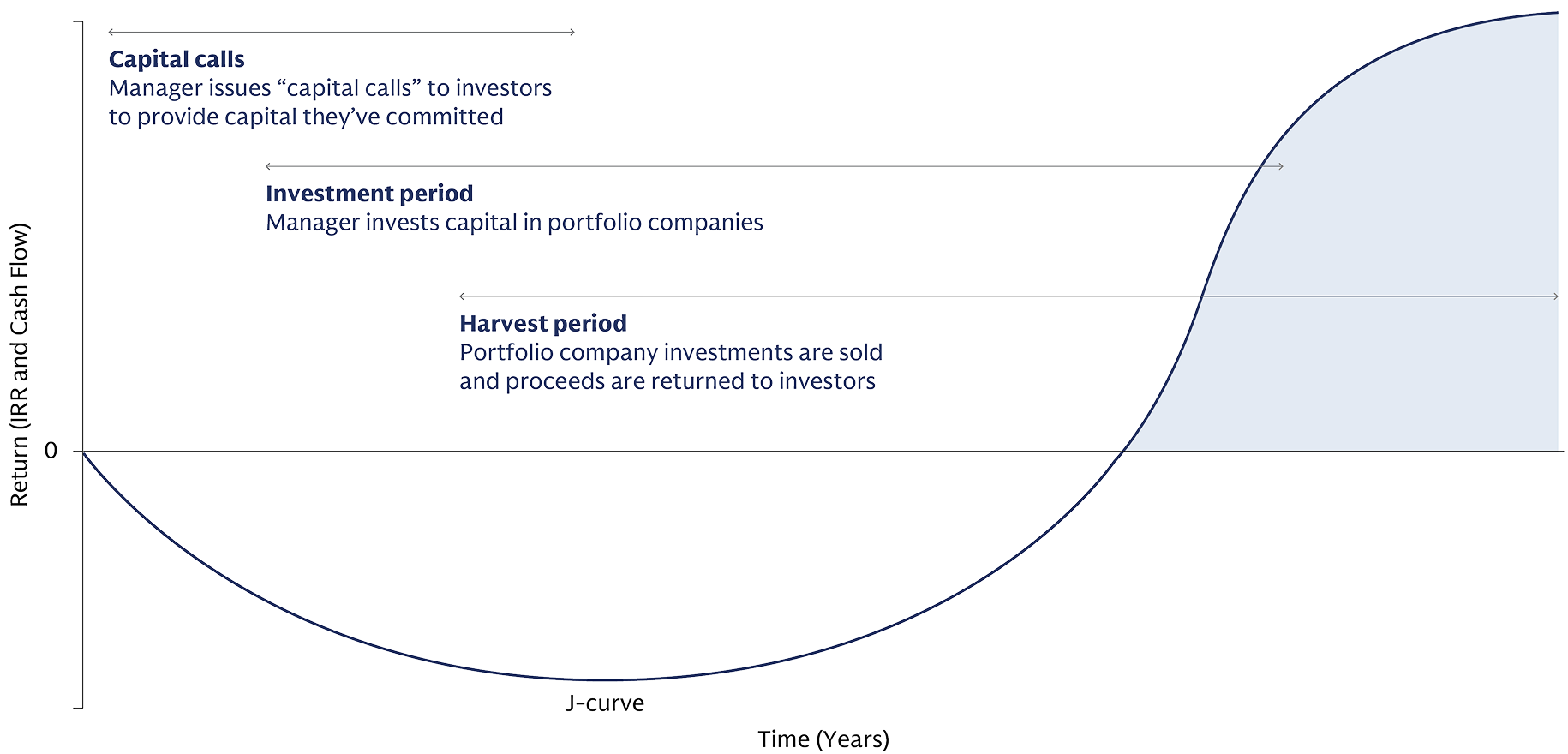
LPs do not invest the capital they’ve committed right away. Instead, during what’s known as the investment period, they provide this capital only as the GP identifies companies to add to the portfolio and makes a capital call on them to fulfill their commitment. The manager injects that capital into these companies, which take time to gradually grow in value. As the companies are sold and proceeds are returned to investors, returns can accelerate.
This return pattern – with a dip as investments are made and a gradual rise as proceeds return – is commonly referred to as the J-curve.
Managers charge investors two kinds of fees:
- Management fees are charged for the administrative costs of managing the fund. They are usually a relatively small percentage – about 1% to 2% – taken from the capital that the investor commits to the fund.
- Performance fees – also known as carried interest – are fees the manager charges on the returns that the fund delivers, usually about 20% of the fund’s returns, with investors receiving the other 80%. The manager generally cannot charge these fees until the investor receives back all the capital they invested, plus a small additional percentage.
An evergreen private equity strategy – also known as an open-end or perpetual fund – does not have a set close date, but instead continues indefinitely. Most funds are fully invested, so investor capital usually gets put to work right away rather than the staggered capital calls of a drawdown fund.
Evergreen funds are also easier to convert into cash, or more liquid. Investors can subscribe and may be able to withdraw – or redeem – from the fund on a regular basis, with restrictions on those redemption requests designed to prevent the manager from having to sell assets at an unfavorable price to meet liquidity demands.
A co-investment is when an investor – usually a Limited Partner – makes a direct passive investment in a company alongside a fund manager rather than putting their money in a fund with multiple assets. Usually, opportunities for co-invest emerge from GP-LP relationships, though sometimes dedicated co-investment managers will create a co-investment strategy that invests in opportunities alongside several other GPs.
A secondary strategy lets both GPs and LPs sell their existing stakes in private market assets. A manager of a university endowment, for example, may want to rebalance the endowment’s portfolio towards public market equities and look to sell its stake in a private market fund on the secondary market. She would look for another Limited Partner to purchase that stake. Learn more about secondaries here.
What Does Private Equity Invest In?
A leveraged buyout is the oldest, most established form of private equity investing. The GP makes a majority investment – or more than 50% ownership – in a company. This majority ownership gives the manager what’s known as a control position, or operational control over a company. With that operational control, the manager can make changes aimed at making the company more valuable.
Managers generally rely on several tools to do this. They may make operational improvements over the course of the hold period, such as hiring a new management team, reducing costs, introducing new product lines and technology tools, or repositioning a company’s brand.
- Sales and marketing
- Data and AI
- Cybersecurity
- Procurement
- Executive search and talent
- M&A strategy
These changes help increase cash flow, which gets used to pay down the financial leverage used to purchase the company in the first place. That can help grow investor confidence in the business and, combined with the operational improvements, contribute to multiple expansion – or investors’ willingness to pay a premium for the profits the business delivers.
Changing macro and market conditions – such as lower interest rates or a burst of enthusiasm around the industry the company operates in – can also contribute to multiple expansion. All together, these factors may help managers exit the company for far more than they acquired it.
Another tool managers use to drive multiple expansion is bundling smaller businesses into one large company. Smaller businesses often have lower multiples at the time they are added to a portfolio than larger companies do; because investors perceive them as more vulnerable, they’re less willing to pay a premium for the profits these businesses deliver. By bringing together several of these small businesses into a single larger one, managers can increase the multiple they trade at.
Leveraged buyouts usually target mature companies that vary in size:
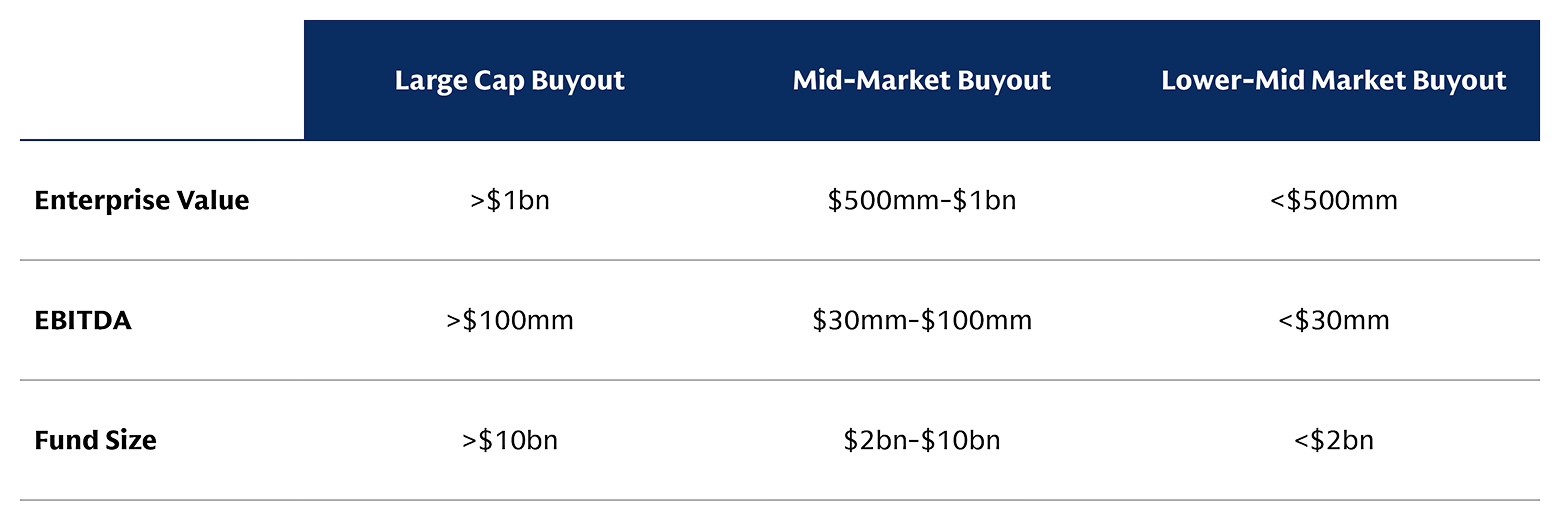
Source: Goldman Sachs, Alternative Investments & Manager Selection. These ranges are intended for indicative purposes only. There is a wide range of dispersion amongst the manager universe as it relates to the interplay between fund size and target portfolio company enterprise value and EBITDA, driven by factors including but not limited to the concentration of the underlying portfolio, amount of co-invest offered, level of portfolio company M&A activity, and ownership targets.
Growth investing usually takes minority stakes in companies that range from healthy, Series B startups to large, stable companies that are pre-IPO, often with an eye to scaling them into market leaders or merging them into a larger entity. The risk-return tradeoff on these companies is usually higher than it is with a standard leveraged buyout transaction: because these companies are less mature, they have higher perceived risk, but also the potential for outsize returns.
Venture investing usually takes minority stakes – typically less than 25% – in founder-owned or early-stage companies with limited financial history and untested ideas, products, or services. Venture generally has the highest risk-return tradeoff of all, as these companies are even less mature than growth companies and their potential for outsized returns and perceived risk is even higher.
Why Invest in Private Equity?
Private equity has outperformed public equity in aggregate over a variety of time frames. One potential reason for this? Private equity managers are often able to “get in on the bottom” of companies before they’re fully matured and ready to enter the public markets. By providing capital and securing a stake in these companies, they both fuel and participate in their success – capturing more growth than may be available in public markets.
Private equity outperformance over global equities
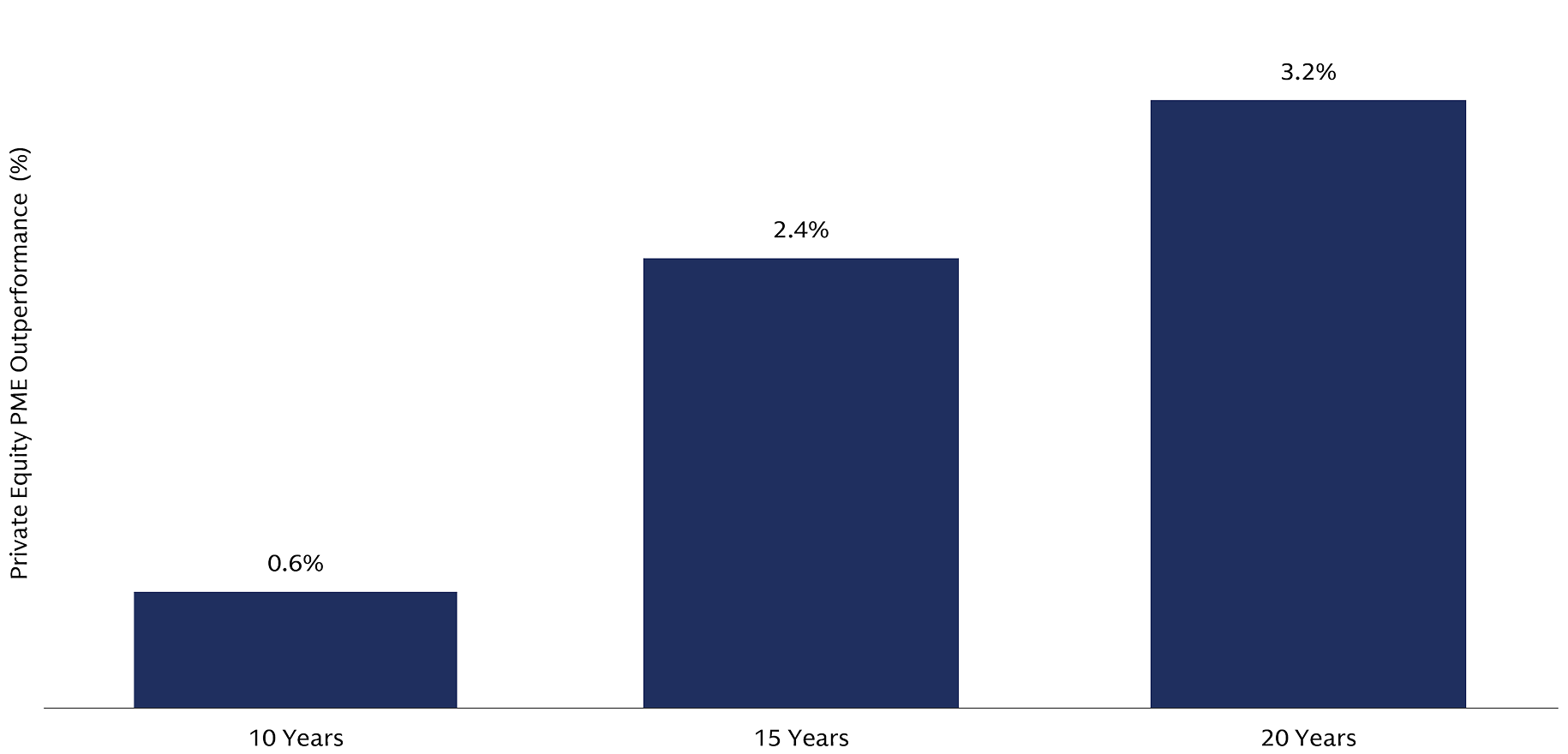
Source: Cambridge Associates, as of 09/30/2025. PME is a public market equivalent methodology that measures the performance comparison between a private investment and a public alternative. PME methodologies assume that inflows are used to purchase public shares whose sale produces outflows, all of it done per the private schedule. Under PME, actual private contributions are invested in the public market index. Distributions are calculated in the same proportion as in the private investment. In essence, the public equivalent “sells” the same proportion of the dollar value of public shares contained in the calculated NAV as the private investment sells in private shares. Public returns, combined with these PME cash flows, generate a public-equivalent NAV stream. The PME outperformance is calculated from the sample IRR minus the PME Index IRR. This calculation does not adjust for leverage, hedging, or other risk factors that may be present in the private equity investment. Unlike public equity investments, private equity is illiquid and may not be readily sold for its stated value. Positive PME outperformance indicates outperformance compared to the index return, and negative PME outperformance indicates underperformance. Private equity PME vs. the MSCI World index.
Private equity gives investors a wider opportunity set than public markets. The number of public companies are shrinking in many developed markets, while the number of private companies keeps growing. That means there are more companies across all different sizes, sectors, and levels of maturity available for investment in the private markets, potentially contributing to a portfolio’s diversification.
Total number of companies
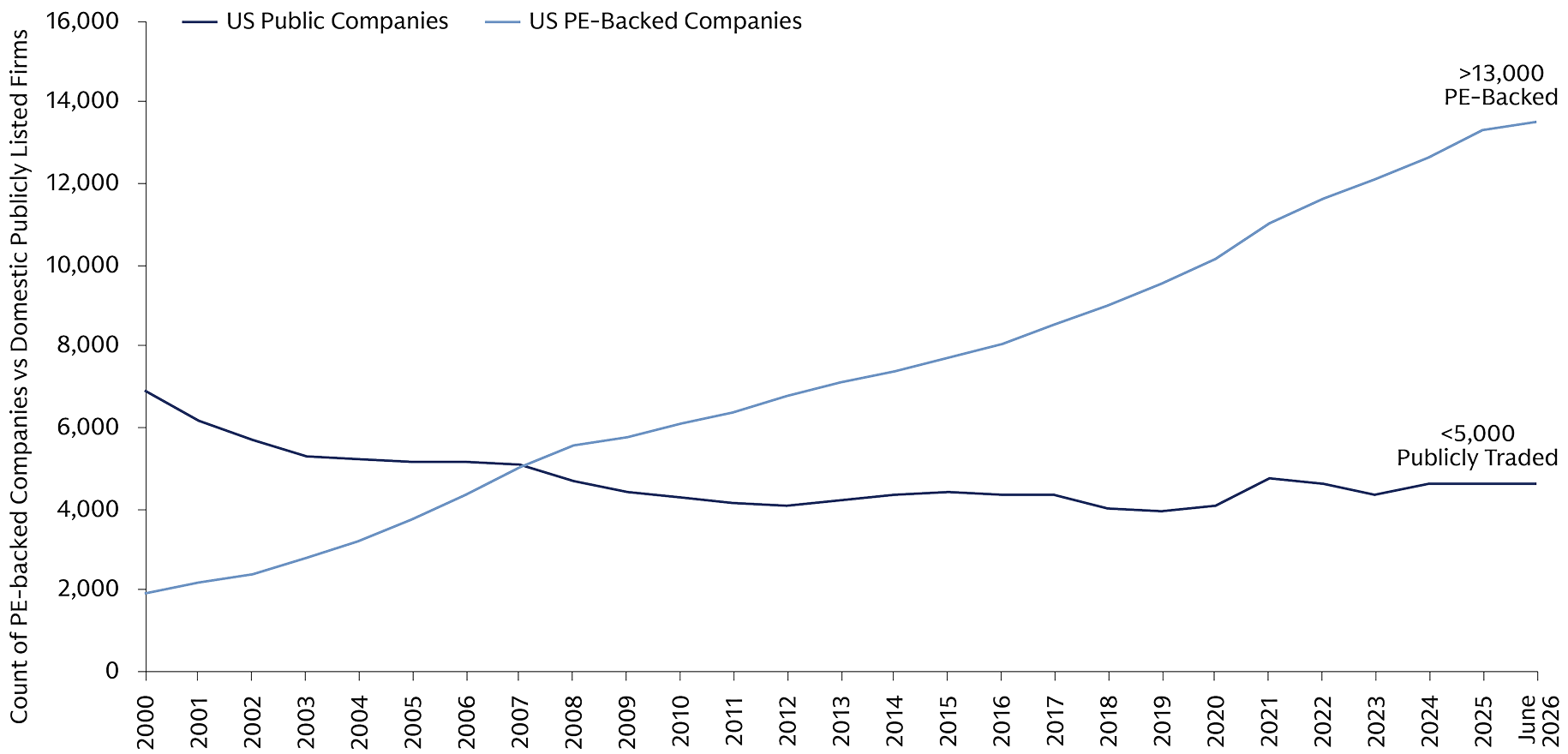
Source: PitchBook, as of June 30, 2026. Publicly listed data reflects domestic firms listed on the NYSE and Nasdaq from before 2024 and is from World Bank and Statista. 2024 and 2025 data is from Morningstar.
Private equity benefits from operational control. A study found that private equity companies grew revenues and earnings by greater amounts and had higher margins than publicly owned companies of comparable size.
Why? One factor may be the close relationship private equity managers have with their portfolio companies. They work hand-in-hand to optimize the companies for long-term value and can often influence them more easily than public equity managers.
Operating Metrics: Public versus private equity
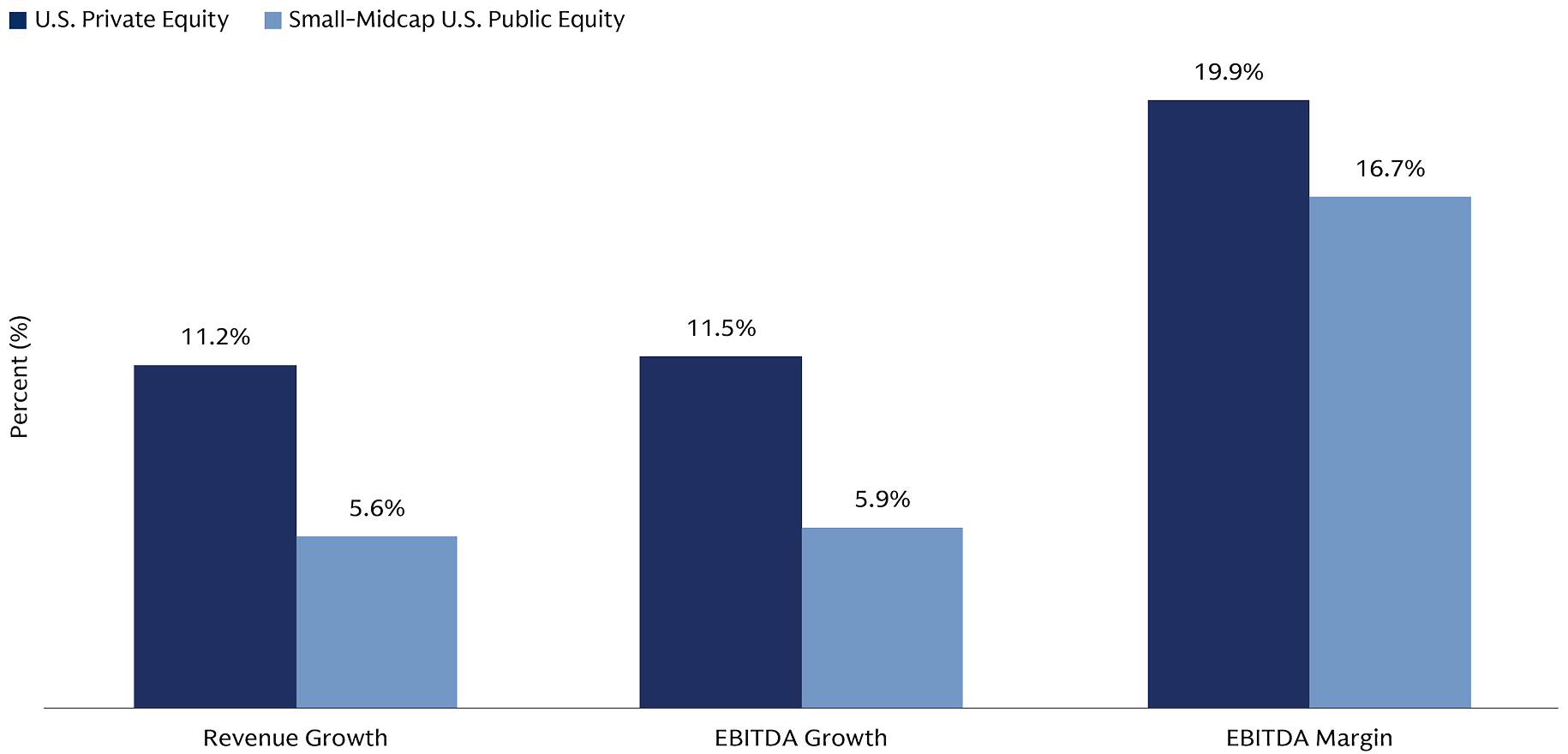
Cambridge Associates, “US Private Equity: Looking Back, Looking Forward: Ten Years of CA Operating Metrics.” Median operating metrics for the period 2000-2020.
What to Consider When Investing In Private Equity
Consider the following when assessing private equity investments:

Private equity investments cannot typically be bought and sold on a regular basis, unlike publicly traded securities. Investors should be prepared to commit capital for an extended period of time, typically ten or more years. Evergreen funds may offer some liquidity, but usually only on a quarterly basis and with some restrictions. Consider what your liquidity needs are before pursuing private market investments.

Returns in private equity are not uniform. Outcomes depend heavily on a manager's ability to build a diversified portfolio of attractive companies, support and successfully exit them.
As a result, top quartile managers have typically been able to generate stronger returns relative to the broader universe of managers. That makes manager selection critical. Consider your manager’s track record and how the performance they deliver compares with others’.

Private equity investments are designed to create value over years, not quarters. Managers often work closely with companies to support initiatives that may take time to deliver results. Investors should be comfortable focusing on long-term value creation and understand that performance may fluctuate over shorter periods.
Frequently Asked Questions
1 Source: Cato Institute, “Where the Wild Things Are: The Governance of Private Companies,” January 3, 2024.
2 Source: PitchBook, as of June 30, 2026. Publicly listed data reflects domestic firms listed on the NYSE and Nasdaq from before 2024 and is from World Bank and Statista. 2024 and 2025 data is from Morningstar.
3 Source: Phil Mackintosh and Michael Normyle, NASDAQ, “Drivers of IPOs Supportive to Start 2026,” January 22, 2026.
4 Source: PitchBook, as of June 30, 2026. Publicly listed data reflects domestic firms listed on the NYSE and Nasdaq from before 2024 and is from World Bank and Statista. 2024 and 2025 data is from Morningstar.