Investment Outlook 2026

Key Themes for 2026
We believe 2026 will require an active, disciplined investment approach. Our key themes pinpoint catalysts, identify public and private market opportunities, and ways to recalibrate portfolios to unlock returns amid evolving megatrends.
Staying Active Amid Complexity
Active, disciplined investing is key amid central bank shifts, new trade dynamics, and idiosyncratic credit events. We pinpoint easing cycles, AI, and dealmaking as catalysts, and remain focused on strategically positioning portfolios to seek returns.
Navigating the Nuances in Public Markets
We see potential for greater equity market dispersion and favor active global equity diversification and a blend of fundamental and quantitative strategies. In fixed income, we are focused on diversified duration, strategic curve positioning, and active security selection. We see income opportunities in securitized credit, high yield credit, and emerging market debt.
Exploring Alternative Dimensions in Private Markets
We pose key questions that may inform outcomes for existing portfolio assets and guide future capital deployment. We address private equity valuations and potential pressure points in private credit. We discuss whether real estate is ready for a rebound, and where attractive opportunities are in infrastructure beyond AI.
Shifting Paradigms for Portfolio Construction
We see potential ways to recalibrate portfolios for 2026. We spotlight active ETFs, enhanced passive allocations, tail-risk hedging, and broadening access to alternatives.
Evolving Thematic Landscapes and Megatrends
New opportunities to deploy capital continue to emerge as nations prioritize energy independence, resource security and efficiency, needs that are amplified by AI. We see sustainable investing maturing with a greater focus on performance.

Steering Through Complexity
Where do I invest when everything looks expensive?
When traditional investments appear expensive, we believe a strategic approach beyond simply following benchmarks is crucial. Investors should consider actively managing their portfolio's mix of equities, bonds—and the securities underlying each allocation—strategically tilting portfolios to adapt to market conditions.
Equity and bond valuations are elevated
Asset valuations since 2005
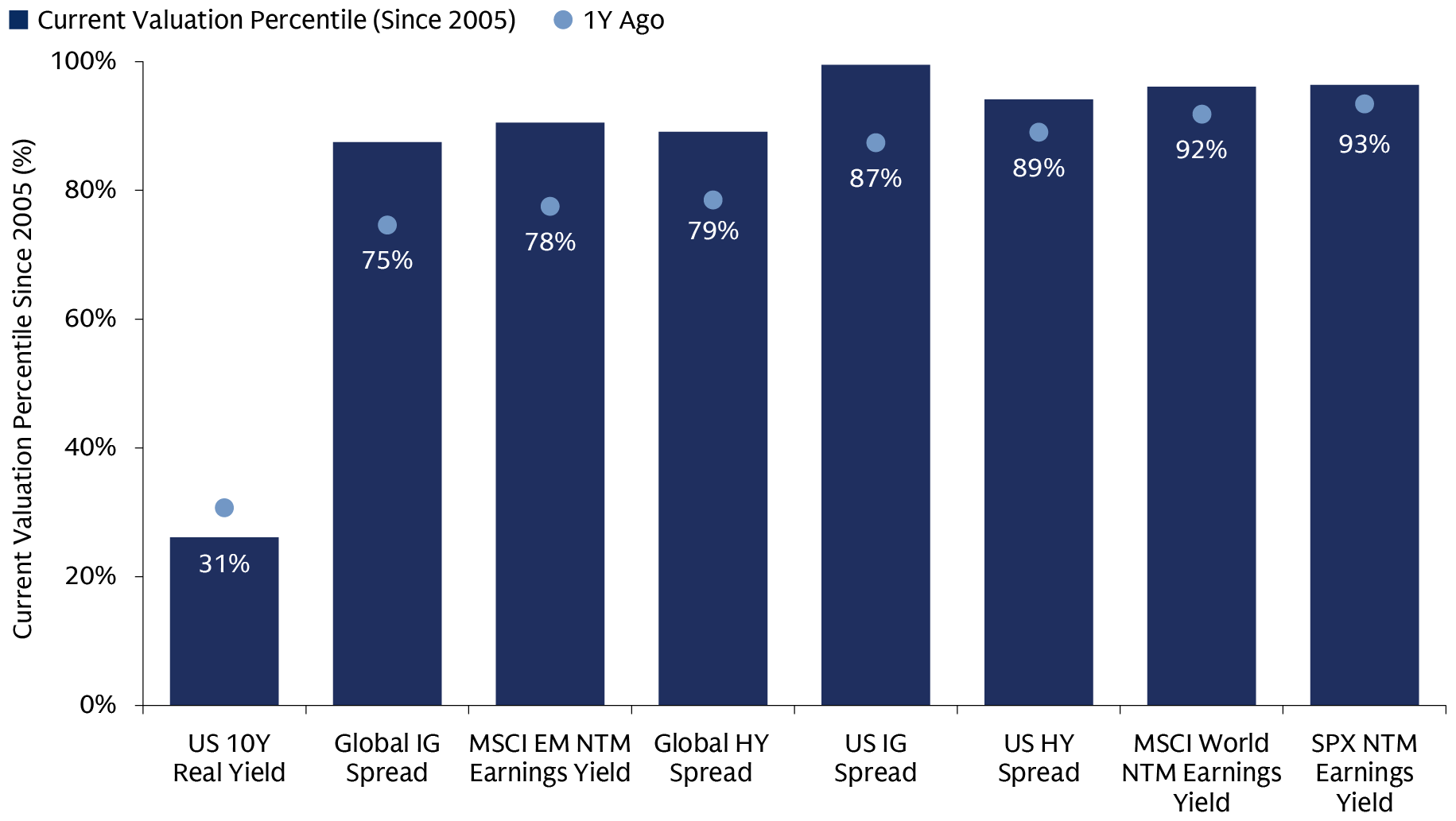
Source: Goldman Sachs Asset Management. As of October 24, 2025. Valuation percentiles are since 2005 as MSCI EM forward P/E data stats from 2005. Past performance does not guarantee future results, which may vary.
How could consumer spending be impacted by tariffs?
US consumer confidence, while generally robust, shows emerging signs of weakness among lower-income households. However, this demographic has a limited impact on overall spending, as the wealthiest 20% of households account for 40% of total consumption, while lower-income groups spend less than 10%.
US consumption is a tale of two spending realities
The wealthiest 20% of US households account for 40% of total consumption
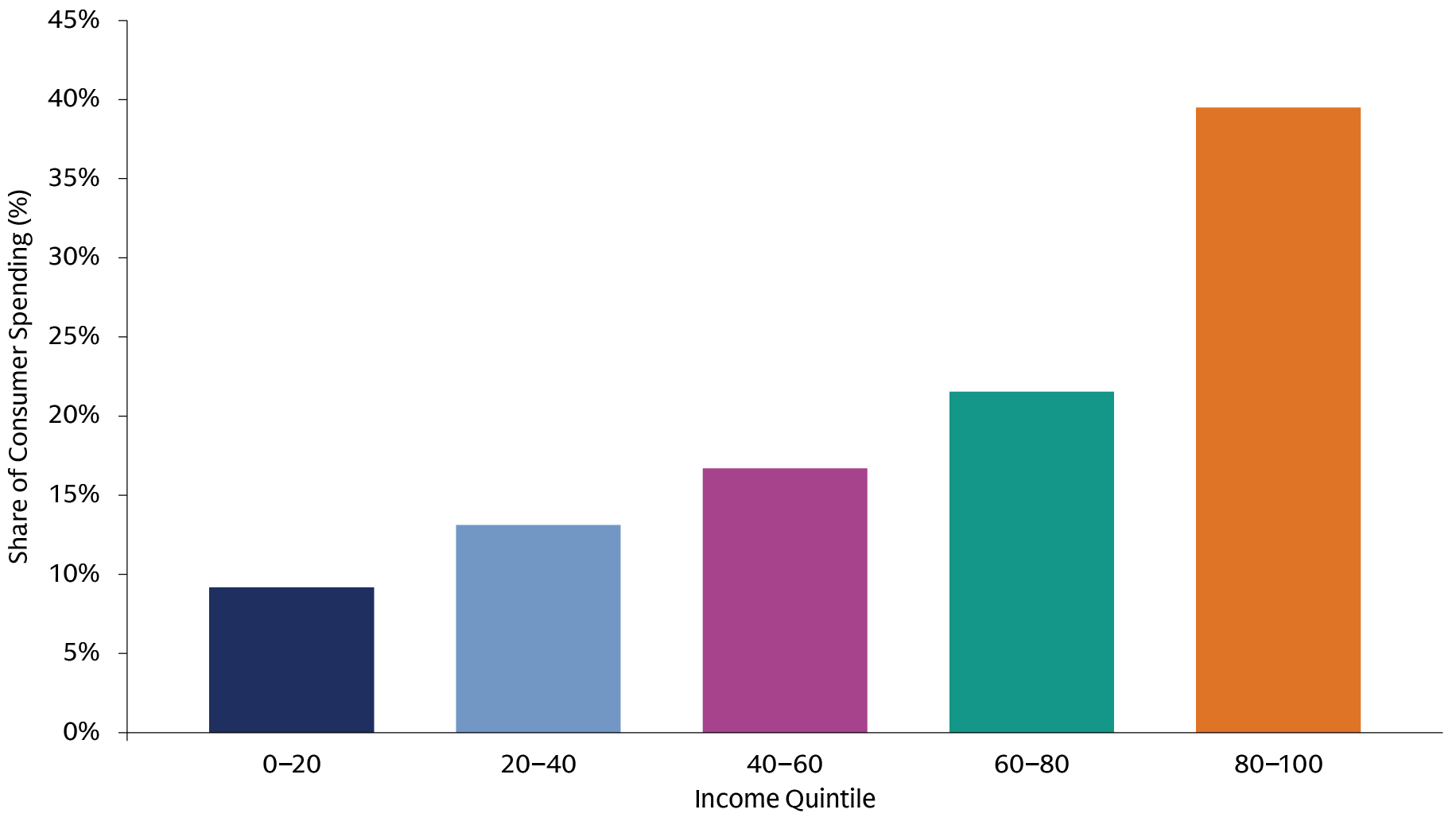
Source: Bureau of Labor Statistics, Macrobond. Data from 2023. Historical analysis indicates that the underlying shares of expenditure have remained relatively stable over time. Past performance does not guarantee future results, which may vary.
Is fiscal friction here to stay?
Pinpointing the exact moment when fiscal anxieties emerge or peak is impossible, but a deep understanding of the landscape is essential for government bond investors. There is no single debt-to-GDP ratio that automatically triggers a fiscal crisis; Japan's debt-to-GDP ratio has exceeded 200% for over a decade without catastrophe. In our view, the surrounding conditions matter more.
Rising 30-year yields partially reflect concerns over debt sustainability
Long-end yields are more susceptible to fiscal concerns and inflation expectations.
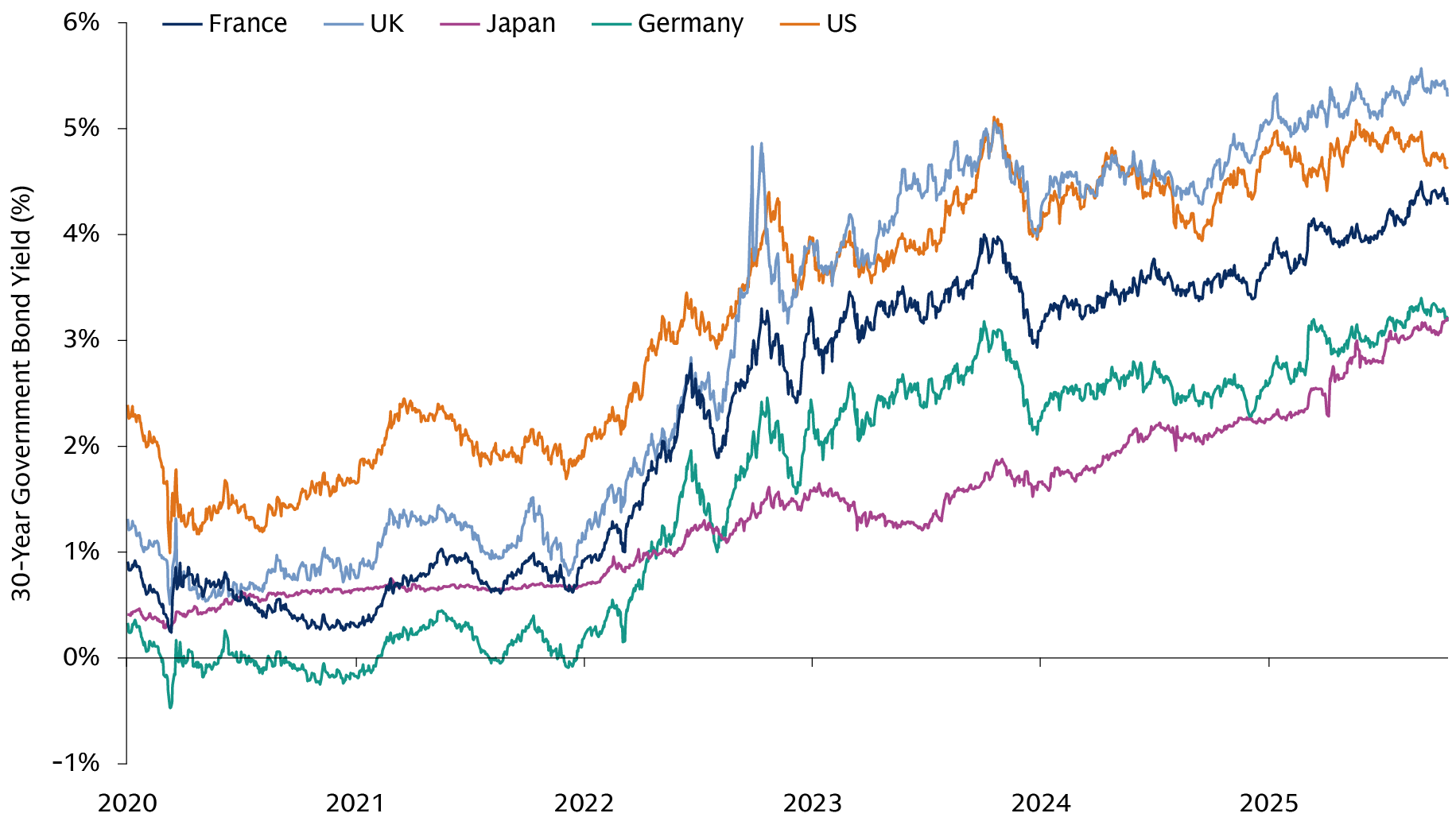
Sources: Goldman Sachs Asset Management, Macrobond. As of October 15, 2025. Past performance does not guarantee future results, which may vary.