Agentic AI Explained

What is Agentic AI?
Imagine telling a digital assistant, “Plan and book a business trip to London for next week,” and then walking away to focus on work. Instead of simply generating a list of flight options, agentic AI takes the reins. It checks the calendar for conflicts, purchases tickets within the company's policy, reserves a hotel room based on existing preferences, and emails the itinerary to the team. AI shifts from merely chatting and advising to acting and executing. A once passive tool morphs into a proactive partner.
Agentic AI uses specialized agents, each responsible for discrete functions, to dynamically communicate, share contextual information, and coordinate actions across entire business workflows. These systems maintain persistent memory of past interactions, adapt to exceptions through machine learning, and continuously refine their performance through feedback loops.
What distinguishes agentic AI is its capacity for autonomous decision-making within governed parameters. While human oversight remains essential for exceptional cases, the system resolves most scenarios independently, learning from outcomes to expand its autonomous capability over time. This represents a significant extension from traditional automation, which requires explicit programming for every contingency.
How is Agentic AI Different from Previous Versions of AI?
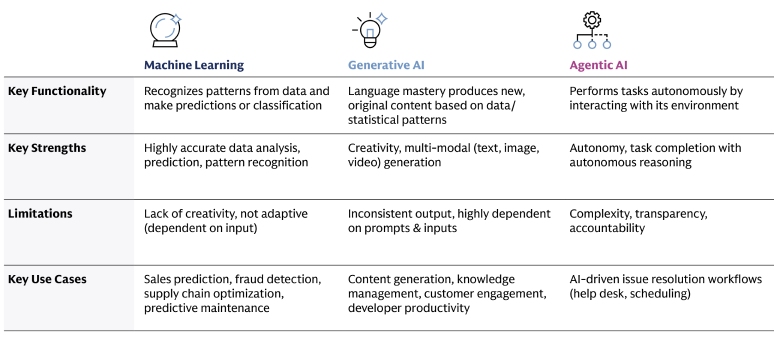
Traditional enterprise AI focuses on automating repetitive, rules-based tasks. Solutions deliver productivity improvements (e.g., faster processing, fewer errors, and cost reduction) but remain constrained by their siloed scope and requirement for human intervention in decision making and exception handling.
Agentic AI reframes the paradigm. Focused agents collaborate, share context, and adapt dynamically. The agents learn from outcomes, update rules, and gradually improve in a continuous learning loop. Rather than simply accelerating work, agentic AI assumes responsibility for complete business processes, autonomously making decisions and managing exceptions within established governance frameworks.
Why is Agentic AI So Critical for Companies?
We believe agentic AI is critical in several ways. It enables scalability of complex operations, with an ability to harness large, diverse datasets for continuous improvement. It facilitates a transition to outcome-based processes, resulting in shared productivity gains with clients. And it can drive competitive differentiation with faster, more accurate, and more flexible solutions that can increase customer satisfaction and retention.
Agentic AI spans a spectrum of use cases. However, unlike traditional automation suited for repetitive workflows, the true transformative power of agentic AI is unlocked when applied to certain kinds of challenges: those with high process complexity, high volume, and high variance. While a high volume of simple tasks can on its own justify investment, the real unlock occurs where complexity and variance intersect. When systems must navigate exceptions, learn from new data, and coordinate across decision points, the value of agentic automation far exceeds the sum of individual task improvements.
This is not to say that simpler workflows should be ignored; they remain relevant for building confidence. However, agentic AI should not be viewed merely as the final step in a linear automation journey. Instead, it represents a discrete capability leap. Organizations facing high-variance challenges (tasks that are unpredictable, inconsistent, or subject to frequent change) can bypass earlier phases of rigid automation to directly deploy agentic systems capable of handling exceptions and rationalizing numerous decision points. Relying solely on point solutions for isolated, low-variance problems can miss the larger strategic opportunity that agentic systems present: creating intelligent, adaptable, and end-to-end processes that drive significant competitive advantage.