Market Brief: From "Don't Fight the Fed" to "Don't Fight the Fundamentals"



Key Takeaways
The New Playbook: Beyond the Central Bank Backstop
For more than a decade following the 2008 financial crisis, one rule governed markets: don't fight the Fed. Accommodative monetary policy lowered discount rates, supported liquidity, and repeatedly helped stabilize asset prices during periods of stress. That framework is less reliable today.
Rather than easing preemptively to cushion market downturns, central banks are navigating a new regime of persistent supply shocks, sticky inflation, and resilient economic activity. Geopolitical tensions have driven sharp energy gains this year, with Brent crude up 80% to $108 per barrel and European natural gas surging more than 190%.1 This ongoing energy shock has raised inflation risks, lifted global bond yields and driven a hawkish policy pivot.
The Fed raised the federal funds target range by 25bps to 3.75%–4.00% at its September meeting; the ECB has tightened twice this year, calling its latest move a "no-brainer"; and the Bank of Japan continues its exit from ultra-easy policy.
For investors, this environment demands a new playbook built on two core principles:
- Less reliance on the Fed (the policy reality): Under Chair Kevin Warsh, Fed policy has become highly scenario-dependent with limited forward guidance. Investors can no longer assume that routine asset price weakness will trigger rapid monetary easing.
- Do not fight the fundamentals (the investment response): Economic and corporate fundamentals alongside the AI investment cycle—not central bank intervention—are driving financial assets. Despite higher rates, persistent inflation, and repeated supply shocks, global expansion continues, and a broad-based corporate default cycle has yet to emerge.
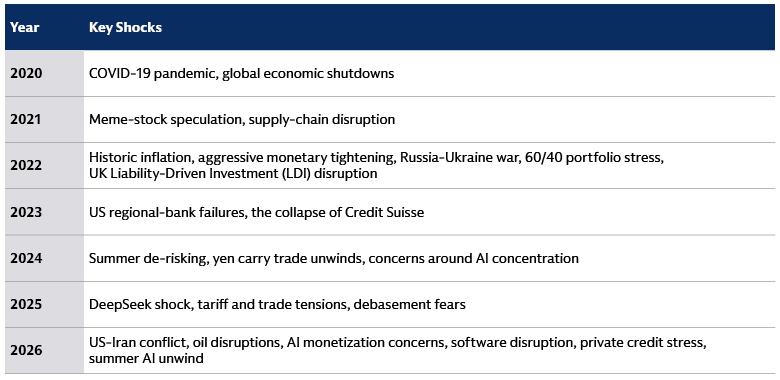
Source: Goldman Sachs Asset Management. As of September 16, 2026. For illustrative purposes only and does not reflect an exhaustive list.
Is the hawkish pivot justified?
Central banks have turned more hawkish despite limited evidence that the energy shock has broadened into persistent underlying price pressures. Inflation expectations remain broadly anchored, there is no clear wage-price spiral, and pass-through from higher input costs into food and imported goods has stayed contained. If the primary drivers of sticky inflation are supply disruptions that monetary policy cannot directly resolve, and may ultimately prove temporary, why tighten at all? The answer is risk management, not a response to runaway inflation, on two fronts:
- Credibility preservation: Policymakers were too slow to respond to persistent inflation in 2022. The Warsh Fed and its global peers are determined not to be late twice. The risk is not simply higher oil or gas prices; it is that a persistent energy shock could lift inflation expectations, alter wage-setting behavior, and broaden into core prices. Policymakers want to contain that risk before it becomes embedded.
- Growth as a cushion: A resilient starting point for growth gives central banks room to tighten preemptively, guarding against inflation broadening without immediate recession risk.
The US is the clearest case study:
- Resilient growth and labor markets: Growth is running a little above 2%, close to trend, while the labor market remains stable and, in some areas, continues to tighten. The economy added 162K jobs in August.2 Some of this strength reflects normalization in sectors such as hospitality and local-government education, but the broader message is one of resilience.
- Persistent inflation pressures: Core inflation has remained above the Fed’s 2% personal consumption expenditures (PCE) inflation objective for more than five years.3 Chair Warsh recently noted that 54% of goods and services in the PCE basket are seeing inflation above 3%—down from roughly 77% at the post-pandemic peak, but still above the 32% average of the two decades before the pandemic.4
- The catalyst for action: Much of the US inflation overshoot traces to volatile or temporary drivers—energy, AI-related demand, tariffs, even phone bills—but the Fed is unwilling to wait them all out. At August's Jackson Hole symposium, Chair Warsh said the Fed's "predominant focus right now should be on prices." A firm 2.4% annual core CPI reading for August cemented the case for a September hike.5
Navigating a less predictable Fed
Justifying the hike is one thing; predicting what the Fed does next is another. A 25bps hike at the September FOMC was widely expected, so attention focused not on the decision, but on what came with it: the updated Summary of Economic Projections — including the "dot plot"6—and the Chair's read on whether financial conditions are now restrictive enough. This is because what happens next depends as much on how the Fed interprets the economy as on the economy itself.
The updated projections struck a hawkish tone, with the Committee revising inflation and growth higher and unemployment lower. Even so, the dot plot stopped short of signaling aggressive tightening: the median policymaker sees one more hike this year and no change in 2027.
Reading the Chair is harder. Warsh submits no dot, so the median reveals little about his thinking, and he has curtailed forward guidance, leaving markets to infer his stance from tone, the data he emphasizes, and his reading of financial conditions. That inference has swung sharply this year—from dovish through April, when his view that AI would lift productivity and dampen inflation dominated; to hawkish at the June FOMC, as rising oil prices and a hawkish dot plot shifted the debate toward hikes; to a more patient July tone that nonetheless pushed long-end yields higher on fears that delay would force sharper tightening later; and finally to Jackson Hole in August, where persistent inflation became the overriding concern and cemented expectations for a September hike.
The September press conference added fresh ambiguity. Warsh called the hike a removal of "a dose of accommodation" but would not say whether he now views policy as restrictive. Unlike his predecessor and most colleagues, who frame policy against a neutral rate, he judges the stance by its effect on financial conditions—and markets do not know which conditions he is watching. The available measures conflict: bond yields have risen sharply, implying conditions have already tightened and further hikes may be modest, while credit spreads remain tight, suggesting conditions are still accommodative and more tightening may be warranted.
Considering this uncertainty, our Fixed Income team believes the near-term Fed outlook is best framed through scenarios rather than a single point forecast.
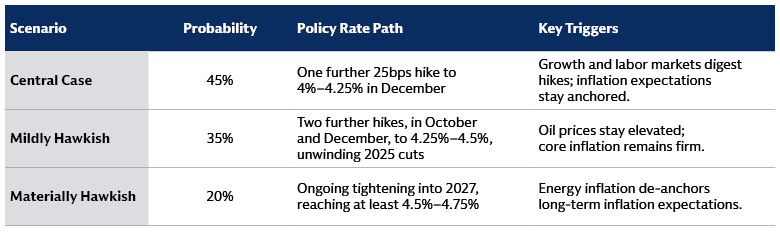
Source: Goldman Sachs Asset Management. For illustrative purposes only. The economic and market forecasts presented herein are for informational purposes as of the date of this document. There can be no assurance that the forecasts will be achieved.
Whether the Fed can pivot to rate cuts—as anticipated entering the year—depends on two factors:
- Inflation moderation: The Fed will need evidence that inflation impulses from tariffs, energy, and AI-related demand are fading, without becoming embedded in broader price-setting behavior.
- Financial conditions: This remains central to Chair Warsh's reaction function. At Jackson Hole, he said he was "hard pressed to describe broad financial conditions as restrictive." If conditions stay easy, the Fed may feel little pressure to ease even as inflation begins to cool.
The New Anchor: Fundamentals
With central bank support less certain as a market backstop, corporate and economic fundamentals have become the primary anchor for portfolios. Three engines are driving the cycle:
- Corporate earnings: 2Q26 marked one of the strongest earnings seasons in recent history: S&P 500 earnings increased 32% year-over-year, while 85% of companies exceeded expectations, representing the seventh consecutive quarter of double-digit growth.7 Strength was broad-based across sectors and geographies.
- Consumer spending: Employment income, household wealth, and debt servicing capacity all remain supportive of consumer spending in aggregate. Retailers report that consumers are still spending but are becoming more value-conscious. Household balance sheets have also weathered higher rates better than expected, although divergence by income quartile is widening. The auto sector is a useful stress test: higher energy prices should weigh on demand, as consumers face both higher financing costs and higher fuel expenses, yet US auto sales remain robust.
- The AI capex cycle: AI supports growth through capital expenditure today and, potentially, productivity tomorrow. It has bolstered consumer spending through wealth effects, as US and Asian retail investors benefit from stronger AI-linked holdings, and has lifted Asian economies through AI-related exports. But the AI cycle cuts both ways: AI-related demand is part of the Fed's inflation risk assessment, while the market's longer-term AI thesis depends on massive investment converting into new revenue streams, free cash flow, and measurable productivity gains. AI remains an important structural tailwind and investment opportunity, but it is also a source of concentration, valuation, and capital-allocation risk.
Back the fundamentals, with caution
The investment backdrop remains constructive, but less forgiving. Earnings, consumer resilience, and AI-related investment continue to support the expansion. Yet much of that strength is already reflected in elevated equity valuations, tight credit spreads, and concentrated market leadership. With the Fed less likely to respond rapidly to ordinary market weakness, investors should rely less on broad beta and place greater emphasis on diversification, valuation discipline, security selection, and active risk management.
- Diversify across regions, styles, and income sources. European and emerging market equities offer differentiated exposure to AI supply chains, energy transition, domestic consumption, infrastructure, and economic security, often at more attractive starting valuations than selected areas of the US market. Within US equities, balance long-duration growth exposure with quantitative strategies. In fixed income, tight spreads favor dynamic multi-sector approaches that can rotate toward areas where expected income better compensates for credit, liquidity, and duration risk.
- Prioritize quality and refinancing resilience over broad exposure. With the margin for error reduced, favor companies and issuers with durable organic revenue, healthy margins, strong interest coverage, and limited reliance on low-rate refinancing—and be cautious in credit where expected returns depend on continued benign refinancing conditions. Within AI, distinguish those already monetizing demand from those whose valuations rest principally on long-dated productivity assumptions.
- Manage duration actively and maintain targeted downside risk mitigation. Proactive rate hikes may stabilize front-end government bond yields, but long-end yields remain exposed to fiscal supply, inflation uncertainty, and a rising term premium—so stay flexible across the curve rather than assuming duration will protect in a supply-driven inflation shock. A less certain Fed backstop also raises the value of hedging against an energy shock, a disorderly rise in long-end yields, an AI-related de-rating, or a sharper deterioration in consumer and earnings fundamentals.
Key Risks to Watch
- Persistent energy inflation. Sustained increases in oil and gas prices could lift inflation expectations, intensify wage pressures, and keep core inflation elevated. This may force central banks to maintain restrictive policy for longer.
- Unproven returns on AI capex. As noted, the AI cycle cuts both ways: companies continue to increase capital spending and debt issuance to fund AI infrastructure. The key risk is that this investment does not translate into sufficient revenue growth, free cash flow, or productivity gains—particularly for companies taking on significant leverage—which could trigger a sharp reassessment of AI-related valuations.
- Fading consumer resilience. Consumer strength could weaken if layoffs broaden, real wage growth turns negative, or credit delinquencies rise materially. A sharp correction in AI-related equities could also create a negative wealth effect, weighing on spending and risk appetite.
- Weakening earnings breadth. Broad-based negative earnings revisions and margin compression beyond isolated sectors would signal deteriorating corporate fundamentals.
- Disorderly credit tightening. A sharp widening in credit spreads, weaker market liquidity, or reduced access to primary debt markets for lower-quality issuers could raise refinancing risks and tighten financial conditions quickly.
1 Bloomberg, Goldman Sachs Asset Management. Brent price based on ICE Brent Futures. Natural gas prices based on ICE Endex Dutch TTF Natural Gas Futures Contract. As of September 16, 2026. 09:18am BST.
2 Macrobond, Goldman Sachs Asset Management, and the US Bureau of Economic Analysis (BEA). Note: Real GDP expanded at an annual rate of 2.1% in the second quarter. We estimate trend growth to be around 2%.
3 Macrobond, Goldman Sachs Asset Management, and the US Bureau of Economic Analysis (BEA). Based on core Personal Consumption Expenditures (PCE) inflation, which has run above the Fed’s 2% target for 65 consecutive months (March 2021 through July 2026).
4 See In Our Time, a speech by Chairman Kevin Warsh at “Financial Innovation: Implications for Payments and Policy,” an economic policy symposium sponsored by the Federal Reserve Bank of Kansas City, Jackson Hole (August 28, 2026).
5 Macrobond, US Bureau of Labor Statistics (BLS).
6 A chart the Federal Reserve publishes with its quarterly Summary of Economic Projections (SEP), in which each Fed official marks, with a single dot, where they expect the federal funds rate to be at the end of the next few years and over the longer run. The dots are anonymous, so the chart shows the range and clustering of policymakers' rate expectations without attributing any view to a named individual; the median dot is watched most closely as a rough guide to the likely path of interest rates.
7 Bloomberg. As of August 31, 2026.