Not All Quants Are Alike: Exploring Where Equity Alpha Comes From





Key Takeaways
The prevailing narrative of the past decade has been one of a steady march toward passive investing and the commoditization of traditional smart beta factors, with the alpha opportunity assumed to be shrinking. We believe the opposite is true. Changes in market structure, investor behavior, and the data ecosystem have created more frequent and more varied inefficiencies—conditions that favor managers able to process broad information sets and act on them quickly.
The evidence is in the results. Strong recent performance across the quant peer group has not meant uniform performance: dispersion is wider than a decade ago across most equity universes. That points to a shift in where alpha now sits—less in static exposures to well-known style premia, more in continuously refreshed proprietary insight, with factor exposures treated as a controlled outcome of stock selection rather than an input to it.
We believe this reframes investor decision making. In our view, it is less about a choice between 'quant' and 'non-quant' strategies, and more about selection among diverse systematic processes where unique, highly differentiated approaches are poised to potentially outperform.
Have Quant Strategies Been Performing Well for the Same Reasons?
Quant strategies have delivered robust results in recent years, reviving appetite for systematic stock selection approaches but also raising legitimate questions about potential crowding. However, strong performance is not the same as homogeneous performance.
These have historically been perceived as relatively uniform, with managers assumed to be drawing on the same factors (such as value, growth, quality, and momentum), using similar datasets, and arriving at similar portfolios.
But the evidence suggests otherwise. As the chart below shows, dispersion among the returns of quant strategies is wider today than a decade ago. Quant managers may be performing well at the same time, but in our view, they are performing well for increasingly different reasons.
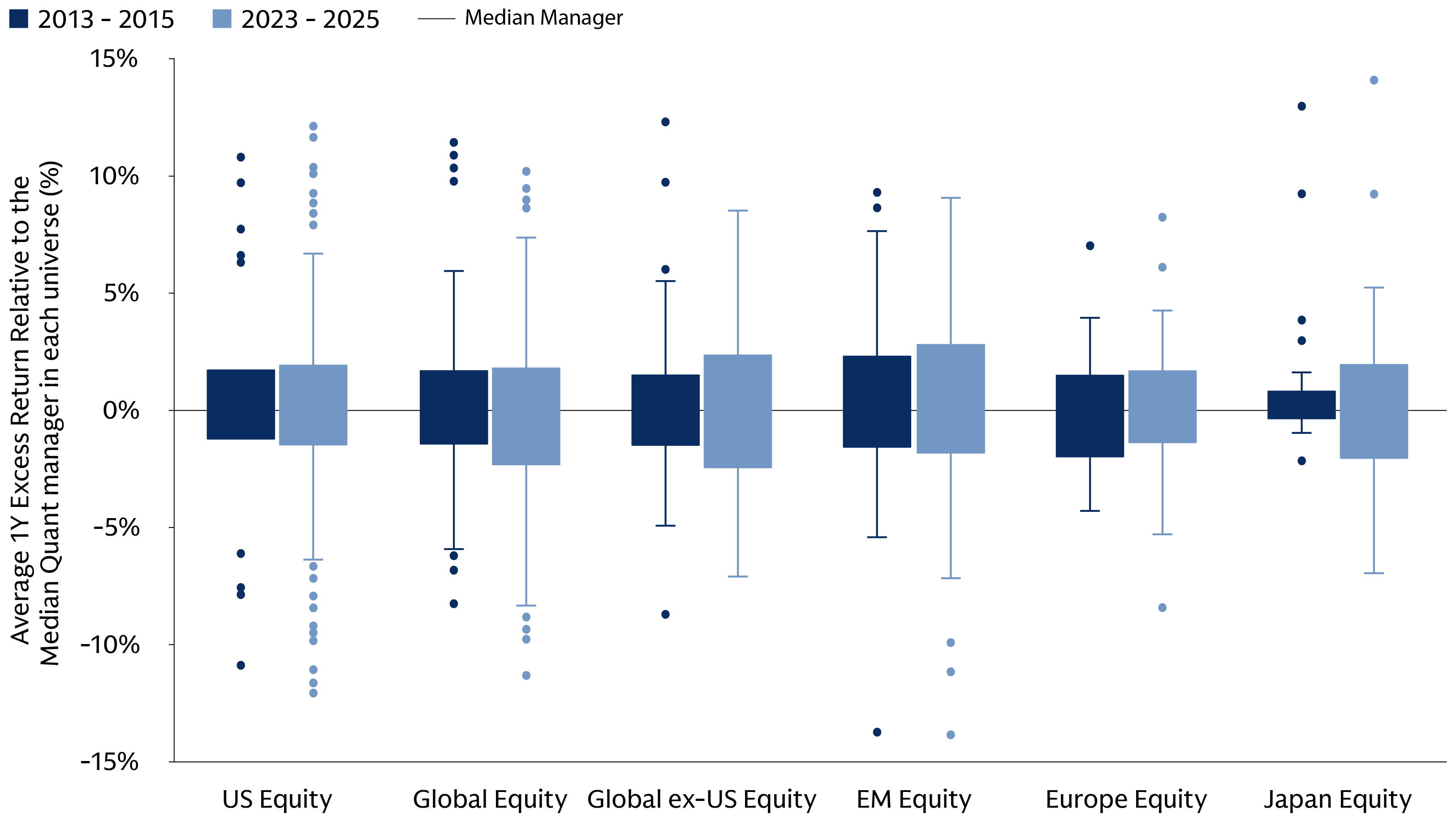
Source: Goldman Sachs Asset Management and eVestment, data as of December 2025, retrieved in May 2026, for quantitative managers in each eVestment universe category. *Excess returns are averaged over the respective periods (January 2013–December 2015 and January 2023–December 2025), representing 36 monthly observations. We show three-year windows (rather than longer periods like five or ten years) to exclude the impact of the outsized market volatility in 2020 that drove a significant spike in performance dispersion. The edges of the box represent the 25th (Q1) and 75th (Q3) percentile, and the whiskers represent the standard whisker limits based on the interquartile range (Q3 + 1.5 x IQR and Q1 − 1.5 x IQR). For illustrative purposes only.
We believe this increased dispersion reflects three structural forces:
- Market structure developments like the rise of passive investing, increased retail participation, and a more fragmented investor base by domicile mean markets are reacting more to short-term dynamics than long-term fundamentals. This is leading to more alpha opportunities, but only for managers with the skills and resources to identify and capitalize on them.
- The growth of alternative data has made the ability to process this information a key competitive advantage for some managers.
- Some managers have invested heavily in data infrastructure, engineering, and machine learning, while others still rely mainly on traditional datasets and widely used factor frameworks.
In our view, increased dispersion is evidence that systematic managers are drawing on different information sets, techniques, and tools. With that in mind, if quant strategies have been performing well in general, an important question when choosing a manager is where their alpha actually comes from.
We believe the answer is differentiated sources of alpha.
What Are These Differentiated Sources of Alpha?
Differentiated sources of alpha are generated from proprietary insights rather than broad exposure to widely used style factors. Smart beta strategies, for example, target exposures to predefined and slowly evolving factor premia. By contrast, a differentiated alpha strategy seeks to exploit new, dynamic, and less widely observed inefficiencies, with any exposure to traditional factor exposure being an outcome of security selection rather than an input to it. Where the first approach delivers a known risk profile and accepts whatever return it produces, the second pursues a return stream and monitors any incidental factor exposures to control the risk profile.
In our view, a differentiated alpha process should:
- Be underpinned by a wide range of proprietary investment signals rather than a handful of established factor premia such as value, quality, price, momentum, and size
- Focus primarily on bottom-up stock selection
- Be explicitly designed to limit its reliance on traditional factors
Differentiation and performance dispersion are interlinked. Where alpha is sought through widely known traditional signals, quant strategies’ exposures and outcomes are likely to converge. Yet, among differentiated alpha strategies, opportunities increasingly arise from manager-specific insights and distinct bottom-up positions, resulting in increased performance dispersion across quant portfolios.
It is useful to consider the correlations of returns or exposures of proprietary factors with those of traditional style factors, with low correlations likely to lead to higher performance differentiation. As an illustration, the chart below sets out the exposure correlations between traditional Axioma style factors with some of the proprietary factors we have used in our QIS Equity Alpha investment process over the past 10 years. Most are very close to zero.
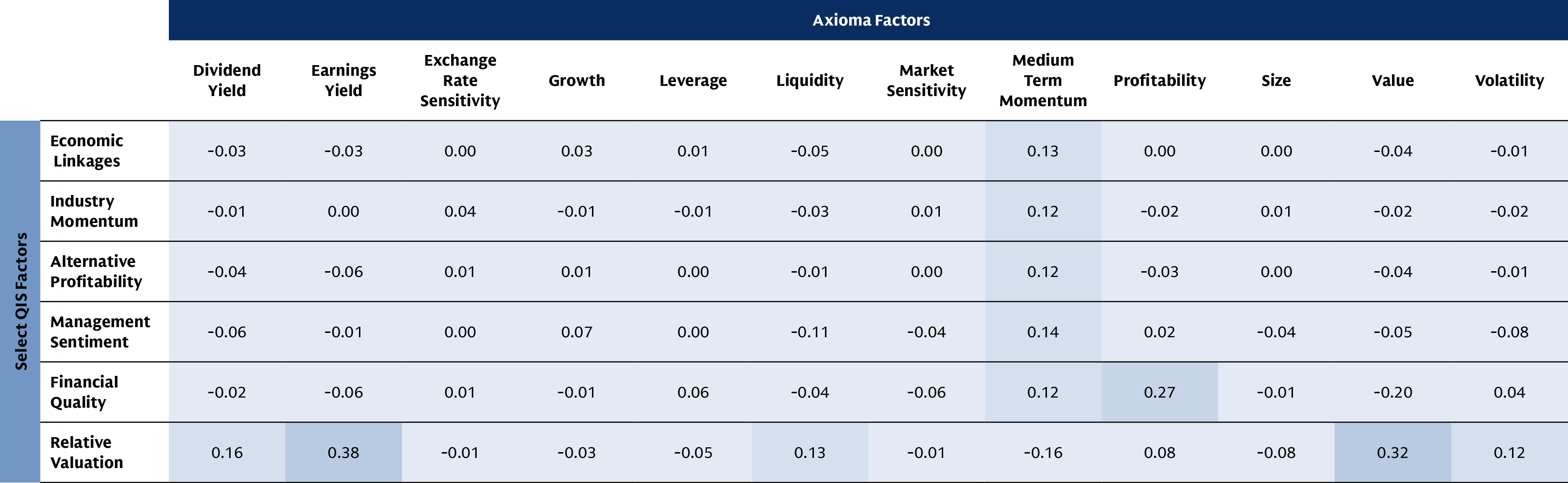
Source: Goldman Sachs Asset Management. As of December 2025. For illustrative purposes only. There is no guarantee these objectives will be met. Past correlations are not indicative of future correlations, which may vary.
Why Does Differentiated Alpha Matter Now?
We believe that today's market environment has made it increasingly possible and valuable to exploit differentiated sources of alpha.
For one, the market structure, investor behavior, and data ecosystems have evolved in ways that have created increased mispricings, amplified stock return dispersion, and broadened the availability of alpha-rich information. All this has expanded the potential opportunity set for quant strategies beyond what traditional factor frameworks seek to capture.
In this environment, capturing alpha involves processing, interpreting, and exploiting inefficiencies before they become consensus – not through holding factor premia that are widely known and used. We believe success is increasingly dependent on identifying subtle changes in company fundamentals, sentiment, thematic developments, and investor behavior early on.
What’s more, in market regimes where leadership broadens, headline index returns often mask significant industry- and stock-level dispersion, while the return available from selection grows relative to the return available from exposure to the market, potentially making stock selection and proprietary information advantages increasingly valuable.
Meanwhile, in an era of increased volatility, we believe dynamic risk management that can cope with frequent factor rotations has become more important. Concentration risk has become a big issue for equity portfolios, while geopolitical risks continue to drive market volatility. The consequence is faster regime shifts and cyclical rotations than static smart beta frameworks are designed to control for.
Factor rotations in particular have become both sharper and harder to time as periods of persistent performance, which have tended to extend longer, are increasingly punctuated by abrupt reversals, making any approach based on holding fixed factor exposures more vulnerable. For example, consider the relative performance of the MSCI World Growth factor, which outperformed considerably from 2017 to 2020, thereafter reversing abruptly in 2021 and ending in 2022 underperforming the broader index by more than 11%.
While traditional multi-factor portfolios can compensate for underperformance of a given style through exposure to other traditional factors to a certain extent, they will still be exposed to any underperforming traditional factors by design and suffer if these go through long periods of underperformance without the ability to eliminate this exposure, like value for most of the 10 years leading up to 2021.
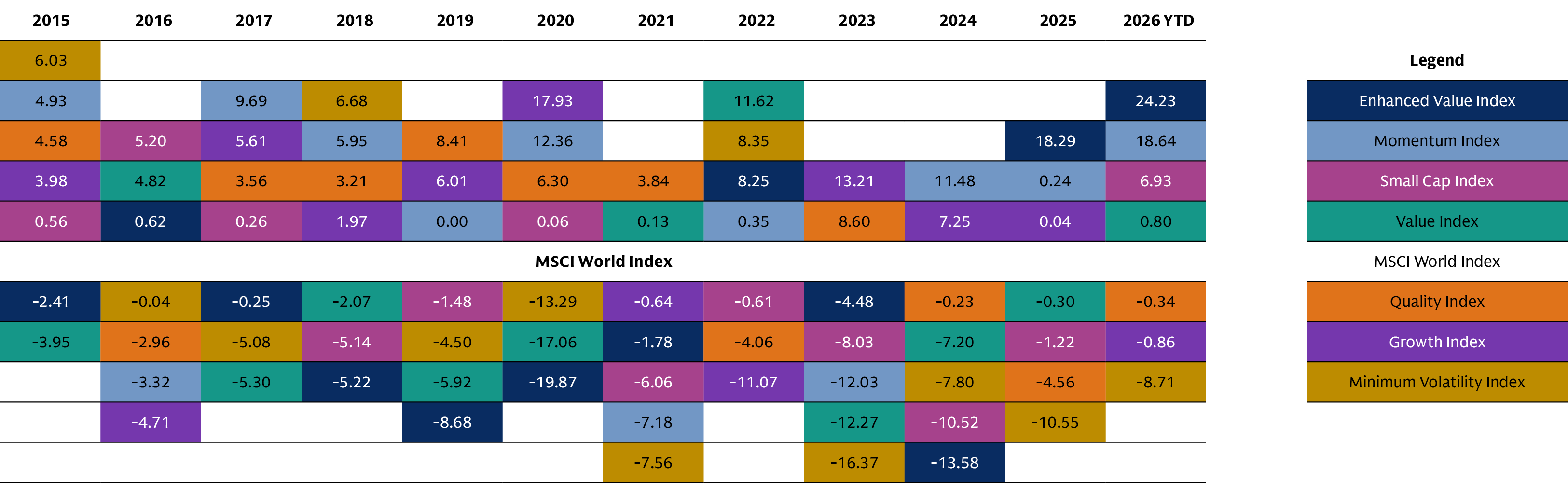
Source: Goldman Sachs Asset Management, Bloomberg, MSCI. As of June 2026. For illustrative purposes only. Factors are represented by MSCI factor indices in USD. These include MSCI World TR Net Index, MSCI World Growth TR Net Index, MSCI World Value TR Net, MSCI World Enhanced Value, MSCI World Minimum Volatility TR Net, MSCI World Quality TR Net, MSCI World Small Cap. Index descriptions are provided in the glossary. Please refer to MSCI for the factors’ definitions. Style excess returns are calculated by subtracting the annual performance of the MSCI World Index (Net Total Return, USD) from the MSCI factor index performance.
Amid this environment, we believe an active approach is crucial to navigate volatility, with dynamic risk management involving continuous monitoring of factor exposures, correlations and macro sensitivities, and the ability to adjust exposures accordingly. This capability transforms market volatility from a hazard into a source of tactical opportunity.
What Does a Modern Quant Process That Is Able to Exploit Differentiated Sources of Alpha Look Like?
In our view, a modern quant process that can navigate factor rotations and alpha decay should be based on proprietary insights, efficient implementation, continuous adaptation, and dynamic risk management.
- Proprietary insight covering a wide range of alpha sources and horizons: The strongest signals are difficult to replicate based on proprietary data and/or processing and not easily explained by conventional factor frameworks. A differentiated process should combine a broad array of return drivers that can complement each other, spanning different pockets of the market across sectors, market caps, and countries, as well as different time horizons. Ideally, these signals should have dynamic weights that can adjust in different factor environments.
- Efficient implementation: Identifying alpha is only part of the challenge. Efficient portfolio construction, trading, transaction costs, and rebalancing determine how much of that alpha ultimately reaches clients.
- Continuous adaptation: Because markets, data, investor behavior, and leadership patterns are always evolving, a differentiated process must continually use new research to refresh the signals it uses; monitor decay, crowding, and efficacy; and treat factor exposure as an outcome rather than an input.
It is possible to assess how models evolve over time by considering the overlap in stock views generated by previous historical models compared with those of today. For example, our QIS Equity Alpha team’s model from 2012 only reaches approximately 40% of the conclusions that its 2026 model draws. This percentage increases each year, as the chart below shows.
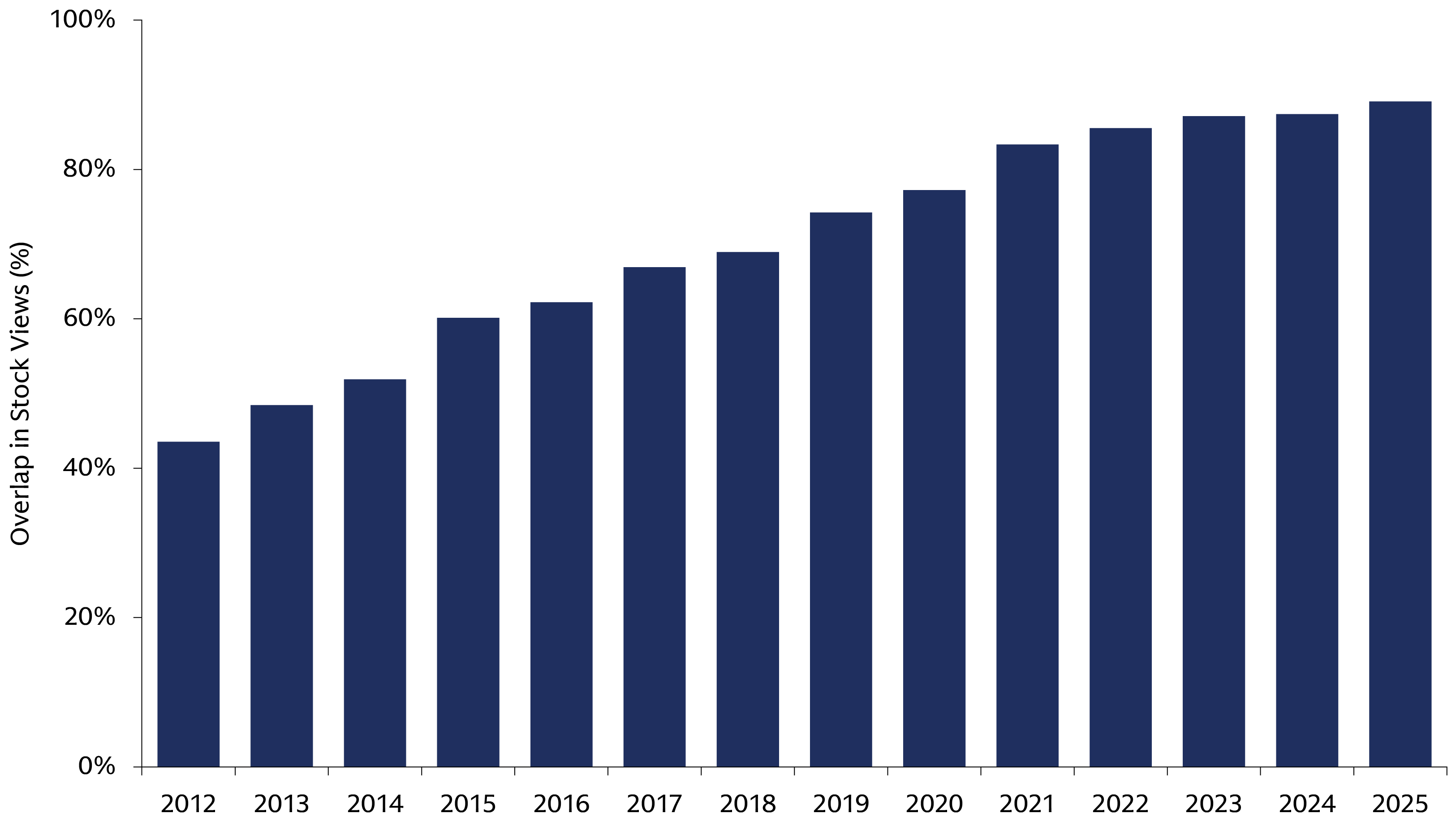
Source: Goldman Sachs Asset Management. As of December 31, 2025. For illustrative purposes only.
- Dynamic risk management: Particularly in concentrated or volatile markets, we believe it is essential for managers to dynamically monitor and control their portfolios’ unintended exposures, liquidity, concentration and sensitivity to macro factors, and also carefully monitor their holdings in crowded positions.
How Can Investors Assess If a Quant Strategy Is Truly Differentiated?
In our view, investors need to look beyond factor and style labels and consider the way the investment process works. The key is to understand where alpha actually comes from: the data being analyzed, the distinctiveness of the research process, the ability to identify new opportunities as markets evolve, and the durability of the competitive advantage.
We suggest three considerations to help them in this process.
- Risk decomposition: Determine the proportion of active risk that comes from stock-specific and industry positioning relative to common style factors and other sources. A profile dominated by stock-specific risk, with minimal style-factor risk, is likely to be based on manager-specific insight rather than exposure to traditional factors, like the example below. The trend also matters: a consistently high specific risk contribution highlights the coherence of a process design focused on resilient bottom-up stock selection across market environments, while rising specific-risk contribution over time indicates a process increasingly reliant on differentiated insights and committed to adaptation with market evolutions.
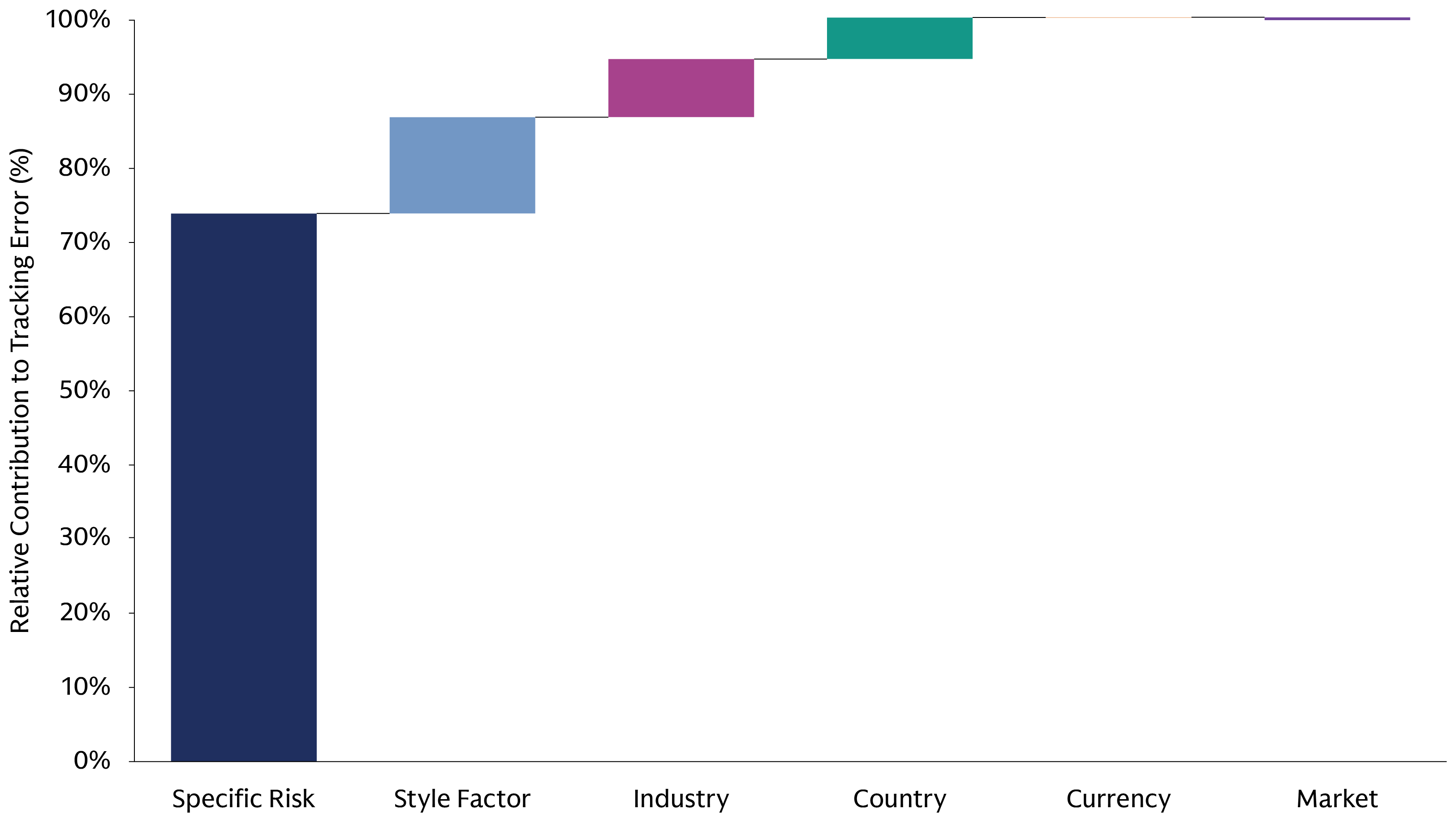
Source: Goldman Sachs Asset Management, Axioma. As of June 2026. For illustrative purposes only, we present the Axioma risk decomposition for an illustrative Equity Alpha global strategy.
- Signal-to-style correlations: Analyze the correlation of proprietary signals to common style exposures. Low, stable correlations between proprietary signals and common style exposures are the clearest quantitative evidence that factor exposure is an outcome of a quant model rather than a target.
- Comparing behavior with a strategy’s peer group beyond returns: Test the strategy’s factor profile and return patterns against other systematic managers in the same category. Beyond investigating if a strategy outperformed, it is important to analyze correlations and differences in performance patterns across regimes and during drawdowns and factor rotations. A strategy that is genuinely differentiated should provide a diversified return stream not only relative to fundamental managers, but also other systematic strategies.
If you would like to discuss ways to uncover where equity alpha is coming from, our Quantitative Investment Strategies team would welcome the conversation.