The Pension Window of Opportunity for Liability-Driven Investing


Portfolio Manager Perspective
Why may today’s environment present a window of opportunity for corporate pension plans?
While rising bond yields have created challenges for many investors, they benefit corporate defined benefit (DB) plans since the increased discount rates reduce the present value of plan liabilities. With long-end US Treasury yields near their highest levels in over two decades, the aggregate funded status of the US corporate DB universe has also risen to its highest point this century. At the same time, our latest estimated average GAAP discount rate approached 6% at the end of August 2026, its highest level since the Global Financial Crisis. Together, we believe stronger funded positions and higher available yields may provide an attractive backdrop for plans to advance de-risking objectives.
If funded positions have improved, why do many plans still appear underhedged?
On the surface, the aggregate fixed income allocation of US corporate DB plans increased from 32% in 2007 to an estimated 52% at the end of 2025. However, the asset allocation shift has not been uniform. During the low-rate environment, some well-funded plans were reluctant to increase fixed income allocations because they feared locking in historically low yields, even when their glide paths indicated that additional de-risking was appropriate. In our database, more than 40% of plans still held less than 50% in fixed income as of 2025, and the distribution was similar among plans that were already overfunded. In our view, this indicates that stronger funded status has not always translated into a commensurate increase in liability hedging.
The rate environment has pivoted to move higher. How should plans think about acting on this opportunity?
Plan sponsors may want to reassess whether their current asset allocation and interest-rate hedge remain aligned with their funded status, liability profile, glide path, and broader plan objectives. For plans that delayed de-risking because yields appeared unattractive, we believe the highest yields available in more than 15 years may reduce that concern and create a more favorable entry point for increasing fixed income exposure. The appropriate action may vary by plan, however. Physical bond allocations do not capture hedging conducted through derivatives, and plans that are still accruing benefits may intentionally retain greater exposure to growth assets even when overfunded.
What role can active fixed income management play within a de-risking strategy?
De-risking need not mean giving up return. For corporate pension sponsors, active credit strategies may pursue excess returns within an LDI framework through benchmark-relative positioning across sectors, the corporate curve, and out-of-benchmark exposures. We believe potential opportunities sit in select pockets of investment-grade fixed income, the short end of the corporate curve, and the technology and healthcare sectors.
In our view, an active approach reallocates risk toward higher-quality, more liquid exposures rather than sacrificing the return objective altogether. The result is a de-risking path that retains daily liquidity and the return potential needed to help fund long-dated obligations for corporate pension plans with such objectives.
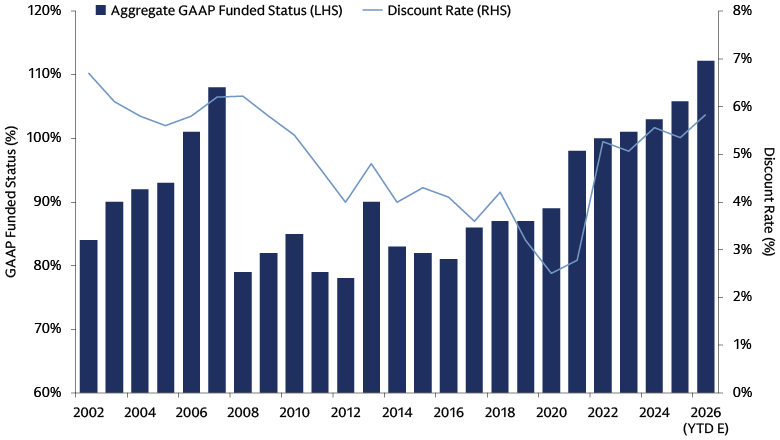
Source: Goldman Sachs Asset Management and company reports. 2026 (YTD E) estimate as of August 31, 2026. Based upon all the US (when specified) defined benefit plans of S&P 500 companies. Historical average actual discount rate based upon the arithmetic average of US plan discount rates (when specified) of S&P 500 companies with December fiscal year-ends. For illustrative purposes only.
Turning Today's Rate Environment into Lasting Stability
- LDI strategies seek to hedge the interest-rate sensitivity of pension liabilities, which in turn dampens the funded-status swings that have historically pressured procyclical, poorly-timed allocation decisions.
- We believe the strategy brings potential benefit by reducing certain interest-rate risks and freeing sponsors' risk budget and bandwidth to concentrate on other important considerations (i.e., strategic asset allocation, endgame considerations, and the plan's governance model).
- For corporate pension allocators, elevated rates have materially improved funding ratios. The environment may create an opportunity to help convert cyclical gains into more durable positioning through disciplined liability matching.
For more information, please refer to our recently published whitepaper “The Pension Window of Opportunity”.