Quantitative Investment Strategies

How does QIS seek to use data-driven analysis to deliver investment excellence?
We believe the answer lies in our ability to cut through noise and identify meaningful signals to inform investment decisions. Clients may benefit from our ability to:
- Transform data into actionable insights: We believe our dynamic quantitative portfolio management process supports more precise quant investing, giving you the clarity to make investment decisions with confidence.
- Continuously evolve our process: Our signals are rigorously tested, refined, and updated continuously as markets and data change.
- Capitalize on innovation: We operate a framework supported by a scalable platform and a perpetual research effort dedicated to preserving our informational edge in the market.
Equity Alpha Strategies
Systematically leveraging vast amounts of data and advanced technologies in pursuit of an informational advantage, thereby seeking to deliver consistent and differentiated alpha combined with disciplined risk management across equity markets.
Smart Beta Equity Strategies
Seeking to offer exposure to well-established common equity factors using a rules-based, transparent, and cost-competitive portfolio construction methodology.
Absolute Return Strategies
Leveraging our time-tested alpha engine in the long/short space to offer global equity market neutral strategies.
Liquid Alternatives Strategies
Aiming to deliver alternative beta and enhanced outcomes via options-based volatility strategies, hedging overlays, and strategies that seek to replicate the investment experience of hedge funds or private equity in liquid, accessible, transparent vehicles.
- Equity Alpha Strategies
- Smart Beta Equity Strategies
- Absolute Return Strategies
- Liquid Alternatives Strategies
Equity Alpha Strategies
Systematically leveraging vast amounts of data and advanced technologies in pursuit of an informational advantage, thereby seeking to deliver consistent and differentiated alpha combined with disciplined risk management across equity markets.
Smart Beta Equity Strategies
Seeking to offer exposure to well-established common equity factors using a rules-based, transparent, and cost-competitive portfolio construction methodology.
Absolute Return Strategies
Leveraging our time-tested alpha engine in the long/short space to offer global equity market neutral strategies.
Liquid Alternatives Strategies
Aiming to deliver alternative beta and enhanced outcomes via options-based volatility strategies, hedging overlays, and strategies that seek to replicate the investment experience of hedge funds or private equity in liquid, accessible, transparent vehicles.
Network. Data. Expertise.
As one of the world’s most influential information hubs, Goldman Sachs Asset Management’s network provides access to the people and institutions that drive markets. This access acts as a catalyst—where every connection generates insights, uncovers opportunities, and drives results.
Our scale, technology, and integration across markets enable our QIS team to identify patterns, anticipate trends, and distinguish the signal from the noise. Our informational edge stems from a universe of data that reveals what others cannot see, enabling us to deliver differentiated insights.
With 35+ years of continuous research, our team’s expertise amplifies this foundation—driving faster insights, more informed decisions, and measurable outcomes. Human oversight ensures that data-driven insights are grounded in judgment, not just computation.
Our edge is built through our network, data, and expertise, allowing us to seek distinctive results for our clients.
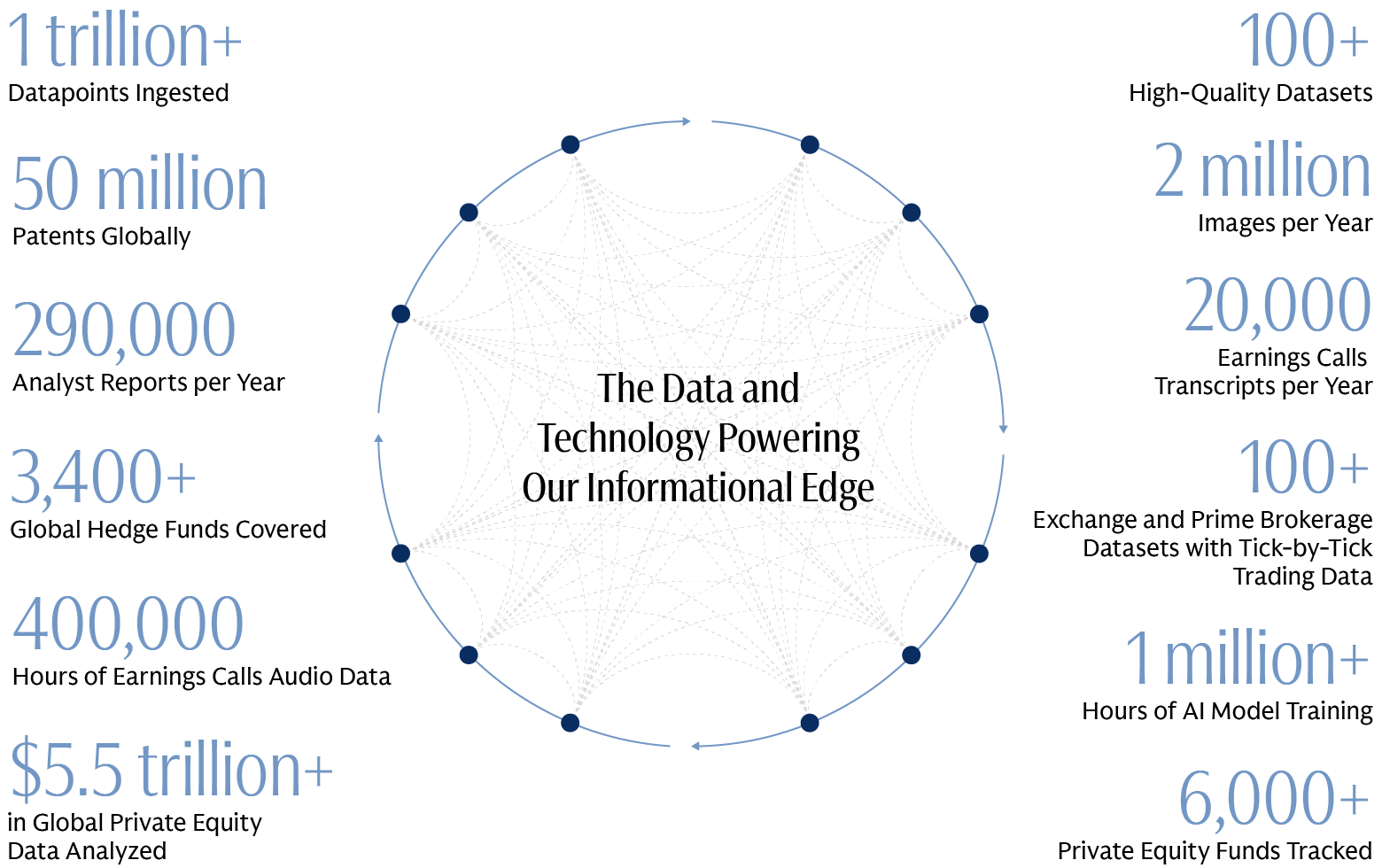
Our Informational Edge
The data and technology powering our informational edge.
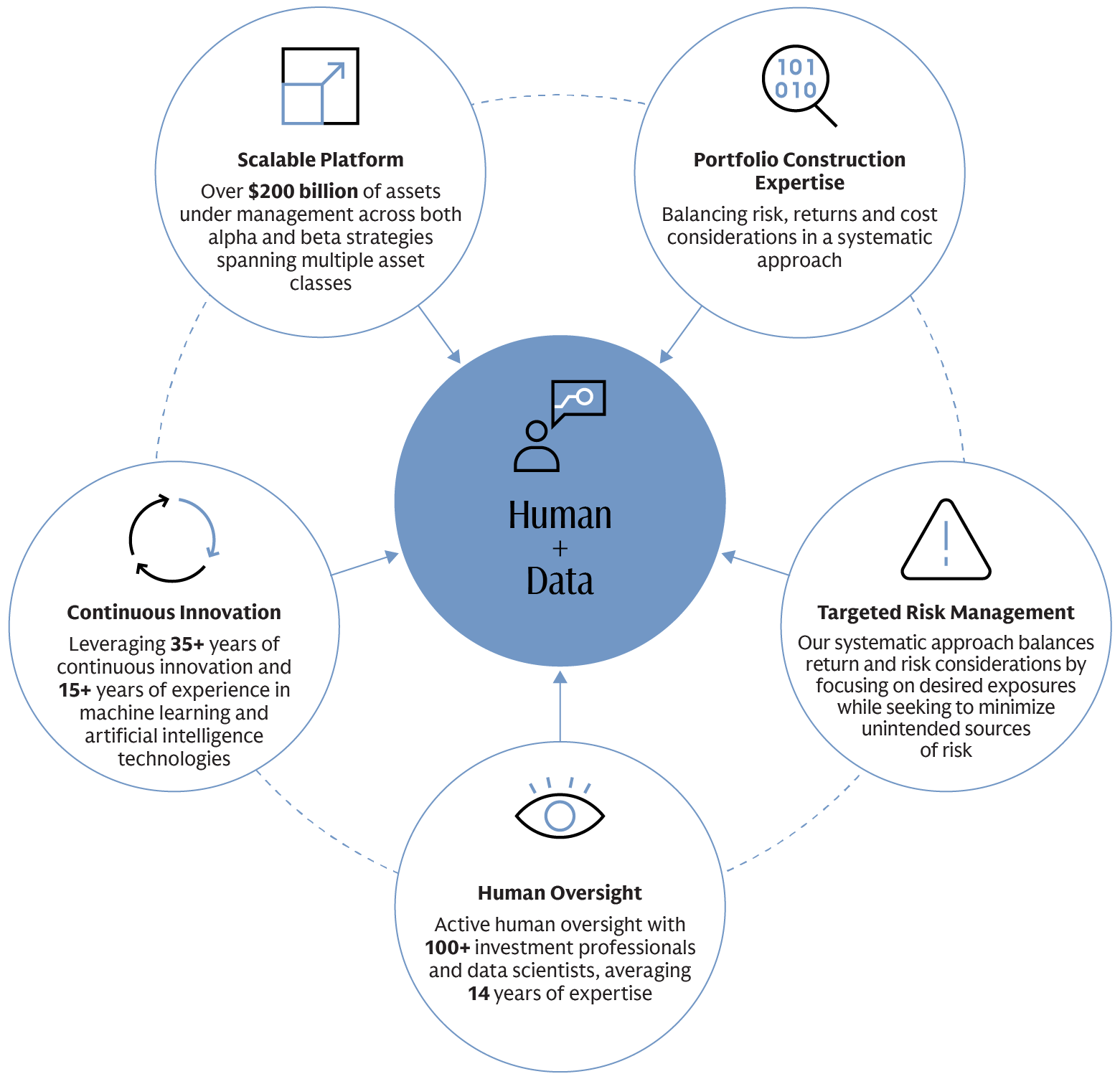
By pairing advanced technology with active human oversight, we build tailored investment portfolios.
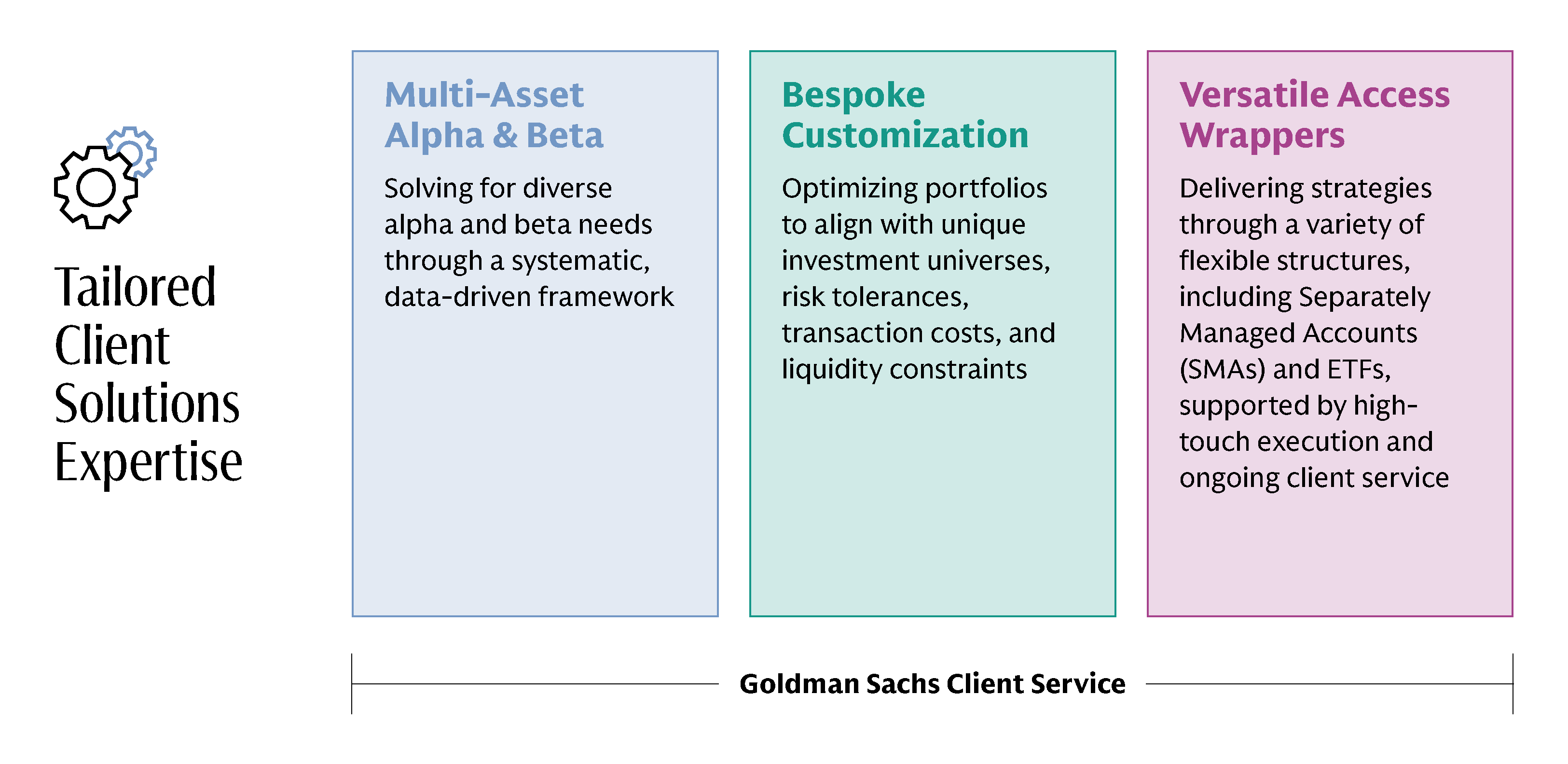
We leverage our systematic framework to design bespoke investment solutions tailored to each client's unique objectives.
Meet The Team

Frequently Asked Questions

QIS is a systematic investing platform that leverages data and technology to identify and capture potential investment opportunities across markets. The QIS team focuses on uncovering inefficiencies that arise from informational asymmetry, delayed price discovery, and behavioral biases, using a disciplined, explainable, repeatable framework.
QIS aims to deliver a quantitative competitive edge in complex markets across both equities and liquid alternatives through:
- Scalable Alpha & Uncorrelated Returns: Seeking to provide tailored solutions with the aim to meet distinct investor goals, from generating systematic alpha and differentiated exposure to delivering robust portfolio diversification.
- Access to Inefficiencies: Aiming to exploit market inefficiencies that are harder to capture through traditional approaches and systematically capturing hedge fund-like risk premia.
- Tailored Implementation: Aiming to deliver customized solutions through a well-established, disciplined portfolio construction framework.
- Consistent Performance: Seeking consistent, persistent, and diversified performance across varying market cycles.
Our edge isn’t just having more data—it’s leveraging 35+ years of investment expertise with the aim to continuously turn that data into valuable insights with the backing of robust infrastructure and technology. In this process, we design signals that are robust across market environments, dynamic in nature and complementary to one another, seeking performance resilience as markets shift. Beyond this, innovation is in our DNA and our process is designed to evolve alongside markets. Signals are continuously tested, refined, onboarded and replaced as needed, with models updated to reflect new data and changing market conditions, supported by ongoing research and a scalable development platform.
No. Systematic does not mean opaque. While our models operate at scale, they are built on defined inputs and rules. This allows for a clear understanding of what is driving returns, how risks are managed, and where performance is coming from. Human oversight is essential to our process and shapes what data is used, how models are designed, and how outputs are interpreted. The goal is not to replace judgement, but to apply it more consistently, using systematization to scale decisions while retaining accountability for outcomes.
QIS is designed to be flexible within a disciplined framework. Portfolio construction can incorporate specific objectives—such as risk targets, regional or sector preferences, sustainability considerations, or implementation constraints, while maintaining the integrity of the underlying signals. The systematic process allows these preferences to be applied consistently and at scale, rather than on an ad hoc basis.
AI's value lies in expanding our scope and scale of analysis and accelerating execution, not in technology for its own sake. AI and advanced analytics allow QIS to uncover complex data relationships, test ideas rigorously, and adapt signals dynamically. Crucially, these capabilities are embedded in a structured framework that consistently translates insights into controlled, investable positions, driven by human oversight.
QIS approaches hedge fund strategies by seeking to deliver systematic alpha across multiple asset classes by leveraging extensive data, advanced technology, and a rich heritage in systematic investing. We employ quantitative and discretionary approaches across both absolute return and liquid alternative pillars. Our systematic and disciplined approach to market neutral investing is designed to provide investors with consistent, uncorrelated absolute returns and highly credible execution across the risk spectrum. Our hedge fund and private equity replication strategies seek to deliver return streams traditionally associated with illiquid, private asset classes in a liquid and transparent manner.
Public Investing Offerings
Our integrated solutions are designed to help achieve investors’ goals.

Exchange-Traded Funds are subject to risks similar to those of stocks. Investment returns may fluctuate and are subject to market volatility, so that an investor’s shares, when redeemed, or sold, may be worth more or less than their original cost. ETFs may yield investment results that, before expenses, generally correspond to the price and yield of a particular index. There is no assurance that the price and yield performance of the index can be fully matched.
Mutual funds are subject to various risks, as described fully in each Fund’s prospectus. There can be no assurance that the Funds will achieve their investment objectives. The Funds may be subject to style risk, which is the risk that the particular investing style of the Fund (i.e., growth or value) may be out of favor in the marketplace for various periods of time.
The Goldman Sachs International Equity Insights Fund invests primarily in a broadly diversified portfolio of equity investments in non-U.S. issuers. The Fund’s investments are subject to market risk, which means that the value of the securities in which it invests may go up or down in response to the prospects of individual companies, particular sectors or governments and/or general economic conditions. Foreign and emerging markets investments may be more volatile and less liquid than investments in U.S. securities and are subject to the risks of currency fluctuations and adverse economic, social or political developments. The securities of mid- and small-capitalization companies involve greater risks than those associated with larger, more established companies and may be subject to more abrupt or erratic price movements. The Investment Adviser’s use of quantitative models to execute the Fund’s investment strategy may fail to produce the intended result. Different investment styles (e.g., “quantitative”) tend to shift in and out of favor, and at times the Fund may underperform other funds that invest in similar asset classes. The Fund may have a high rate of portfolio turnover, which involves correspondingly greater expenses which must be borne by the Fund, and is also likely to result in short-term capital gains taxable to shareholders.
The Goldman Sachs International Small Cap Insights Fund invests primarily in a broadly diversified portfolio of equity investments in small capitalization non-U.S. issuers. The Fund’s investments are subject to market risk, which means that the value of the securities in which it invests may go up or down in response to the prospects of individual companies, particular sectors or governments and/or general economic conditions. Foreign and emerging markets investments may be more volatile and less liquid than investments in U.S. securities and are subject to the risks of currency fluctuations and adverse economic, social or political developments. The securities of mid- and small-capitalization companies involve greater risks than those associated with larger, more established companies and may be subject to more abrupt or erratic price movements. The Investment Adviser’s use of quantitative models to execute the Fund’s investment strategy may fail to produce the intended result. Different investment styles (e.g., “quantitative”) tend to shift in and out of favor, and at times the Fund may underperform other funds that invest in similar asset classes. The Fund may have a high rate of portfolio turnover, which involves correspondingly greater expenses which must be borne by the Fund, and is also likely to result in short-term capital gains taxable to shareholders.
The Goldman Sachs Small Cap Equity Insights Fund invests primarily in a broadly diversified portfolio of equity investments in small-capitalization U.S. issuers, including foreign issuers traded in the United States. The Fund’s investments are subject to market risk, which means that the value of the securities in which it invests may go up or down in response to the prospects of individual companies, particular sectors or governments and/or general economic conditions. The securities of mid- and small capitalization companies involve greater risks than those associated with larger, more established companies and may be subject to more abrupt or erratic price movements. The Investment Adviser’s use of quantitative models to execute the Fund’s investment strategy may fail to produce the intended result. Different investment styles (e.g., “quantitative”) tend to shift in and out of favor, and at times the Fund may underperform other funds that invest in similar asset classes. The Fund may have a high rate of portfolio turnover, which involves correspondingly greater expenses which must be borne by the Fund, and is also likely to result in short-term capital gains taxable to shareholders.
The Goldman Sachs Data Enhanced International Equity ETF seeks long-term growth of capital. The Fund is an actively managed exchange-trade fund. The Fund pursues its investment objective by investing primarily in equity securities issued by non-U.S. issuers. The Fund's investments are subject to market risk, which means that the value of the securities in which it invests may go up or down in response to the prospects of individual companies, particular sectors or governments and/or general economic conditions. Foreign and emerging markets investments may be more volatile and less liquid than investments in U.S. securities and are subject to the risks of currency fluctuations and adverse economic, social or political developments. The Fund may invest a large percentage of its assets in Europe and may be subject to greater losses than if it were less concentrated in Europe. At times, the Fund may be unable to sell illiquid investments without a substantial drop in price, if at all. The Investment Adviser's use of quantitative models to execute the Fund's investment strategy may fail to produce the intended result. The securities of mid- and small-cap companies involve greater risks than those associated with larger, more established companies and may be subject to more abrupt or erratic price movements. Foreign and emerging markets investments may be more volatile and less liquid than investments in U.S. securities and are subject to the risks of currency fluctuations and adverse economic, social or political developments, including regional armed conflicts, sanctions, tariffs, counter-sanctions, retaliatory tariffs and other retaliatory actions. Different investment styles (e.g., “growth”, “value” or “quantitative”) tend to shift in and out of favor, and at times the Fund may underperform other funds that invest in similar asset classes. The Fund is “non-diversified” and may invest a larger percentage of its assets in one or more issuers or in fewer issuers than “diversified” funds. Accordingly, the Fund may be more susceptible to adverse developments affecting any single issuer held in its portfolio and to greater losses resulting from these developments.
Fund shares are not individually redeemable and are issued and redeemed by the Fund at their net asset value (“NAV”) only in large, specified blocks of shares called creation units. Shares otherwise can be bought and sold only through exchange trading at market price (not NAV). Shares may trade at a premium or discount to their NAV in the secondary market. Ordinary brokerage commissions apply. Brokerage commissions will reduce returns.
The Goldman Sachs MSCI World Private Equity Return Tracker ETF (the “Fund”) seeks to provide investment results that closely correspond, before fees and expenses, to the performance of the MSCI World Private Equity Return Tracker Index (Net, USD, Unhedged) (the “Index”), which seeks to approximate the returns of private equity investments by replicating region, sector and style exposures through investment in publicly listed equities. THE FUND IS NOT A PRIVATE EQUITY FUND AND DOES NOT INVEST IN PRIVATE EQUITY OR PRIVATE EQUITY VEHICLES OR FUNDS. The Fund’s investments are subject to market risk, which means that the value of the securities in which it invests may go up or down in response to the prospects of individual companies, particular sectors, governments or countries and/or general economic conditions in the U.S. or throughout the world. Stock markets have experienced periods of substantial price volatility in the past and may do so again in the future. Because the Fund may concentrate its investments in an industry or group of industries to the extent that the Index is concentrated, the Fund may be subject to greater risk of loss as a result of adverse economic, business or other developments affecting that industry or group of industries. The Fund is not actively managed, and therefore the Fund will not generally dispose of a security unless the security is removed from the Index.
Fund shares are not individually redeemable and are issued and redeemed by the Fund at their net asset value (“NAV”) only in large, specified blocks of shares called creation units. Shares otherwise can be bought and sold only through exchange trading at market price (not NAV). Shares may trade at a premium or discount to their NAV in the secondary market. Ordinary brokerage commissions apply. Brokerage commissions will reduce returns.
The Goldman Sachs Emerging Markets Equity Insights Fund invests primarily in a diversified portfolio of equity investments in emerging country issuers. The Fund's investments are subject to market risk, which means that the value of the securities in which it invests may go up or down in response to the prospects of individual companies, particular sectors or governments and/or general economic conditions. Foreign and emerging markets investments may be more volatile and less liquid than investments in U.S. securities and are subject to the risks of currency fluctuations and adverse economic, social or political developments. Because of its exposure to Asian issuers, the Fund is subject to greater risk of loss as a result of volatile securities markets, adverse exchange rates and social, political, military, regulatory, economic or environmental developments, or natural disasters that may occur in Asian countries. At times, the Fund may be unable to sell illiquid investments without a substantial drop in price, if at all. The Investment Adviser's use of quantitative models to execute the Fund's investment strategy may fail to produce the intended result. Different investment styles (e.g., "quantitative") tend to shift in and out of favor, and at times the Fund may underperform other funds that invest in similar asset classes. The Fund may have a high rate of portfolio turnover, which involves correspondingly greater expenses which must be borne by the Fund, and is also likely to result in short-term capital gains taxable to shareholders.
The Goldman Sachs Absolute Return Tracker Fund seeks to deliver long-term total return consistent with investment results that approximate the return and risk patterns of a diversified universe of hedge funds. The Fund’s Investment Adviser believes that hedge funds derive a large portion of their returns from exposure to sources of market risk (“Market Exposures”) and “Trading Strategies” involving long and/or short positions in Market Exposures and/or individual securities or baskets of securities. In seeking to meet its investment objective, the Fund uses a dynamic investment process to seek to identify the appropriate weights to Market Exposures and Trading Strategies that approximate the return and risk patterns of specific hedge fund sub-strategies. The Investment Adviser then applies a quantitative methodology, in combination with a qualitative overlay, to assess the appropriate weight to each Market Exposure and Trading Strategy. The Fund may seek to establish long and/or short positions in a multitude of Market Exposures. However, from time to time, regulatory constraints or other considerations may prevent the Fund from precisely replicating the returns of the Market Exposures and Trading Strategies.
The Fund seeks to gain exposure to the commodities markets by investing in a wholly-owned subsidiary of the Fund organized as a company under the laws of the Cayman Islands (the “ART Subsidiary”). The ART Subsidiary primarily obtains its commodity exposure by investing in commodity-linked derivative instruments (which may include total return swaps on commodity indexes, sub-indexes and single commodities, as well as commodity (U.S. or foreign) futures, commodity options and commodity-linked notes). The ART Subsidiary may also invest in other instruments, including fixed income securities, either as investments or to serve as margin or collateral for its swap positions, and foreign currency transactions (including forward contracts). The Fund is subject to the risk that exposure to the commodities markets may subject the Fund to greater volatility than investments in traditional securities. Derivative instruments may involve a high degree of financial risk. These risks include the risk that a small movement in the price of the underlying security or benchmark may result in a disproportionately large movement, unfavorable or favorable, in the price of the derivative instrument; the risk of default by a counterparty; and liquidity risk. The Fund may invest in derivatives (including foreign currency transactions) for hedging and non-hedging purposes. The Fund’s borrowing and use of derivatives may result in leverage, which can make the Fund more volatile. The Fund is subject to the risks associated with short selling of securities, which involves leverage of the Fund’s assets and presents various other risks. The Fund may be obligated to cover its short position at a higher price than the short price, resulting in a loss. Losses on short sales are potentially unlimited as a loss occurs when the value of a security sold short increases.
Over-the-counter (“OTC”) transactions are subject to less government regulation and supervision. When the Fund enters into an uncleared OTC transaction, it is subject to the risk that the direct counterparty will not perform its obligations under the transaction. The Fund may also hold significant amounts of U.S. Treasury or short-term instruments. Investments in fixed income securities are subject to the risks associated with debt securities generally, including credit, liquidity and interest rate risk. The Fund’s investments are subject to market risk, which means that the value of the securities in which it invests may go up or down in response to the prospects of individual companies, particular sectors or governments and/or general economic conditions. The securities of mid- and small-capitalization companies involve greater risks than those associated with larger, more established companies and may be subject to more abrupt or erratic price movements. Foreign and emerging markets investments may be more volatile and less liquid than investments in U.S. securities and are subject to the risks of currency fluctuations and adverse economic, social or political developments. The Fund may make investments that are or may become illiquid. At times, the Fund may be unable to sell illiquid investments without a substantial drop in price, if at all. Investments in master limited partnerships (“MLPs”) are subject to certain risks, including risks related to limited control and limited rights to vote, potential conflicts of interest, cash flow risks, dilution risks, limited liquidity and risks related to the general partner’s right to force sales at undesirable times or prices. The Fund’s investments in other investment companies (including ETFs) subject it to additional expenses. The Fund is subject to tax risk as a result of its investments in the ART Subsidiary and in commodity index-linked structured notes. The Fund may have a high rate of portfolio turnover, which involves correspondingly greater expenses which must be borne by the Fund, and is also likely to result in short-term capital gains taxable to shareholders. The Investment Adviser’s use of quantitative models to execute the Fund’s investment strategy may fail to produce the intended result. Different investment styles (e.g., “quantitative”) tend to shift in and out of favor, and at times the Fund may underperform other funds that invest in similar asset classes.
The investment program of the Fund is speculative, entails substantial risks and includes alternative investment techniques not employed by traditional mutual funds. The Fund should not be relied upon as a complete investment program. The Fund’s investment techniques (if they do not perform as designed) may increase the volatility of performance and the risk of investment loss, including the loss of the entire amount that is invested, and there can be no assurance that the investment objective of the Fund will be achieved.
Diversification does not protect an investor from market risk and does not ensure a profit.
THIS MATERIAL DOES NOT CONSTITUTE AN OFFER OR SOLICITATION IN ANY JURISDICTION WHERE OR TO ANY PERSON TO WHOM IT WOULD BE UNAUTHORIZED OR UNLAWFUL TO DO SO.
Prospective investors should inform themselves as to any applicable legal requirements and taxation and exchange control regulations in the countries of their citizenship, residence or domicile which might be relevant.
Past performance does not guarantee future results, which may vary. The value of investments and the income derived from investments will fluctuate and can go down as well as up. A loss of principal may occur.
This information discusses general market activity, industry or sector trends, or other broad-based economic, market or political conditions and should not be construed as research or investment advice. This material has been prepared by Goldman Sachs Asset Management and is not financial research nor a product of Goldman Sachs Global Investment Research (GIR). It was not prepared in compliance with applicable provisions of law designed to promote the independence of financial analysis and is not subject to a prohibition on trading following the distribution of financial research. The views and opinions expressed may differ from those of Goldman Sachs Global Investment Research or other departments or divisions of Goldman Sachs and its affiliates. Investors are urged to consult with their financial advisors before buying or selling any securities. This information may not be current and Goldman Sachs Asset Management has no obligation to provide any updates or changes.
The portfolio risk management process includes an effort to monitor and manage risk, but does not imply low risk.
Views and opinions expressed are for informational purposes only and do not constitute a recommendation by Goldman Sachs Asset Management to buy, sell, or hold any security. Views and opinions are current as of the date of this publication and may be subject to change, they should not be construed as investment advice.
Individual portfolio management teams for Goldman Sachs Asset Management may have views and opinions and/or make investment decisions that, in certain instances, may not always be consistent with the views and opinions expressed herein.
The website links provided are for your convenience only and are not an endorsement or recommendation by Goldman Sachs Asset Management of any of these websites or the products or services offered. Goldman Sachs Asset Management is not responsible for the accuracy and validity of the content of these websites.
Neither MSCI nor any other party involved in or related to compiling, computing, or creating the MSCI data makes any express or implied warranties or representations with respect to such data (or the results to be obtained by the use thereof), and all such parties hereby expressly disclaim all warranties of originality, accuracy, completeness, merchantability, or fitness for a particular purpose with respect to any of such data. Without limiting any of the foregoing, in no event shall MSCI, any of its affiliates or any third party involved in or related to compiling, computing or creating the data have any liability for any direct, indirect, special, punitive, consequential or any other damages (including lost profits) even if notified of the possibility of such damages. No further distribution or dissemination of the MSCI data is permitted without MSCI’s express written consent.
THIS FUND IS NOT SPONSORED, ENDORSED, SOLD OR PROMOTED BY MSCI INC. (“MSCI”), ANY OF ITS AFFILIATES, ANY OF ITS INFORMATION PROVIDERS OR ANY OTHER THIRD PARTY INVOLVED IN, OR RELATED TO, COMPILING, COMPUTING OR CREATING ANY MSCI INDEX (COLLECTIVELY, THE “MSCI PARTIES”). THE MSCI INDEXES ARE THE EXCLUSIVE PROPERTY OF MSCI. MSCI AND THE MSCI INDEX NAMES ARE SERVICE MARK(S) OF MSCI OR ITS AFFILIATES AND HAVE BEEN LICENSED FOR USE FOR CERTAIN PURPOSES BY GOLDMAN SACHS ASSET MANAGEMENT.
There is no guarantee that objectives will be met.
The Net Asset Value (NAV) is the market value of one share of the Fund. Percentages may not sum to 100% due to rounding.
Alternative Investments often engage in leverage and other investment practices that are extremely speculative and involve a high degree of risk.
The QIS Equity Alpha team leverages Natural Language Processing (NLP) techniques and advanced transformer technology within deep learning models to analyze text and audio. Natural language processing (NLP) is an interdisciplinary subfield of computer science and linguistics, primarily concerned with giving computers the ability to support and manipulate human language. This analysis is designed to help inform portfolio management decisions and is one data point among many to make investment decisions which is subject to human supervision. All investment decisions are made by human portfolio managers.
A summary prospectus, if available, or a Prospectus for the Fund containing more information may be obtained from your authorized dealer or from Goldman Sachs & Co. LLC by calling (retail - 1-800-526-7384) (institutional – 1-800-621-2550). Please consider a fund's objectives, risks, and charges and expenses, and read the summary prospectus, if available, and the Prospectus carefully before investing. The summary prospectus, if available, and the Prospectus contains this and other information about the Fund.
Goldman Sachs & Co. LLC, distributor of the Fund(s), is not a bank, and Fund shares distributed by Goldman Sachs & Co. LLC are neither deposits nor obligations of, nor endorsed, nor guaranteed by any bank or other insured depository institution, nor are they insured by the Federal Deposit Insurance Corporation, the Federal Reserve Board, or any other government agency. Investment in the Funds involves risks, including possible loss of the principal amount invested.
ALPS Distributors, Inc. is unaffiliated with Goldman Sachs Asset Management.
ALPS Distributors, Inc. is the distributor of the Goldman Sachs ETF Funds.
This material is provided for informational purposes only. It is not an offer or solicitation to buy or sell any securities.