Alternative Access to Alpha: Why Liquid Alternatives in Changing Market Environments?


We explore how liquid hedge fund strategies may assist corporate pension plans in managing funded level volatility as well as unlock alternative ways for plans to access alpha opportunities. Read the Corporate Pension Monthly for our latest estimates of aggregate corporate defined benefit funded status, asset class returns, and notable news.
Portfolio Manager Perspective
How has the current market backdrop (higher interest rates and market volatility) changed the opportunity set for hedge fund strategies?
Whilst significant geopolitical developments, market dislocations, and elevated volatility can all pose a risk to traditional asset allocation, they also represent a rich opportunity set for the hedge fund industry. The recent period has been good for hedge funds performance – particularly over the past three years – and this has been the case for most hedge fund categories. This is linked to the very diverse nature of hedge funds – they can be highly specialized and strongly lean into emerging trends and themes. On the other hand, they can also be very nimble in their allocation, including across asset classes. A large portion of managers can also utilize short positions and leverage.
How should investors think about hedge funds vs. private markets as a source of potential portfolio diversifiers and return generators?
In addition to higher volatility and interest rates, increased correlation between traditional asset classes calls for adding a diversified stream of returns, for which hedge funds are well positioned. As mentioned earlier, hedge funds are inherently flexible in their mandates, enabling them to perform across market and economic regimes. Including hedge funds in an alternative sleeve of a portfolio alongside other private solutions, e.g., private equity and real estate, is also very common.
Moving onto implementation, what are the potential benefits and considerations for liquid strategies vs. traditional drawdown funds?
Liquid alternatives – in particular hedge fund replication in this context – seek to deliver in a liquid manner a return stream associated with traditionally illiquid and private asset classes. A replication approach can provide efficient access, albeit the illiquid and private returns streams cannot be replicated perfectly. In a traditional fund allocation, however, typical investor challenges include high minimums, long capital lock-up periods, relatively high fees, and complexity linked to manager selection. Liquid alternatives provide an alternative access route which is transparent, accessible, and liquid. Additionally, liquid alternatives can harness data and systematic methods to provide solutions diversified across styles and with minimal manager selection risk vs. traditional funds.
Many corporate pension plans are in a fully and/or over-funded position. How do hedge funds play a role in these portfolios?
The broad US corporate pension system is well-funded in the current interest rate environment,1 and many plans are considering strategies to “de-risk” and lock in their funding gains. Liquid hedge fund strategies may enhance plans’ return potential and may play an important role for risk and surplus management with attractive flexibility. Particularly in volatile and concentrated markets, the flexibility to nimbly seek and allocate across alpha opportunities with lower correlation to traditional and bond markets, such as market-neutral, global macro, or relative value, may prove highly valuable.
Hedge fund strategies may also have applications for sophisticated Liability-Driven Investment (LDI) frameworks through portable alpha structures. This implementation structure may allow plans to maintain liability hedging programs while still maintaining the upside potential to capture excess returns to cover regular cash outflows in benefit payments, administrative fees, and PBGC premiums.
Navigating Hedge Fund Selection in Changing Market Environments
Power in Diversification
- Correlations between equities and fixed income have been unstable historically and rising sharply since the COVID-19 pandemic. We believe this means investors need to think differently about portfolio diversification.
- With lower sensitivity to core assets, exposure to hedge funds may reduce portfolio volatility and deliver alternative sources of return, especially during market drawdowns.
- We believe higher-for-longer rates, geopolitical fragmentation, and market volatility may persist, providing tailwinds for hedge funds to generate alpha.
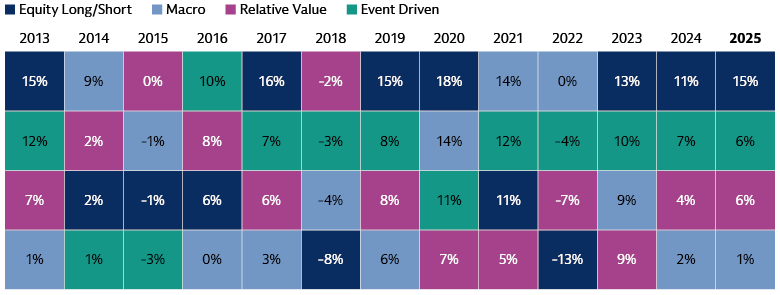
Source: Goldman Sachs Asset Management as of December 31, 2025. Past performance does not predict future returns and does not guarantee future results, which may vary. Please refer to the disclosures section for more information on the styles. The hedge fund universe referenced consists of the QIS Alternatives Hedge Fund Universe, based on an aggregate of multiple database providers with more than 3,000 hedge funds. Diversification does not protect an investor from market risk and does not ensure a profit. Past correlations are not indicative of future correlations, which may vary.
1 For more information, please refer to our Pension Review “First Take” report.